


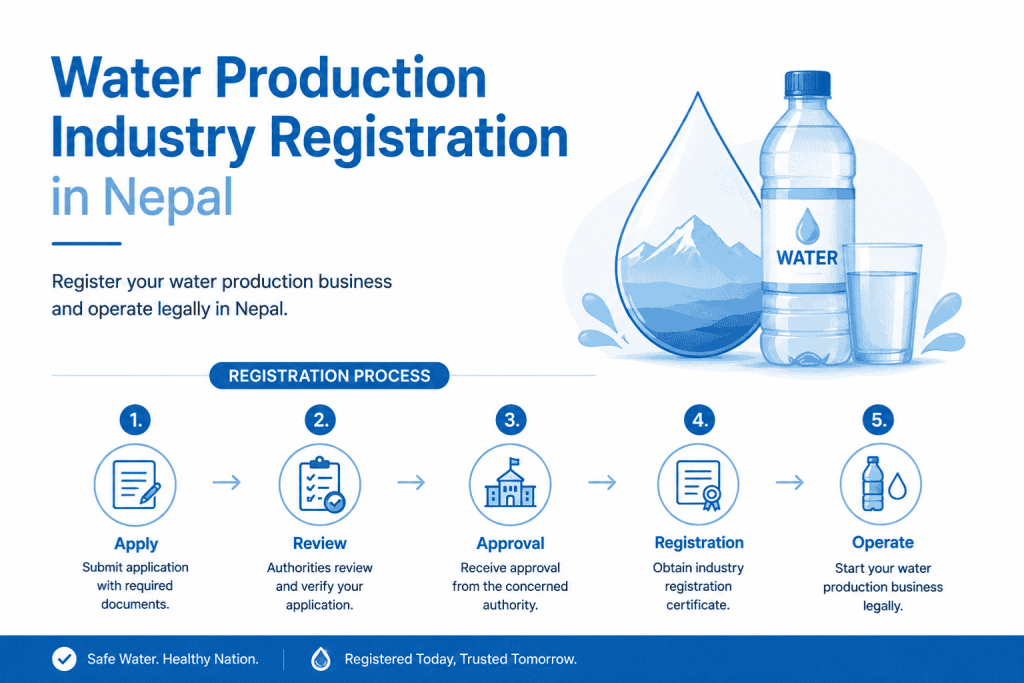
Nepal has a growing demand for packaged drinking water, mineral water, and purified water products. The water production industry registration in Nepal requires formal registration before beginning any commercial activity. Whether you plan to establish a small packaged water unit or a large-scale mineral water bottling plant, the registration process involves multiple government bodies and compliance requirements.
This article explains the full process of water production industry registration in Nepal, covering applicable laws, required documents, fees, and regulatory standards.
What Is Water Production Industry Registration in Nepal?
Water production industry registration in Nepal refers to the formal legal process of obtaining permission and licenses to manufacture, bottle, package, and sell drinking water or mineral water products commercially. This registration process falls under the jurisdiction of the Department of Industry (DoI) or the relevant Province Industry Office, depending on the scale of the investment.
The registration process also involves compliance with food safety and quality standards regulated by the Department of Food Technology and Quality Control (DFTQC) under the Ministry of Agriculture and Livestock Development.
The primary laws governing this sector include:
- Industrial Enterprises Act, 2076 (2020)
- Food Act, 2023 BS (1966 AD) and its amendments
- Food Regulation, 2027 BS (1970 AD)
- Nepal Standards (Certification Mark) Act, 2037 BS
- Nepal Bureau of Standards and Metrology (NBSM) Act
- Company Act, 2063 BS (2006 AD)
Which Authorities Regulate Water Production Industry in Nepal?
Multiple government agencies regulate the water production industry in Nepal. Each agency plays a specific role in the registration and licensing process.
| Authority | Role |
|---|---|
| Department of Industry (DoI) | Industry registration and operating license |
| Province Industry Office | Registration for small and medium investments |
| Department of Food Technology and Quality Control (DFTQC) | Food safety license and label approval |
| Nepal Bureau of Standards and Metrology (NBSM) | Nepal Standard (NS) certification |
| Department of Revenue Investigation | Tax registration (PAN/VAT) |
| Local Government/Municipality | Local business license |
| Department of Environment | Environmental Impact Assessment (if applicable) |
The Department of Industry is the central authority for industry registration under the Industrial Enterprises Act, 2076. Industries with fixed assets above NPR 150 million fall under the federal-level DoI, while smaller industries are handled by the Province Industry Office.
What Are the Types of Water Production Industries in Nepal?
Before starting the registration process, you must classify your water production business. Nepal recognizes several types of water production businesses:
- Packaged Drinking Water Industry – Purified water packaged in bottles or jars
- Mineral Water Industry – Water sourced from natural springs with defined mineral content
- Purified Water Supply Industry – Large-scale water treatment and distribution
- Carbonated Water Industry – Sparkling or carbonated packaged water
- Flavored Water Industry – Water with added flavors or nutrients
The classification determines which regulatory standards apply. For example, mineral water must meet Nepal Standard NS 227 for natural mineral water, while packaged drinking water must comply with NS 159 standards set by the Nepal Bureau of Standards and Metrology.
What Documents Are Required for Water Production Industry Registration?
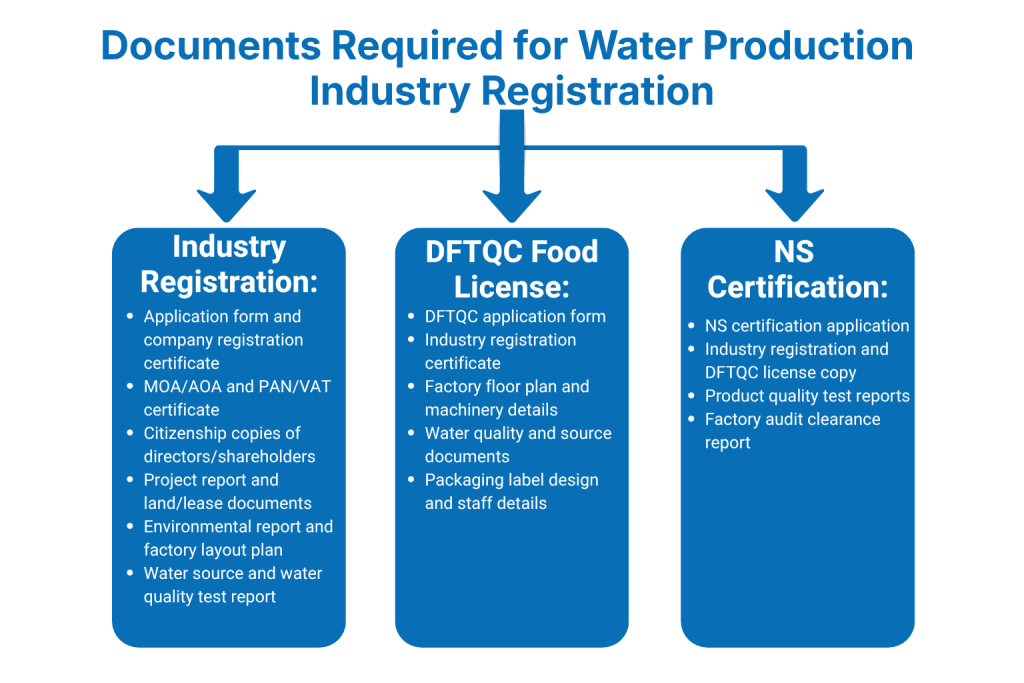
The water production industry registration in Nepal requires a comprehensive set of documents. The documents must be submitted to the Department of Industry or the Province Industry Office depending on your investment level.
Documents Required for Industry Registration (DoI):
- Completed industry registration application form
- Company registration certificate (under the Company Act, 2063 BS)
- Memorandum of Association and Articles of Association
- PAN/VAT registration certificate from the Inland Revenue Department
- Citizenship certificates of all directors/shareholders
- Project report or business plan (feasibility study)
- Land ownership certificate or lease agreement for factory premises
- Site map and factory layout plan
- Environmental study report (Initial Environmental Examination or Environmental Impact Assessment)
- Source of water (borehole certificate, WASCO approval, or natural spring documentation)
- Water quality test report from a DFTQC-recognized laboratory
Documents Required for DFTQC Food License:
- Completed DFTQC license application form
- Industry registration certificate from DoI
- Factory floor plan showing production, storage, and testing areas
- List of machinery and equipment
- Water source documents and quality analysis report
- Label design for packaging approval
- Personnel details including food safety officers
Documents Required for Nepal Standards (NS) Certification from NBSM:
- Application for NS mark certification
- Industry registration and DFTQC license copy
- Product quality test reports from NBSM-accredited laboratories
- Factory audit clearance from NBSM inspectors
What Is the Step-by-Step Process for Water Production Industry Registration in Nepal?
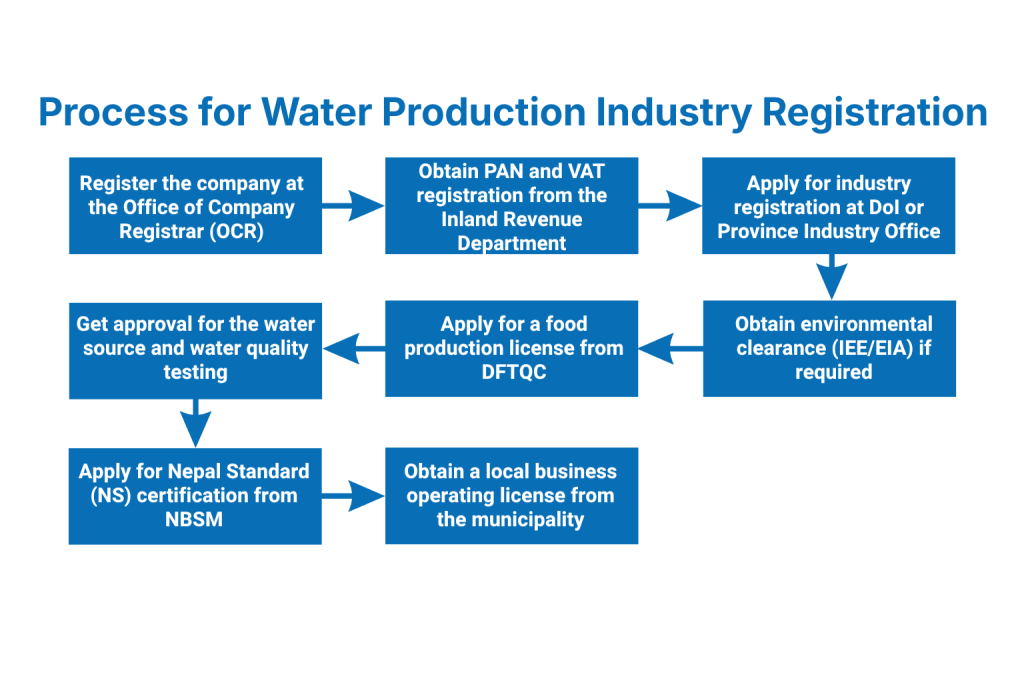
The water production industry registration in Nepal follows a multi-step process. The process begins with company formation and ends with obtaining the Nepal Standard certification mark.
Step 1: Register a Company
Register your company with the Office of Company Registrar (OCR) under the Company Act, 2063. Choose an appropriate business structure such as a private limited company or public limited company.
Step 2: Obtain PAN and VAT Registration
Apply for a Permanent Account Number (PAN) and Value Added Tax (VAT) registration with the Inland Revenue Department if your annual turnover exceeds the VAT threshold.
Step 3: Apply for Industry Registration at DoI or Province Office
Submit the industry registration application with all required documents to the Department of Industry (for large-scale industries) or the Province Industry Office (for cottage, small, and medium industries under the Industrial Enterprises Act, 2076).
Step 4: Obtain Environmental Clearance
If your project requires an Initial Environmental Examination (IEE) or Environmental Impact Assessment (EIA) under the Environment Protection Act, 2076, obtain clearance from the Ministry of Forests and Environment before proceeding.
Step 5: Apply for DFTQC Food Production License
Submit an application to the Department of Food Technology and Quality Control for a food production license. DFTQC inspectors will conduct a physical inspection of your factory premises.
Step 6: Obtain Water Source Approval
If your water source is a borehole or natural spring, obtain approval from the relevant local government or Water and Energy Commission Secretariat (WECS). Submit a detailed water quality analysis report from a recognized laboratory.
Step 7: Apply for Nepal Standard (NS) Certification
Submit an application to the Nepal Bureau of Standards and Metrology for NS certification. NBSM will test your product samples and inspect the factory. After successful audit, NBSM grants the NS certification mark, which is mandatory for commercial sale of packaged water in Nepal.
Step 8: Obtain Local Business License
Register with your local municipality or rural municipality for a local business operating license as required under the Local Government Operation Act, 2074.
What Are the Registration Fees for Water Production Industry in Nepal?
The registration fees for water production industry in Nepal vary based on the investment scale and the type of license.
| Type of Registration | Approximate Fee (NPR) |
|---|---|
| Company Registration (Private Limited) | NPR 9,000 – NPR 15,000 |
| Industry Registration (Small Industry) | NPR 2,000 – NPR 5,000 |
| Industry Registration (Medium Industry) | NPR 5,000 – NPR 15,000 |
| DFTQC Food Production License | NPR 5,000 – NPR 25,000 (based on scale) |
| NBSM NS Certification | NPR 10,000 – NPR 30,000 |
| Local Business License | NPR 2,000 – NPR 10,000 (varies by municipality) |
Fees are subject to change. Always verify current fees from the respective government offices or official websites such as www.doind.gov.np and www.dftqc.gov.np.
What Quality Standards Apply to Packaged Water in Nepal?
Nepal enforces mandatory quality standards for all packaged and bottled water sold commercially. These standards are set by the Nepal Bureau of Standards and Metrology (NBSM) and the DFTQC.
- NS 159 – Nepal Standard for packaged drinking water
- NS 227 – Nepal Standard for natural mineral water
- WHO Guidelines for Drinking Water Quality – Referenced by DFTQC
- Codex Alimentarius Standards – Applied for mineral water classification
All water production companies must display the NS mark on their product packaging. Selling packaged water without the NS certification mark is a violation under the Nepal Standards (Certification Mark) Act, 2037 and can result in fines, seizure of products, or cancellation of the production license.
Water quality parameters monitored include pH level, total dissolved solids (TDS), coliform bacteria count, heavy metal content, turbidity, and chemical composition. Regular testing at DFTQC-recognized laboratories is mandatory for maintaining the license.
What Are the Key Legal Requirements for Operating a Water Production Industry in Nepal?
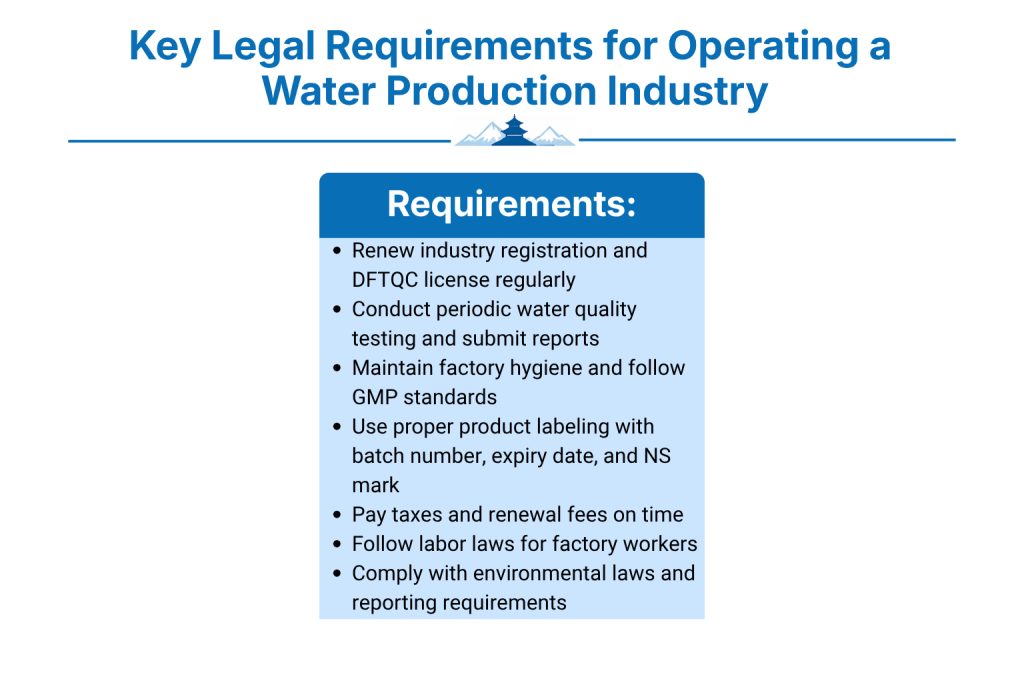
Operating a water production industry in Nepal involves continuous compliance with legal requirements beyond just initial registration.
- Renewal of the industry registration certificate annually or as required under the Industrial Enterprises Act, 2076
- Annual renewal of the DFTQC food production license
- Periodic quality testing and submission of test reports to DFTQC and NBSM
- Maintaining factory hygiene and Good Manufacturing Practices (GMP) as prescribed by DFTQC
- Proper labeling of all products including batch number, manufacturing date, expiry date, and NS certification mark as per the Food Regulation, 2027 BS
- Payment of industry-related taxes and renewal fees to local government and federal tax authorities
- Compliance with labor laws under the Labor Act, 2074 (2017) for factory workers
- Environmental compliance reports as per the Environment Protection Act, 2076
Can a Foreign Investor Register a Water Production Industry in Nepal?
Yes, foreign investors can establish and register a water production industry in Nepal. However, they must comply with the Foreign Investment and Technology Transfer Act (FITTA), 2075 (2019) and the Industrial Enterprises Act, 2076.
Foreign investment in the water production sector requires prior approval from the Department of Industry. The investment must be repatriated through proper banking channels, and the foreign investor must obtain foreign investment approval before proceeding with industry registration.
The water production sector is generally open for foreign investment, but investors must confirm the sector is not listed in a restricted or negative list under FITTA, 2075. The Investment Board Nepal handles investments above NPR 6 billion, while the DoI handles smaller foreign investments.
Conclusion
Water production industry registration in Nepal involves multiple government authorities including the Department of Industry, DFTQC, NBSM, and local governments. Compliance with the Industrial Enterprises Act, 2076, Food Act, 2023 BS, and Nepal Standards certification requirements is mandatory for all water production businesses. Proper documentation, quality testing, and adherence to GMP standards form the foundation of a legally compliant water production operation in Nepal. For official information, visit www.doind.gov.np, www.dftqc.gov.np, and www.nbsm.gov.np.
FAQs
1. Is NS certification mandatory for selling packaged water in Nepal?
Yes. The Nepal Bureau of Standards and Metrology (NBSM) makes NS certification mandatory for all packaged drinking water and mineral water sold commercially in Nepal under the Nepal Standards (Certification Mark) Act, 2037.
2. Which office handles water production industry registration in Nepal?
The Department of Industry (DoI) handles large-scale water industry registration, while the Province Industry Office handles small and medium industries under the Industrial Enterprises Act, 2076.
3. How long does the water production industry registration process take in Nepal?
The complete registration process, including company registration, industry registration, DFTQC license, and NS certification, typically takes 3 to 6 months depending on document readiness and inspection schedules.
4. What is the role of DFTQC in water production industry registration?
DFTQC issues the food production license and approves product labels. It also monitors factory hygiene, GMP compliance, and product quality standards for all water production businesses in Nepal.
5. Do I need an Environmental Impact Assessment for a water bottling plant in Nepal?
Small water bottling plants may require only an Initial Environmental Examination (IEE). Larger plants must undergo a full Environmental Impact Assessment (EIA) under the Environment Protection Act, 2076.
6. What happens if I operate a water production plant without proper registration in Nepal?
Operating without registration violates the Industrial Enterprises Act, 2076, and the Food Act, 2023 BS. Penalties include fines, product seizure, factory closure, and possible criminal liability under applicable food safety and industry laws.