

A trademark is often the single most valuable intangible asset a business owns in Nepal. Whether you are a Nepali manufacturer, a foreign investor establishing a subsidiary, or an overseas brand owner licensing your name to a local partner, registration with the Department of Industry (DOI) is the only way to obtain enforceable statutory rights over a mark in Nepal. This guide, prepared by CompanyNP, explains the legal framework, eligibility, documentation, procedure, fees, renewal cycle and tax treatment of trademarks in Nepal, based strictly on the Patent, Design and Trademark Act, 2022 (1965), the Foreign Investment and Technology Transfer Act, 2019 (FITTA), the Income Tax Act, 2058 (2002), and prevailing Nepal Rastra Bank (NRB) regulations.
What Is a Trademark and Which Law Governs Trademark Registration in Nepal?
How does Nepali law define a trademark?
Section 2 of the Patent, Design and Trademark Act, 2022 defines a trademark as any word, symbol, or picture, or a combination of these, used by a firm, company or individual to distinguish its products or services from those of others. In practice, the Department of Industry accepts:
- Word marks (brand names, taglines)
- Device or logo marks
- Composite marks combining words and devices
- Service marks used for banking, hospitality, education, IT and other services
- Collective marks used by associations and cooperatives
Section 16 of the Act states that no person shall use a trademark without registering it with the Department. Registration is therefore not merely advisable; it is the statutory basis of ownership and enforcement.
Which authority administers trademarks?
The Department of Industry, Ministry of Industry, Commerce and Supplies, is the competent registering authority for all industrial property, comprising patents, designs and trademarks. Applications, examinations, publications and renewals are handled by the Industrial Property Section of the Department. Official forms, notices and the Industrial Property Bulletin are published at doind.gov.np. The consolidated text of the governing statute is available through the Nepal Law Commission at lawcommission.gov.np.
What international treaties apply to Nepal?
Nepal is a member of the World Intellectual Property Organization and acceded to the Paris Convention for the Protection of Industrial Property in 2001. Nepal is also a World Trade Organization member and is therefore bound by the TRIPS Agreement. Two consequences matter for applicants:
- A priority claim of six months may be asserted on the basis of an earlier application filed in another Paris Convention country.
- Nepal is not a party to the Madrid Protocol. An international registration cannot designate Nepal, so a direct national application before the Department of Industry is mandatory.
Which marks cannot be registered?
Section 18 of the Act empowers the Department to refuse registration where the mark:
- Adversely affects the prestige of any individual or institution
- Harms public conduct, morality, or the national interest
- Damages the reputation or goodwill of the trademark of another person
- Is already registered in the name of another proprietor
- Lacks distinctiveness or is merely descriptive of the goods or services
Who Can Apply and What Documents Are Required for Trademark Registration in Nepal?
Who is eligible to file an application?
Any of the following may apply, either individually or jointly:
- A Nepali citizen or sole proprietorship firm
- A private limited or public limited company registered with the Office of the Company Registrar under the Companies Act, 2063
- A partnership firm, cooperative, or non-governmental organisation
- A foreign natural person or foreign legal entity, irrespective of whether it has a place of business in Nepal
Foreign applicants are not required to first incorporate a company in Nepal in order to hold a Nepali trademark. However, foreign applicants must act through a locally resident authorised agent, since the Department corresponds only with an address within Nepal.
What documents must accompany the application?
The following documents are ordinarily required by the Department of Industry:
- The prescribed application form under the Schedule to the Act, duly completed and signed
- Four to six clear representations of the mark, in the size and format accepted by the Department
- Power of attorney or letter of authority in favour of the local agent or consultant
- Certificate of incorporation or firm registration certificate of the applicant
- Permanent Account Number (PAN) or VAT certificate, for Nepali applicants
- Home country registration certificate or application evidence, where a priority claim is made
- Deed of assignment, where the mark is being applied for by a transferee
- Official receipt of the application fee
Additional documents for foreign applicants
Foreign entities should additionally submit a notarised copy of their certificate of incorporation, a notarised and, where required, consularised power of attorney, and an English translation of any document not originally in English or Nepali. Consistency between the applicant’s legal name on the incorporation certificate and on the power of attorney is essential, as discrepancies are a frequent cause of objection.
How are goods and services classified?
The Department of Industry applies the International Classification of Goods and Services under the Nice Agreement, comprising 34 classes of goods and 11 classes of services. Nepal follows a single-class filing system. A separate application, and a separate fee, is required for each class in which protection is sought. Careful class selection at the outset avoids costly re-filing later, particularly for businesses with both manufacturing and service activities.
What Is the Step-by-Step Trademark Registration Process in Nepal?
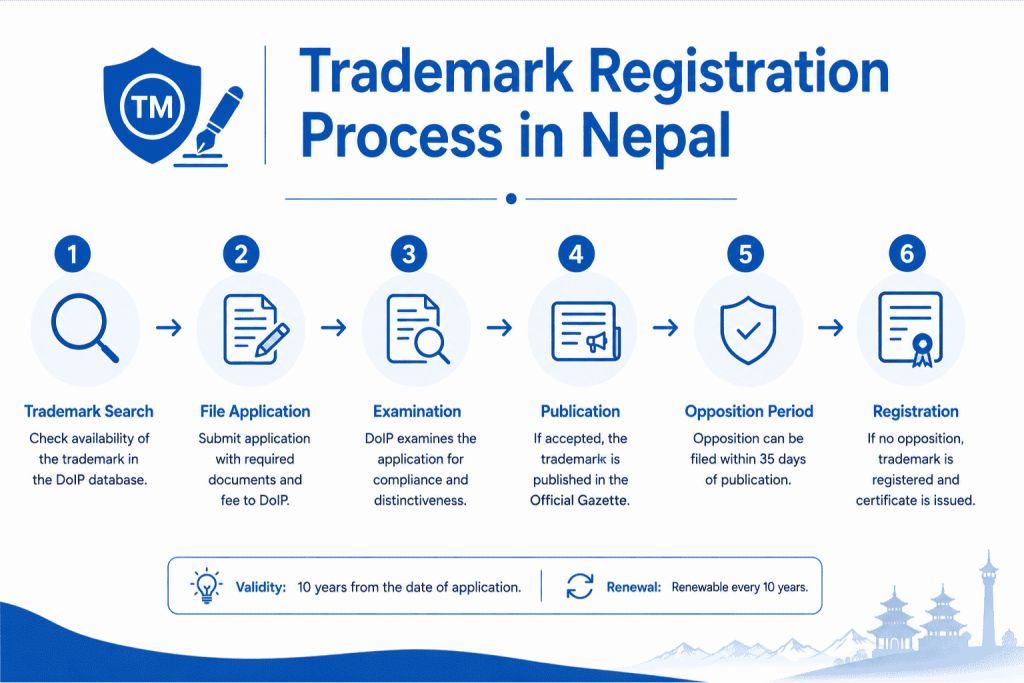
Step 1: Conduct a preliminary trademark search
Before filing, a search of the Department of Industry’s trademark records should be conducted to identify identical or deceptively similar marks in the relevant class. The search is not conclusive, because pending applications may not yet be published, but it substantially reduces the risk of refusal under Section 18.
Step 2: Finalise the mark, applicant details and classification
Determine whether the mark will be filed as a word mark, a device mark, or both. Fix the exact list of goods or services and the Nice class. Confirm that the applicant named in the application is the legal entity that will own and use the mark.
Step 3: Execute the power of attorney and supporting papers
The applicant executes the authority in favour of the filing agent. Foreign applicants should complete notarisation and legalisation at this stage, as these formalities commonly take longer than the filing itself.
Step 4: File the application and pay the official fee
The application, together with the representations of the mark and the prescribed fee, is submitted to the Industrial Property Section of the Department of Industry. A filing number and filing date are allotted. The filing date establishes priority against later applicants in Nepal.
Step 5: Formal examination
The Department verifies that the form is complete, the fee is paid, the representations are legible, and the documents are in order. Deficiencies are communicated to the applicant, who is given an opportunity to rectify them within the time allowed.
Step 6: Substantive examination
The examiner assesses distinctiveness, descriptiveness, and conflict with earlier registered or pending marks, and applies the prohibitions in Section 18. If an objection is raised, the applicant may file a written response with supporting evidence of distinctiveness or prior use, and may request a hearing.
Step 7: Publication in the Industrial Property Bulletin
On acceptance, the mark is published in the Industrial Property Bulletin issued by the Department of Industry. Publication opens the opposition window, during which any interested third party may object to registration on grounds recognised by the Act.
How does opposition work?
An opponent files a notice of opposition with supporting grounds and evidence within the notified opposition period, generally ninety days from publication. The applicant is served and may file a counter-statement. The Department hears both parties and issues a reasoned decision. Under Section 34 of the Act, a party aggrieved by a decision of the Department may appeal to the competent court within thirty-five days.
Step 8: Payment of the registration fee and issuance of the certificate
If no opposition is filed, or if opposition is decided in the applicant’s favour, the applicant pays the registration fee. The Department then enters the mark in the Trademark Register and issues the Certificate of Registration bearing the registration number and date.
Step 9: Use the mark and maintain evidence of use
Registration should be followed by genuine commercial use in Nepal. The Act permits cancellation of registrations in specified circumstances, and evidence of use, such as invoices, packaging, advertising and import documents, is the practical defence against non-use challenges and the foundation of any infringement action.
Step 10: Renew before expiry
Renewal must be applied for before the expiry of the current term. Late renewal within the statutory grace period is permitted on payment of an additional fee; failure to renew results in the mark lapsing and being open to third-party appropriation.
What Are the Costs, Timelines, Renewal Cycle and Tax Obligations?
What is the term of protection?
Under the Patent, Design and Trademark Act, 2022, a registered trademark is protected for seven years from the date of registration and may be renewed for successive seven-year terms without limit, provided renewal applications and fees are filed on time. Nepal’s seven-year cycle differs from the ten-year cycle used in many jurisdictions, and diary management is therefore critical for foreign portfolio holders.
What official fees apply?
Government fees are fixed by the Schedule to the Act and may be revised by the annual Finance Act. As presently applied by the Department of Industry, the principal charges are:
- Application fee for trademark registration: NPR 1,000 per class
- Registration certificate fee: NPR 5,000 per class
- Renewal fee for each seven-year term: NPR 5,000 per class
- Late renewal within the grace period: renewal fee plus the prescribed surcharge
- Recordal of assignment, change of name or address: fees as per the Schedule
Applicants should confirm current rates with the Department before remittance, as scheduled fees are periodically amended.
How long does registration take?
An uncontested application typically proceeds to registration within approximately nine to eighteen months, depending on examination workload, publication cycles and the speed with which objections are answered. Opposed applications take materially longer.
What are the tax implications of trademarks?
Under the Income Tax Act, 2058, payments for the use of a trademark constitute royalty. Key obligations include:
- Withholding tax at 15 percent on royalty payments made to a non-resident, subject to reduction under an applicable double taxation avoidance agreement
- Deposit of withheld tax with the Inland Revenue Department within the statutory timeline, with returns filed at ird.gov.np
- Value Added Tax obligations on imported services, applied on a reverse-charge basis where relevant
- Deductibility of trademark-related expenditure only where properly documented and supported by tax invoices
How Do Foreign Investors Protect and Commercialise Trademarks in Nepal?
When does trademark licensing become a technology transfer?
Under Section 2 of FITTA, 2019, the transfer of technology includes the use of any trademark, patent, design, goodwill, technical know-how or franchise owned by a foreign person. Consequently, when a foreign brand owner permits a Nepali company to use its trademark for consideration, the arrangement is a technology transfer requiring approval from the Department of Industry, or from the Investment Board Nepal where the project falls within its threshold.
What must a technology transfer agreement contain?
The written agreement submitted for approval should clearly state the parties, the trademark licensed, the territory, the term, the basis and rate of royalty, the mode of payment, dispute resolution, and termination. Approval is granted on the agreement as filed, and subsequent amendments require fresh approval.
How is royalty repatriated under NRB rules?
Section 20 of FITTA guarantees repatriation of the amount received under an approved technology transfer agreement in convertible foreign currency. Repatriation is processed through Nepal Rastra Bank in accordance with the Foreign Investment and Foreign Loan Management Bylaws and related circulars published at nrb.org.np. Applicants must produce the approved agreement, evidence of tax clearance and audited accounts. Royalty ceilings for trademark use are prescribed by the applicable regulations and are calculated on total sales or net profit; the exact ceiling should be verified before the agreement is signed, since remittance beyond the approved rate will not be permitted.
What remedies exist against infringement?
The Act prohibits unauthorised use of a registered trademark and provides for fines and confiscation of infringing goods by the Department of Industry, alongside civil remedies. Registered proprietors may also record their marks with customs authorities and pursue action under consumer protection and unfair competition provisions. Prompt action, supported by the registration certificate and evidence of use, is the most effective deterrent.
Practical compliance checklist for foreign brand owners
- Register the mark in Nepal before market entry, not after
- File in every Nice class relevant to present and planned activities
- Diarise the seven-year renewal cycle and grace period
- Record assignments, mergers and name changes promptly
- Obtain FITTA approval before any licensing to a Nepali entity
- Structure royalty within permitted ceilings and withhold tax correctly
Frequently Asked Questions
Can a foreign company register a trademark in Nepal without incorporating a local company?
Yes. Foreign natural persons and foreign legal entities may apply directly before the Department of Industry, provided they appoint a locally resident authorised agent and submit notarised incorporation documents and a valid power of attorney with the application.
Is a trademark search compulsory before filing an application?
A search is not legally compulsory, but it is strongly recommended. Searching the Department of Industry records identifies conflicting earlier marks, reduces the risk of refusal under Section 18, and avoids the loss of official fees and rebranding costs.
How long is a Nepali trademark valid and how often must it be renewed?
Registration remains valid for seven years from the date of registration under the Patent, Design and Trademark Act, 2022, and may be renewed indefinitely for successive seven-year terms upon timely application and payment of the prescribed renewal fee.
Does Nepal accept international registrations filed under the Madrid Protocol?
No. Nepal has not acceded to the Madrid Protocol, so international registrations cannot designate Nepal. Protection is obtained only through a national application before the Department of Industry, although Paris Convention priority may be claimed.
Is government approval required to license a foreign trademark to a Nepali company?
Yes. Under FITTA, 2019, licensing a foreign trademark constitutes technology transfer and requires prior approval of the Department of Industry or Investment Board Nepal, together with a written agreement specifying royalty rates and payment terms.
What tax applies to royalty paid to a foreign trademark owner?
Royalty paid to a non-resident attracts withholding tax at 15 percent under the Income Tax Act, 2058, subject to relief under an applicable double taxation avoidance agreement, with deposit and reporting to the Inland Revenue Department.