

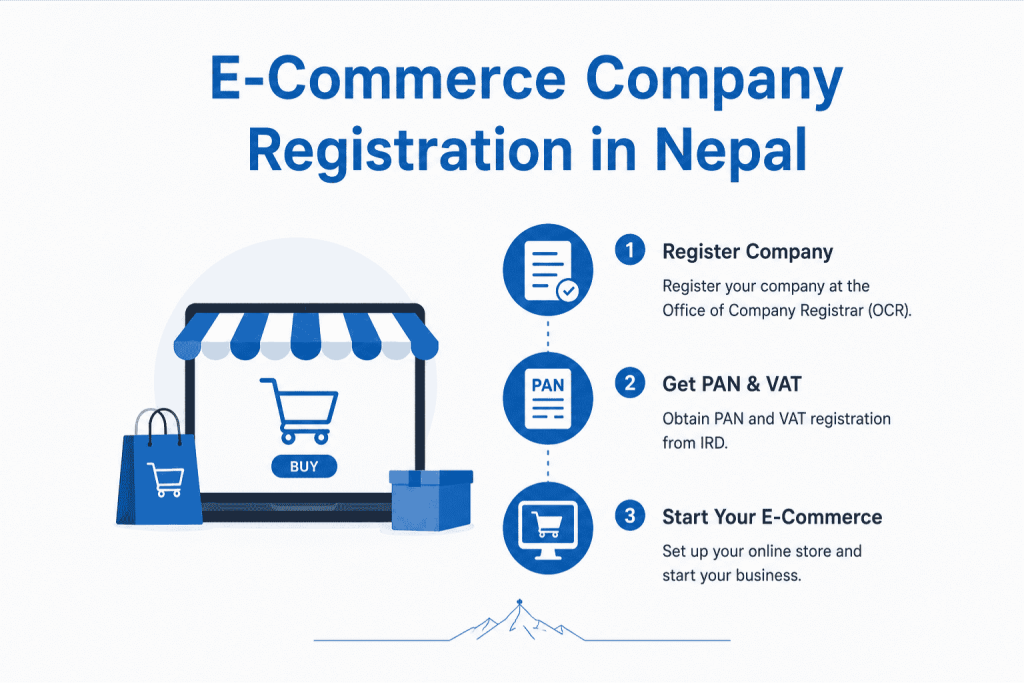
E-Commerce Company Registration in Nepal is emerging, and the government has established clear regulatory frameworks to facilitate business registration for both domestic and foreign entrepreneurs. The process of registering an e-commerce company in Nepal involves understanding multiple legal requirements under the Companies Act 2063, Foreign Investment and Technology Transfer Act 2075, and various guidelines issued by the Department of Industry, Nepal Rastra Bank, and the Inland Revenue Department.
Foreign investors seeking to establish e-commerce operations in Nepal must comply with both federal and provincial regulations. The fundamental requirement is obtaining company registration with the Office of the Company Registrar, which falls under the jurisdiction of the Ministry of Industry, Commerce and Supplies. Additionally, e-commerce businesses must secure multiple regulatory approvals and licenses to operate legally within Nepal’s territory.
The Department of Industry, located under the authority of the Government of Nepal, maintains oversight of company registration and provides detailed guidelines available at doind.gov.np. All foreign investors must familiarize themselves with these requirements before initiating the registration process. This comprehensive guide addresses the essential questions and procedures necessary for establishing a legally compliant e-commerce business in Nepal.
What Are the Prerequisites for E-Commerce Company Registration?
Before beginning the formal registration process, foreign investors must understand the foundational prerequisites that apply to all e-commerce business establishments in Nepal. These prerequisites are mandated under the Companies Act 2063 and supplementary regulations issued by relevant government authorities.
Company Name Approval and Availability Check
The first step in establishing an e-commerce company requires selecting an appropriate business name and verifying its availability through the Office of the Company Registrar. The company name must comply with the following criteria:
- The name must not be identical or confusingly similar to existing registered companies
- The name should not contain restricted words without proper authorization
- The name must reflect the nature of business operations
- Foreign company names must be appropriately translated into Nepali or English
- The name should not violate any trademark or intellectual property rights
The Company Registrar’s office provides an online database where applicants can search for existing company names. This search facility is accessible through the official government portal and helps prevent duplicate registrations. Once a suitable name is identified, formal approval must be obtained before proceeding with registration documents.
Minimum Capital Requirements
The Foreign Investment and Technology Transfer Act 2075 specifies capital requirements for foreign-owned e-commerce enterprises. According to current regulations:
- Minimum foreign investment requirement is determined by sector classification
- E-commerce businesses typically require a minimum of USD 10,000 to USD 50,000 as foreign capital contribution
- Capital must be remitted through official banking channels
- Evidence of capital transfer must be documented and submitted with registration applications
- Capital contribution should be deposited in a designated bank account before formal registration
The Nepal Rastra Bank, functioning as the central monetary authority, monitors all foreign currency transactions. Banks authorized to handle foreign exchange must provide certificates confirming capital remittance. These documents are mandatory requirements for company registration approval.
Identification and Documentation of Foreign Investors
Foreign investors must provide complete identification documents and background information:
- Valid passport copies with biographical pages
- Proof of residential address in the home country
- Criminal clearance certificate from the country of origin
- Tax residency certificate from the home country
- Board resolution or authorization letter from the investor’s home company
- Notarized power of attorney documents
All non-Nepali language documents must be officially translated into English or Nepali by certified translators. The Office of the Company Registrar requires legalized copies for all foreign documents. This documentation serves to establish the legitimacy and legal standing of foreign investors before approval.
How to Register an E-commerce Company in Nepal?
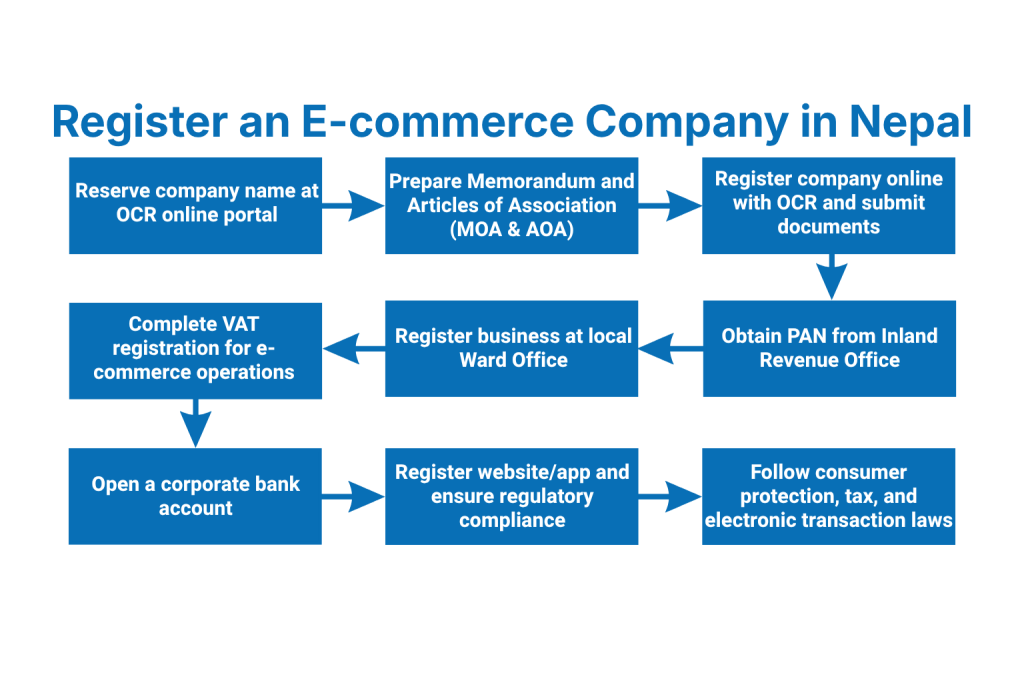
The registration process for e-commerce companies in Nepal follows a structured procedure established by the Office of the Company Registrar and supplemented by sector-specific requirements. Understanding each phase of this process is essential for successful business establishment.
Step-1: Pre-Registration Application and Name Approval
Description: The initial phase involves submitting preliminary documentation to the Office of the Company Registrar for company name verification and approval. Applicants must prepare a formal application letter addressing the Company Registrar, including the proposed company name, business objectives, and basic information about foreign investors. The application should specify the nature of e-commerce operations, whether the business involves retail sales, service provision, marketplace operations, or digital content distribution.
Supporting documents required for this step include:
- Filled forms available at doind.gov.np or the Company Registrar’s office
- Copy of foreign investor’s passport and travel documents
- Preliminary capital confirmation from authorized bank
- Brief business plan describing e-commerce operations
- List of proposed company directors and shareholders
The Company Registrar typically provides name approval within 3 to 5 working days. Once approval is received, applicants receive a formal certificate of name approval, which must be retained as it is required for subsequent registration stages.
Step-2: Preparation of Memorandum and Articles of Association
Description: After name approval, investors must prepare the Memorandum of Association and Articles of Association in compliance with the Companies Act 2063. These documents establish the legal structure, governance framework, and operational guidelines for the company. The Memorandum of Association must clearly state the company’s objectives, capital structure, liability clauses, and subscription details.
The Articles of Association define the internal management procedures, board composition, voting rights, profit distribution mechanisms, and amendment procedures. For e-commerce companies, these documents must address:
- Data protection and customer privacy policies
- E-commerce specific operational procedures
- Digital transaction protocols
- Terms and conditions for online services
- Dispute resolution mechanisms
- Board composition and director responsibilities
Both documents must be prepared according to templates and guidelines available through the Office of the Company Registrar. Foreign investors should engage legal counsel familiar with Nepali company law to ensure compliance. These foundational documents must be notarized and certified before submission.
Step-3: Directors and Shareholders Documentation
Description: E-commerce companies must appoint qualified directors and identify all shareholders according to the Companies Act 2063. The company requires a minimum of one director for private companies and three directors for public companies. At least one director must be a Nepali citizen or permanent resident, and all directors must provide formal consent to serve in their designated positions.
Each director must submit:
- Curriculum vitae with professional credentials
- Permanent citizenship number or tax identification number
- Residential address and contact information
- Affidavit declaring no debarment or legal restrictions
- Board resolution confirming director appointment
- Director designation document
Shareholders’ documentation must include evidence of capital contribution, shareholding percentages, and executed share certificates. If shareholders are foreign entities, they must provide:
- Corporate registration documents
- Tax clearance certificates
- Board authorization for investment in Nepal
- Certified financial statements
- Proof of capital source legitimacy
Step-4: Submission of Registration Application to Company Registrar
Description: After completing all preliminary documentation, applicants submit a comprehensive registration application to the Office of the Company Registrar. This application consolidates all required documents, including the name approval certificate, Memorandum and Articles of Association, director documentation, and capital proof.
The registration application package should include:
- Completed registration forms (Form-1 and Form-4)
- Name approval certificate from Step-1
- Certified Memorandum of Association
- Certified Articles of Association
- Director identification and consent documents
- Shareholder documentation
- Bank certificate confirming capital deposit
- Application fee payment receipt
The applicant must submit documents in person or through authorized representatives. The Company Registrar examines all submissions for completeness and legal compliance. This examination typically requires 7 to 14 working days.
Step-5: Tax Identification Number and VAT Registration
Description: Upon receiving provisional company registration approval, the newly established company must obtain a Tax Identification Number from the Inland Revenue Department. The TIN is essential for tax compliance and is required before commencing business operations. Foreign companies must apply for permanent account number and VAT registration simultaneously.
Required documents for TIN application include:
- Certificate of provisional company registration
- Memorandum and Articles of Association
- Director identification documents
- Proof of business address in Nepal
- Declaration of income and projected revenue
- Bank account details for tax purposes
Value Added Tax registration is compulsory for e-commerce companies if annual turnover exceeds the threshold specified by the Inland Revenue Department. Currently, VAT registration is mandatory for businesses with annual revenue exceeding NPR 3 Million. E-commerce companies must file a VAT return on a regular basis as determined by tax authorities.
Step-6: Sector-Specific Licensing and Regulatory Compliance
Description: Depending on the specific nature of e-commerce operations, additional sector-specific licenses and approvals may be required. E-commerce companies operating in Nepal must comply with the Electronic Transactions Act 2063, Digital Security Act 2018, and other relevant sectoral regulations.
Specific licensing requirements include:
- Business Operation License from municipal authorities
- Goods and Services Tax implications if applicable
- Online Payment Gateway registration with Nepal Rastra Bank
- Data Protection and Privacy Compliance certification
- Cyber Security compliance as per regulations
- Consumer Protection Act 2075 compliance
What Are the Key Legal and Regulatory Frameworks Governing E-Commerce?
E-commerce operations in Nepal are governed by a comprehensive legal framework designed to protect consumers, ensure digital security, and facilitate fair competition. Understanding these regulations is essential for compliance and sustainable business operations.
Electronic Transactions Act 2063
The Electronic Transactions Act 2063 provides the primary legal framework for digital commerce in Nepal. This legislation recognizes electronic signatures, digital documents, and online transactions as legally valid. The Act establishes standards for:
- Electronic agreements and contracts
- Digital record maintenance requirements
- Legal recognition of electronic documents
- Digital signatures and authentication methods
- Liability and responsibility of service providers
- Consumer protection in electronic transactions
E-commerce companies must maintain electronic records in compliance with this Act’s requirements. Records must be preserved for minimum periods specified by law and must be accessible for government inspection.
Digital Security Act 2018
The Digital Security Act 2018 establishes cybersecurity standards and data protection requirements for organizations handling digital information. E-commerce companies must implement:
- Secure payment processing systems
- Data encryption protocols
- Regular security audits and assessments
- Incident reporting procedures
- Customer data protection mechanisms
- Cybersecurity training for employees
Violations of this Act carry significant penalties, including fines and potential imprisonment for responsible persons.
Consumer Protection Act 2075
The Consumer Protection Act 2075 applies specifically to e-commerce transactions and establishes rights and protections for online consumers. E-commerce companies must:
- Provide transparent product and pricing information
- Establish clear refund and return policies
- Honor warranty obligations
- Respond to consumer complaints within specified timeframes
- Maintain customer grievance redressal mechanisms
- Comply with advertising standards and prohibitions
Nepal Rastra Bank Regulations
The Nepal Rastra Bank has issued specific guidelines for online payment systems and digital financial transactions. E-commerce companies must:
- Register payment gateways with authorized service providers
- Comply with cybersecurity requirements for financial transactions
- Maintain customer fund security
- Report suspicious transactions to regulatory authorities
- Implement Know Your Customer procedures
What Tax Obligations Apply to E-Commerce Companies?
Foreign-owned e-commerce companies registered in Nepal are subject to multiple tax obligations under the Income Tax Act 2075 and supplementary regulations issued by the Inland Revenue Department. Understanding these obligations is essential for legal compliance.
Corporate Income Tax
E-commerce companies are subject to corporate income tax on profits generated from business operations in Nepal. The current corporate income tax rate is:
- Standard rate: 25 percent for most companies
- Lower rates may apply for specific sectors or activities
- Tax deductions are available for business expenses
- Depreciation allowances apply to fixed assets
- Loss carryforward provisions enable tax benefits in subsequent years
Value Added Tax
VAT is applicable on taxable supplies made by e-commerce companies. The standard VAT rate is 13 percent, with some goods and services subject to 0 percent rate or exemptions. E-commerce companies must:
- Collect VAT from customers at point of sale
- Maintain VAT registers and transaction records
- File monthly or quarterly VAT returns as prescribed
- Claim input VAT credits for eligible business purchases
- Remit VAT to government by specified deadlines
Withholding Tax Requirements
E-commerce companies must comply with withholding tax obligations on payments made to contractors, suppliers, and service providers. Different withholding tax rates apply based on:
- Type of payment or service provided
- Residency status of payment recipient
- Specific provisions under income tax regulations
- Foreign exchange payments and remittances
Annual Tax Filing and Compliance
All e-commerce companies must file annual income tax returns within the prescribed timeframe, typically by the end of the calendar year. Requirements include:
- Submission of audited financial statements
- Schedule of income from various sources
- Documentation of business expenses and deductions
- Proof of tax paid during the financial year
- Schedule of assets and liabilities
What Are the Ongoing Compliance Requirements?
E-commerce companies must maintain continuous compliance with regulatory requirements beyond the initial registration period. These ongoing obligations ensure legal operation and prevent penalties or business disruption.
Annual Company Registration Renewal
Companies must renew their registration annually with the Office of the Company Registrar. This renewal process involves:
- Submission of annual returns containing updated company information
- Confirmation of director and shareholder details
- Report on changes in company structure or operations
- Payment of annual renewal fees as prescribed
- Maintenance of registered office address in Nepal
Financial Reporting and Auditing
E-commerce companies with annual revenue exceeding specified thresholds must undergo external audit. Required financial documentation includes:
- Annual balance sheet
- Profit and loss statement
- Cash flow statement
- Auditor’s report and certification
- Notes to financial statements
- Disclosure of related party transactions
Financial reports must be prepared according to Nepal Financial Reporting Standards and audited by certified public accountants registered with the Institute of Chartered Accountants of Nepal.
Data Privacy and Protection Compliance
E-commerce companies must maintain ongoing compliance with customer data protection regulations:
- Regular security audits and vulnerability assessments
- Employee training on data protection procedures
- Privacy policy updates and customer notification
- Incident response planning and implementation
- Regular backup and disaster recovery procedures
Customer Complaint Management
Companies must establish and maintain formal grievance redressal mechanisms:
- Dedicated customer service department
- Written complaint registration procedures
- Time-bound resolution timelines
- Appeal procedures for unresolved complaints
- Record maintenance for complaint tracking
| Registration Phase | Timeline | Key Requirements |
|---|---|---|
| Name Approval | 3-5 days | Company name verification, preliminary documents submission |
| Documentation Preparation | 5-10 days | MOA, AOA, director, and shareholder documentation |
| Registration Application | 7-14 days | Complete application submission to Company Registrar |
| Tax Registration | 3-5 days | TIN and VAT registration from Inland Revenue Department |
| Licensing and Compliance | 7-20 days | Sector-specific licenses and regulatory approvals |
| Tax Obligation | Rate | Frequency | Description |
|---|---|---|---|
| Corporate Income Tax | 25% | Annual | Tax on company profits from operations |
| Value Added Tax | 13% | Monthly/Quarterly | Tax on taxable goods and services supplies |
| Withholding Tax | 5-20% | As applicable | Tax on payments to contractors and suppliers |
| Annual Tax Filing | Variable | Annual | Submission of financial statements and returns |
Frequently Asked Questions About E-Commerce Company Registration
1. How long does the complete e-commerce company registration process take in Nepal?
The entire registration process typically takes 4 to 6 weeks from initial application submission to final regulatory approval, including name approval, documentation preparation, company registration, tax identification, and sector-specific licensing. Timeline variations depend on application completeness, document verification requirements, and seasonal processing delays at government offices. Expedited processing may be available through authorized consultants.
2. What is the minimum capital requirement for foreign investors establishing e-commerce companies in Nepal?
According to the Foreign Investment and Technology Transfer Act 2075, minimum capital requirement for e-commerce companies ranges from USD 10,000 to USD 50,000 depending on business classification and operational scale. Capital must be remitted through authorized banking channels with proper documentation. The Nepal Rastra Bank provides capital remittance certificates confirming transfer completion for registration purposes.
3. Must an e-commerce company appoint a Nepali citizen as director or can it be entirely foreign-managed?
The Companies Act 2063 mandates that at least one director must be a Nepali citizen or permanent resident for company governance compliance. This requirement ensures local regulatory accountability and proper implementation of Nepali laws. Foreign directors may be appointed as additional board members, but at least one Nepali director is mandatory for legal operation.
4. What specific licenses beyond company registration are required for e-commerce businesses operating in Nepal?
E-commerce businesses require Business Operation License from municipal authorities, online payment gateway registration with Nepal Rastra Bank, tax identification and VAT registration from Inland Revenue Department, and compliance certifications under Digital Security Act 2018 and Electronic Transactions Act 2063. Additional licenses may be needed depending on specific product categories or services offered.
5. Are e-commerce companies subject to Value Added Tax on all products and services sold online?
E-commerce companies are subject to 13 percent standard VAT rate on most taxable supplies, though certain goods and services qualify for 0 percent rate or complete exemption. VAT registration is mandatory if annual turnover exceeds NPR 3 Million threshold. Companies must file monthly or quarterly VAT returns and maintain detailed transaction records for tax authorities.
6. What compliance requirements must e-commerce companies maintain regarding customer data protection and cybersecurity?
E-commerce companies must implement comprehensive data protection measures under Digital Security Act 2018, including secure payment processing systems, data encryption protocols, regular security audits, incident reporting procedures, and customer data protection mechanisms. Companies must conduct regular cybersecurity assessments, maintain employee training programs, establish backup procedures, and maintain privacy policy compliance with regulatory standards.