



Plywood or Veneer Factory Registration in Nepal Nepal has significant forest resources, and the plywood and veneer manufacturing industry holds strong potential in the Nepalese industrial sector. Entrepreneurs who want to establish a plywood or veneer factory registration in Nepal must follow a structured legal process governed by several national laws and regulations.
The plywood factory registration in Nepal and veneer factory registration in Nepal fall under the manufacturing industry category. The government of Nepal regulates these industries through the Industrial Enterprises Act, 2076 (2020), the Company Act, 2063 (2006), and the Environment Protection Act, 2076 (2019). Any individual or entity planning to open a plywood or veneer manufacturing unit in Nepal must comply with all applicable laws before commencing operations.
This article covers the entire process of registering a plywood or veneer factory in Nepal, including required documents, legal provisions, applicable fees, environmental clearances, and regulatory requirements.
What is a Plywood or Veneer Factory?

A plywood factory is an industrial unit that manufactures plywood boards by bonding multiple layers of wood veneer together using adhesives under heat and pressure. A veneer factory processes thin slices of wood for use in furniture, cabinets, and plywood production.
Both types of factories are classified as wood-based industries under the Industrial Enterprises Act, 2076. They are categorized based on fixed capital investment as follows:
Industry Classification Under Industrial Enterprises Act, 2076
| Feature | Standard Processing | CompanyNP 3-Day Service |
|---|---|---|
| Processing Time | 7–15 working days | 3 working days |
| Document Preparation Support | Limited | Full Support |
| Legal Compliance Review | Not guaranteed | Guaranteed |
| Application Follow-Up | Self-managed | Managed by CompanyNP |
| Invitation Letter Drafting | Not included | Included |
| Dedicated Case Handler | No | Yes |
| Applicant Support | Minimal | End-to-End |
A typical plywood or veneer factory in Nepal generally falls under the small, medium, or large industry classification depending on the scale of investment and production capacity.
Legal Framework for Plywood and Veneer Factory Registration in Nepal
The following laws govern the registration and operation of a plywood or veneer factory in Nepal:
- Industrial Enterprises Act, 2076 (2020) – Primary law for industrial registration
- Company Act, 2063 (2006) – Governs company incorporation
- Forest Act, 2076 (2019) – Regulates raw material sourcing from forests
- Environment Protection Act, 2076 (2019) – Mandates Environmental Impact Assessment (EIA) or Initial Environmental Examination (IEE)
- Labor Act, 2074 (2017) – Regulates workforce employment
- Value Added Tax Act, 2052 (1996) – VAT registration for manufacturing units
- Income Tax Act, 2058 (2002) – Tax compliance for industrial entities
- Foreign Investment and Technology Transfer Act, 2075 (2019) – Applicable for foreign investors
Who Can Register a Plywood or Veneer Factory in Nepal?
Both Nepali citizens and foreign investors can register a plywood or veneer factory in Nepal. Nepali individuals may register as a sole proprietor, partnership firm, or private/public limited company. Foreign investors must follow the Foreign Investment and Technology Transfer Act, 2075 (2019) and obtain approval from the Investment Board Nepal (IBN) or the Department of Industry (DoI) depending on investment size.
Foreign direct investment (FDI) in wood-based industries including plywood and veneer manufacturing is generally permitted in Nepal, subject to conditions set by the government.
Step-by-Step Process for Plywood or Veneer Factory Registration in Nepal
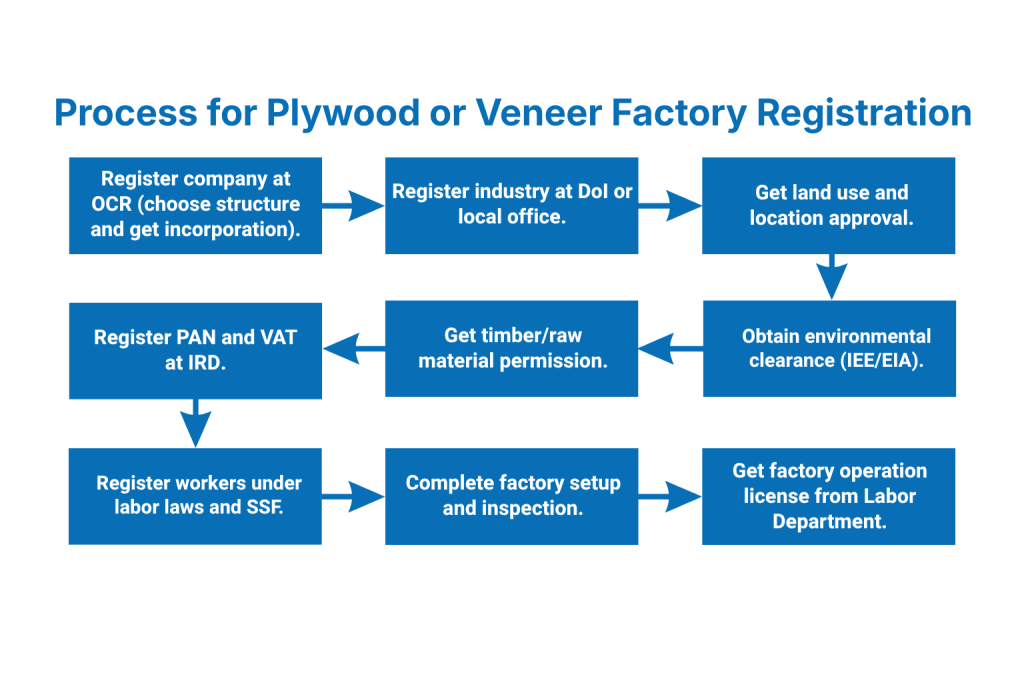
The registration process involves multiple stages across different government offices. Below is the complete step-by-step process:
Step 1: Decide the Business Structure
- Choose between Sole Proprietorship, Partnership, or Private/Public Limited Company
- Private Limited Company is the most preferred structure for medium and large plywood factories
- Register the company at the Office of the Company Registrar (OCR) – www.ocr.gov.np
Step 2: Company Registration at OCR
- Submit the Memorandum of Association (MoA) and Articles of Association (AoA)
- Pay the registration fee based on authorized capital
- Obtain the Certificate of Incorporation
Step 3: Industry Registration at Department of Industry (DoI)
- Visit the Department of Industry – www.doind.gov.np
- Fill out the industry registration form
- Submit required documents
- Obtain the Industry Registration Certificate
- For small industries, registration is done at the District Administration Office (DAO) or District Industry Office
Step 4: Obtain Land Use Approval and Factory Location Clearance
- The factory land must be zoned for industrial use
- Obtain land use approval from the concerned Municipality or Rural Municipality
- A minimum land area is required based on the scale of production
Step 5: Environmental Clearance
- Plywood and veneer factories require Initial Environmental Examination (IEE) or full Environmental Impact Assessment (EIA) depending on size
- Submit the IEE/EIA report to the Ministry of Forests and Environment or concerned authority
- Obtain Environmental Clearance Certificate before starting construction
Step 6: Obtain Forest-Based Raw Material License
- Since plywood and veneer production uses timber as raw material, factories must obtain raw material sourcing approval
- Apply to the Department of Forests and Soil Conservation – www.dofsc.gov.np
- Timber procurement must comply with the Forest Act, 2076
Step 7: VAT and PAN Registration
- Register for Permanent Account Number (PAN) at the Inland Revenue Department (IRD) – www.ird.gov.np
- Register for VAT if annual turnover exceeds Rs. 50 Lakhs (mandatory for manufacturing units)
Step 8: Labor and Social Security Registration
- Register employees under the Social Security Fund (SSF) – www.ssf.gov.np
- Comply with the Labor Act, 2074 regarding employment contracts, minimum wages, and worker safety
Step 9: Obtain Factory Operating License
- After completing construction and installation of machinery, apply for the Factory Operating License from the Department of Labor
- The factory premises must pass the inspection by the Department of Labor
Documents Required for Plywood or Veneer Factory Registration in Nepal
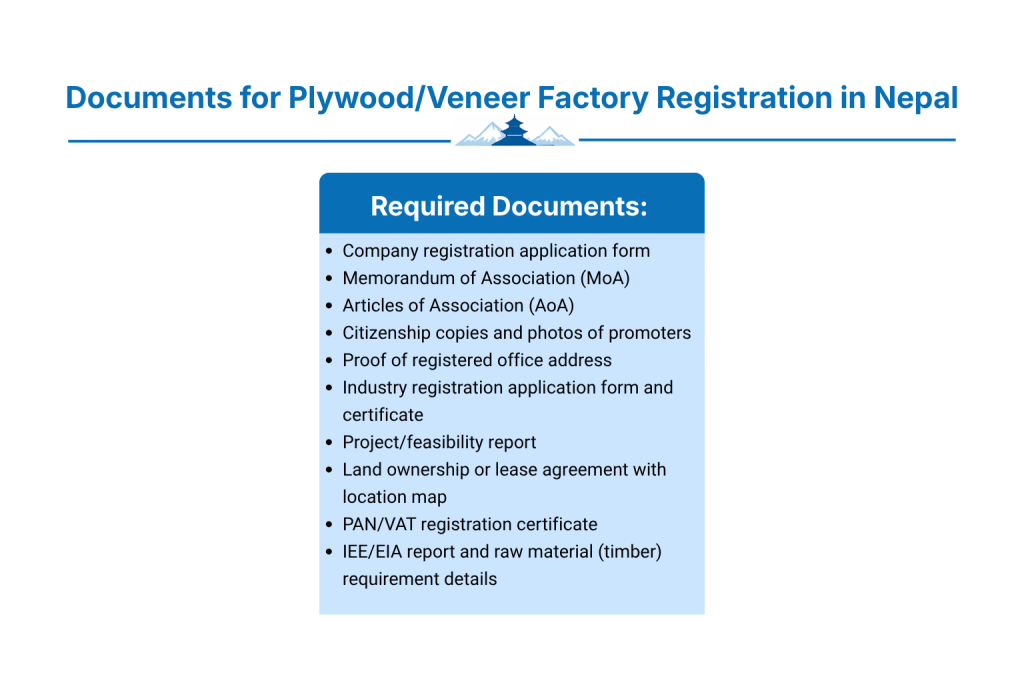
The following documents are required for registering a plywood or veneer factory in Nepal:
For Company Registration (OCR):
- Application form
- Memorandum of Association (MoA) and Articles of Association (AoA)
- Citizenship certificate of promoters
- Passport-sized photographs
- Proof of registered office address
For Industry Registration (DoI):
- Completed industry registration application form
- Company registration certificate (for companies)
- Citizenship copy of owner/promoters
- Project report / Feasibility study
- Land ownership certificate or lease agreement for factory land
- Location map of the factory site
- PAN/VAT registration certificate
For Environmental Clearance:
- IEE or EIA report prepared by certified consultant
- Land ownership documents
- Industry registration certificate
For Raw Material License:
- Industry registration certificate
- Project report showing timber requirement
- Location details of factory
Investment and Fee Structure for Plywood Factory Registration
The registration fees vary depending on the scale and category of the industry.
| Registration Type | Applicable Fee (Approximate) |
|---|---|
| Company Registration (OCR) | Based on authorized capital (Rs. 1,000 to Rs. 75,000+) |
| Small Industry Registration (DoI) | Rs. 500 to Rs. 2,000 |
| Medium Industry Registration | Rs. 5,000 to Rs. 10,000 |
| Large Industry Registration | Rs. 10,000 to Rs. 25,000+ |
| PAN Registration (IRD) | Free |
| VAT Registration | Free |
| Environmental Clearance Fee | Varies per project size |
Note: Fees are subject to change as per government notifications. Always verify the latest fee structure from the concerned department.
Environmental and Forest Compliance for Plywood and Veneer Factories
The plywood and veneer industry depends heavily on timber, which makes environmental and forest compliance a mandatory part of operations in Nepal.
Under the Forest Act, 2076 (2019), factories must source timber only from legal and permitted sources. The Department of Forests and Soil Conservation oversees timber procurement permits.
Under the Environment Protection Act, 2076, factories must:
- Conduct an Initial Environmental Examination (IEE) for medium-scale units
- Conduct a full Environmental Impact Assessment (EIA) for large-scale units
- Submit periodic environmental compliance reports
- Install pollution control systems to manage sawdust, wood waste, and chemical emissions from adhesives
Factories that fail to comply with environmental laws face penalties under Section 56 of the Environment Protection Act, 2076, including fines and suspension of operations.
Tax Incentives for Plywood and Veneer Industry in Nepal
The government of Nepal provides various tax incentives to manufacturing industries under the Industrial Enterprises Act, 2076 and the Income Tax Act, 2058:
- Income Tax Exemption: Industries established in underdeveloped and remote areas receive income tax exemptions for specific periods
- Import Duty Concession: Machinery and equipment imported for production purposes may receive customs duty concessions
- Value Added Tax (VAT) Exemption: Certain raw materials used in production may qualify for VAT exemption
- Special Economic Zone (SEZ) Benefits: Factories established in designated SEZ areas enjoy additional tax and customs benefits under the Special Economic Zone Act, 2073
Role of Government Offices in Plywood Factory Registration
Multiple government offices play a role in the registration and regulation of plywood and veneer factories:
- Department of Industry (DoI): Primary registration authority for medium and large industries
- Office of the Company Registrar (OCR): Company incorporation
- Inland Revenue Department (IRD): PAN and VAT registration
- Department of Forests and Soil Conservation: Timber procurement license
- Ministry of Forests and Environment: Environmental clearance
- Department of Labor: Factory operating license and labor compliance
- Social Security Fund (SSF): Employee social security enrollment
- Municipality/Rural Municipality: Land use and building permit
Challenges in Registering a Plywood or Veneer Factory in Nepal
Entrepreneurs face several practical challenges in the registration process:
- Obtaining environmental clearance takes considerable time and involves detailed documentation
- Forest-based raw material sourcing faces strict regulatory scrutiny under the Forest Act, 2076
- Land acquisition for industrial use in suitable areas can be difficult
- Coordination across multiple government offices requires systematic planning
- Compliance with Labor Act, 2074 requires structured human resource policies
Frequently Asked Questions (FAQs)
1. Which authority registers a plywood or veneer factory in Nepal?
The Department of Industry (DoI) registers medium and large plywood or veneer factories. Small industries register at the District Industry Office. Company incorporation happens at the Office of the Company Registrar (OCR).
2. Is environmental clearance mandatory for a plywood factory in Nepal?
Yes. Under the Environment Protection Act, 2076, a plywood or veneer factory must obtain either an IEE or EIA clearance before starting operations. The type depends on the scale of the factory.
3. Can foreign investors register a plywood factory in Nepal?
Yes. Foreign investors can register a plywood or veneer factory under the Foreign Investment and Technology Transfer Act, 2075. Approval comes from the Department of Industry or Investment Board Nepal based on investment amount.
4. What is the minimum capital required to register a plywood factory in Nepal?
There is no fixed minimum capital prescribed exclusively for plywood factories. However, the factory falls under small, medium, or large industry classification based on fixed capital as per the Industrial Enterprises Act, 2076.
5. Does the plywood factory need a timber or forest product license in Nepal?
Yes. Since plywood production uses timber as raw material, the factory must obtain a timber procurement permit from the Department of Forests and Soil Conservation under the Forest Act, 2076.
6. How long does the plywood factory registration process take in Nepal?
The timeline varies. Company registration takes 3–7 days. Industry registration takes 7–15 days. Environmental clearance may take 3–6 months depending on project size and review time by the concerned authority.