


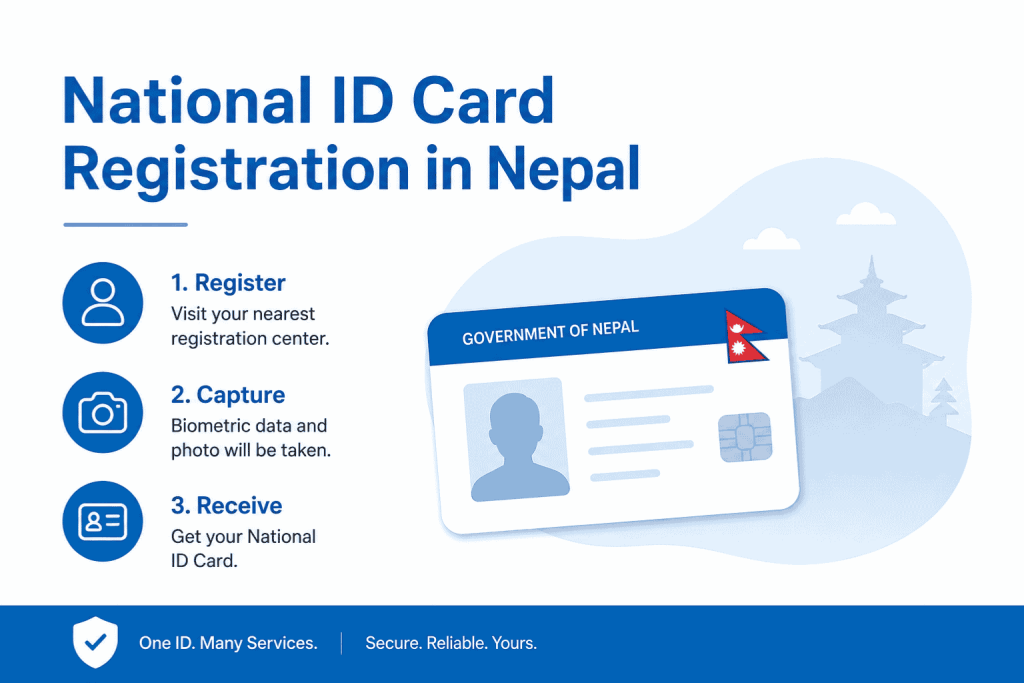
National ID Card Registration in Nepal Nepal launched its National ID Card system, locally known as Rastriya Parichaya Patra, as a centralized biometric identification system for all Nepali citizens. The National ID Card serves as a single, unified proof of identity that integrates personal, demographic, and biometric data of every eligible Nepali citizen. The Department of National ID and Civil Registration (DONIDCR) under the Ministry of Home Affairs administers the entire National ID Card registration process in Nepal.
This article explains everything you need to know about National ID Card registration in Nepal, including eligibility, required documents, step-by-step process, legal framework, fees, and frequently asked questions.
What Is the National ID Card in Nepal?
The National ID Card (Rastriya Parichaya Patra) is a smart card issued by the Government of Nepal to every Nepali citizen who has reached the age of 16 years or above. It contains a unique identification number called the National Identity Number (NIN), which links to the individual’s civil registration records.
The National ID Card contains both visual and digital information, including:
- Full name of the cardholder
- Date of birth
- Gender
- Permanent and temporary address
- Photograph
- Fingerprint data (biometric)
- Iris scan data (biometric)
- Digital signature
- National Identity Number (NIN)
The card functions as a multi-purpose identity document that can be used for accessing government services, banking services, voting, and other official purposes across Nepal.
Legal Framework Governing National ID Card in Nepal

The National Identity Card and Vital Registration Act, 2076 (2019) is the primary law governing the issuance and management of National ID Cards in Nepal. The National Identity Card and Vital Registration Regulations, 2077 (2020) further detail the implementation procedures.
Key legal provisions include:
- Section 4 of the Act mandates that every Nepali citizen aged 16 years and above must obtain a National ID Card.
- The Act establishes the Department of National ID and Civil Registration (DONIDCR) as the apex body for registration and card issuance.
- The Act also governs birth registration, death registration, marriage registration, and other vital events linked to the National ID system.
- The law provides for penalties in case of submission of false information during registration.
The Government of Nepal has made it clear that the National ID Card will eventually replace multiple identity documents and serve as the single source of truth for citizen identification.
Who Is Eligible for National ID Card Registration in Nepal?
The following individuals are eligible to apply for a National ID Card in Nepal:
- Nepali citizens who are 16 years of age or above
- Citizens holding a citizenship certificate (Nagarikta) issued by the Government of Nepal
- Non-Resident Nepalis (NRNs) who hold Nepali citizenship may also register under specific provisions
- Citizens who have recently obtained citizenship upon reaching adulthood
Citizens below 16 years of age are not eligible for the National ID Card. However, their birth registration records are maintained in the national database.
Documents Required for National ID Card Registration in Nepal
Applicants must submit specific documents during the National ID Card registration process. The required documents vary slightly based on individual circumstances.
For General Citizens:
- Citizenship Certificate (Nagarikta Patra) – Original and photocopy
- Birth Registration Certificate – If available
- House Number Certificate or Residence Proof
- Passport-size photograph (in some cases)
- Marriage Certificate – For married individuals (if applicable)
- Migration Certificate (Basai Sarai) – If the applicant has migrated from another district
For Elderly or Differently-Abled Citizens:
- A representative or caretaker may assist during the biometric data collection process
- Additional supporting documents may be required depending on the individual’s condition
Step-by-Step Process for National ID Card Registration in Nepal

The National ID Card registration process in Nepal involves both online pre-registration and offline biometric enrollment at designated registration centers.
Step 1: Online Pre-Registration
- Visit the official portal of the Department of National ID and Civil Registration at https://donidcr.gov.np
- Click on “Online Registration” or “Rastriya Parichaya Patra Darta”
- Fill in your personal details including name, date of birth, address, and citizenship number
- Upload required documents as specified on the portal
- Submit the online form and note the Application Reference Number
Step 2: Visit the Registration Center
- After online pre-registration, visit the nearest National ID Card registration center or the designated District Administration Office (DAO)
- Carry all original documents along with copies
- Present your Application Reference Number to the registration officer
Step 3: Biometric Data Collection
- Fingerprints of all ten fingers are scanned
- Iris scan of both eyes is captured
- Digital photograph is taken at the center
- Digital signature is collected
Step 4: Verification and Approval
- The registration officer verifies all submitted documents against the application
- The information is matched with the citizenship database maintained by the Department of Immigration and local government
- Corrections are made if any discrepancy is found
Step 5: Card Issuance
- After successful verification, the National ID Card is printed and issued
- Applicants may receive the card at the registration center or through designated distribution points
- The card contains the unique National Identity Number (NIN) assigned to the applicant
Where to Register for National ID Card in Nepal?
The Government of Nepal has established registration centers at multiple locations to make the National ID Card registration process accessible to all citizens.
Registration Center TypeLocationAuthorityDistrict Registration CentersAll 77 DistrictsDistrict Administration Office (DAO)Metropolitan/Sub-Metropolitan OfficesMajor CitiesLocal Government OfficesRural Municipality OfficesRural AreasGaunpalika OfficesMobile Registration CampsRemote AreasDONIDCR Field TeamsCentral OfficeKathmanduDONIDCR Headquarters
Citizens from remote areas are served through mobile registration camps organized by DONIDCR periodically. These camps reach areas where citizens cannot easily travel to district headquarters.
Fee Structure for National ID Card in Nepal
The Government of Nepal has set specific fees for National ID Card registration and issuance.
Service TypeFee (NPR)RemarksFirst-time Registration and Card IssuanceFree / SubsidizedGovernment-subsidized for initial issuanceReplacement (Lost Card)As per DONIDCR notificationFee applicableReplacement (Damaged Card)As per DONIDCR notificationFee applicableInformation Update/CorrectionNominal FeeDepends on type of correctionDuplicate Card IssuanceAs prescribedSubject to revision
Citizens are advised to check the latest fee structure at the official DONIDCR website at https://donidcr.gov.np as fees are subject to change through government notifications.
What Information Is Stored on the National ID Card?
The Rastriya Parichaya Patra stores both physical (printed) information and digital (chip-stored) information.
Printed on Card:
- Full name (in Nepali and English)
- National Identity Number (NIN)
- Date of Birth
- Gender
- Permanent Address
- Photograph
- Card Issue and Expiry Date
Stored in Digital Chip:
- Biometric fingerprint data
- Iris scan data
- Digital signature
- Civil registration linkage data
- Complete demographic profile
The digital chip in the card enables electronic verification of the cardholder’s identity at authorized service points, banks, government offices, and other institutions.
Uses of National ID Card in Nepal
The National ID Card (Rastriya Parichaya Patra) is accepted across a wide range of official and private sector services in Nepal.
- Government Services – Obtaining passports, driving licenses, and other official documents
- Banking and Financial Services – Opening bank accounts, KYC compliance
- Voting – Used as an identity proof during elections
- Social Security – Accessing social security allowances and government benefits
- Healthcare – Identification in public hospitals and health insurance programs
- Land Registration – Property transactions and land ownership records
- Educational Institutions – Admission and certification processes
- Employment – Identity verification during recruitment in public and private sector
Updating or Correcting Information on National ID Card
Citizens can apply for correction or update of information on their National ID Card under the following circumstances:
- Name correction – Due to spelling errors or legal name change
- Address update – Change of permanent or temporary residence
- Date of birth correction – Supported by legal documentation
- Marital status update – After marriage or divorce
- Photograph update – In case of significant physical changes
The application for correction must be submitted at the nearest registration center along with supporting documents that justify the requested change. The National Identity Card and Vital Registration Act, 2076 outlines the provisions for such corrections.
Challenges in National ID Card Registration in Nepal

Several challenges affect the National ID Card registration process in Nepal, particularly in remote and rural areas.
- Limited infrastructure in remote hill and mountain districts
- Connectivity issues that slow down the online pre-registration process
- Lack of awareness among senior citizens and marginalized communities
- Documentation gaps where some citizens lack proper citizenship certificates
- Long waiting periods at district registration centers in densely populated areas
The Government of Nepal, through DONIDCR, continues to address these challenges by organizing mobile registration camps and awareness campaigns.
Frequently Asked Questions (FAQs) About National ID Card Registration in Nepal
1. What is the minimum age to apply for a National ID Card in Nepal?
The minimum age to apply for a National ID Card in Nepal is 16 years. Any Nepali citizen who is 16 years old or above and holds a citizenship certificate is eligible to register.
2. Can I apply for a National ID Card online in Nepal?
Yes, citizens can complete online pre-registration through the official DONIDCR portal at https://donidcr.gov.np. However, biometric enrollment must be completed in person at a designated registration center.
3. Is the National ID Card mandatory in Nepal?
Yes. Under the National Identity Card and Vital Registration Act, 2076 (2019), every eligible Nepali citizen aged 16 and above is required to obtain a National ID Card. The card is gradually becoming mandatory for accessing most government services.
4. What should I do if my National ID Card is lost?
If your National ID Card is lost, you must report it to the nearest registration center or DONIDCR office and apply for a duplicate card. A fee is applicable for duplicate card issuance, and you must submit relevant documents.
5. How long does it take to receive the National ID Card after registration?
The processing time varies by location. At major district registration centers, the card may be issued within a few days to a few weeks after successful biometric enrollment and document verification.
6. Can a Non-Resident Nepali (NRN) apply for a National ID Card?
Non-Resident Nepalis who hold Nepali citizenship may be eligible to register for the National ID Card. They must possess a valid Nepali citizenship certificate and follow the standard registration process at the relevant DONIDCR office.
Conclusion
The National ID Card (Rastriya Parichaya Patra) registration system in Nepal represents a major step toward a digitally unified civil identification framework. Governed by the National Identity Card and Vital Registration Act, 2076, the system aims to provide every eligible Nepali citizen with a secure, biometric-linked identity document. Citizens are encouraged to complete their National ID Card registration promptly by visiting the DONIDCR official website or the nearest district registration center. Keeping personal information updated in the national database ensures smooth access to government and private sector services across Nepal.