

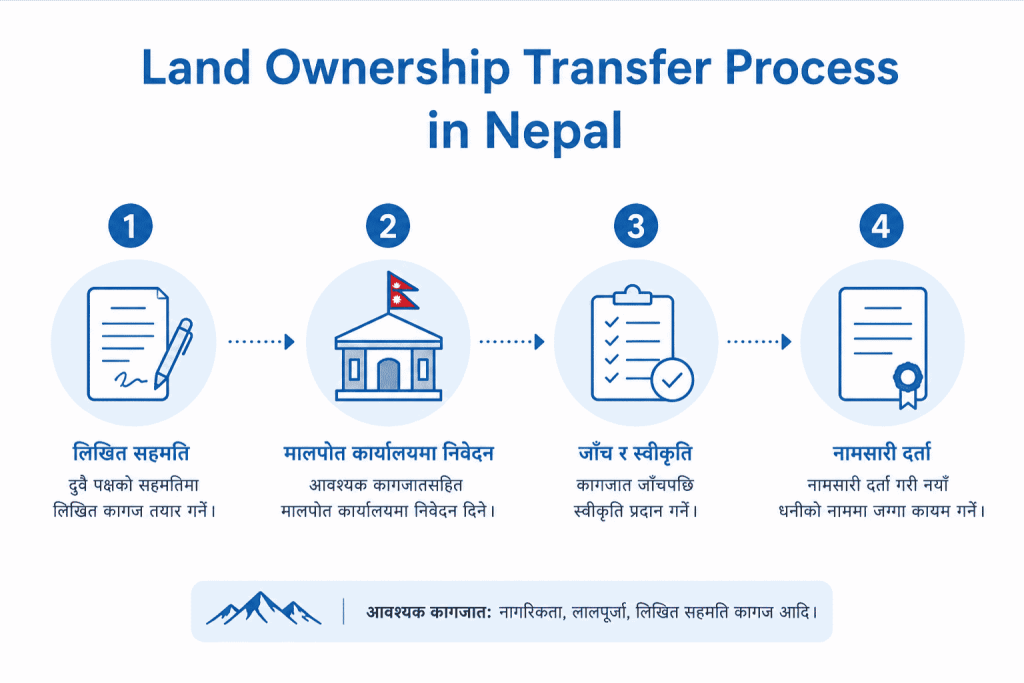
Land ownership transfer in Nepal is a formal legal act. It is not completed by a private agreement or by payment alone. Ownership passes only when a written deed is registered at the concerned Land Revenue Office (Malpot Office) and the land ownership certificate, known as the Lalpurja, is issued in the name of the new owner. This article explains the governing statutes, the eligibility of foreign nationals and foreign-invested companies, the documents required, the step-by-step registration procedure, and the applicable taxes and fees.
What Is Land Ownership Transfer Under Nepali Law?
Land ownership transfer means the legal passing of title over a parcel of land from one person or legal entity to another, recorded in the official land records maintained by the State.
Which laws govern land transfer in Nepal?
The principal legal sources are:
- The Constitution of Nepal, Article 25, which guarantees the right to property to citizens of Nepal, subject to law.
- The Land Act, 2021 (1964), which prescribes land ceilings, tenancy rules and restrictions on holding land beyond the prescribed limit.
- The Land Revenue Act, 2034 (1977) and the Land Revenue Rules, 2036, which govern deed registration, land revenue, mutation (Dakhil Kharej) and issuance of the Lalpurja.
- The Muluki Civil Code, 2074 (2017), which regulates sale, gift (Dan Bakas), exchange, partition (Ansabanda) and inheritance of immovable property, and requires registration of deeds relating to immovable property.
- The Land (Survey and Measurement) Act, 2019 (1963), which governs cadastral maps, plot numbers (Kitta Number) and Survey Office (Napi) records.
- The Income Tax Act, 2058 (2002), particularly Sections 95A and related provisions on advance tax and capital gains on disposal of land and buildings.
- The Foreign Investment and Technology Transfer Act, 2075 (FITTA 2019) and the Industrial Enterprises Act, 2076, for land use by foreign-invested industries.
- Nepal Rastra Bank rules, including the Foreign Investment and Foreign Loan Management Bylaws, for inward remittance and repatriation.
Authentic Nepali texts of these laws are published by the Nepal Law Commission at lawcommission.gov.np.
What are the recognised modes of transfer?
Transfer by sale and purchase
The most common mode is a sale deed (Rajinama), executed by the seller and purchaser before the Land Revenue Office. Consideration, plot number, area, four boundaries (Char Killa) and land classification must be clearly stated.
Transfer by gift, partition, inheritance and exchange
Other lawful modes include gift deeds within or outside the family, partition deeds among coparceners, transmission on death (Namsari) supported by a death certificate and relationship certificate, exchange deeds, and transfer following a court judgment or auction. Each mode has a separate deed format and a separate fee treatment under the Land Revenue Act and the annual Finance Act.
Who Is Legally Permitted to Acquire Land in Nepal?
Eligibility is the first legal question in any land transaction, especially where foreign parties are involved.
Can foreign nationals own land in Nepal?
As a general rule, a foreign natural person cannot purchase or own land in Nepal in a personal capacity. The right to property under Article 25 of the Constitution is conferred on citizens, and the Land Act, 2021 restricts acquisition of land by foreigners. Foreign nationals may, however, lawfully obtain rights of use through long-term lease arrangements, or hold land indirectly through a company incorporated in Nepal in which they have invested with approval.
How may a company with foreign investment hold land?
A company registered in Nepal under the Companies Act, 2063 is a separate legal person of Nepal, even if its shareholders are foreign. Such a company may acquire land in its own name for its approved business or industrial purpose, subject to the following:
- Prior foreign investment approval under FITTA 2019 from the Department of Industry, or from the Investment Board Nepal for projects above the threshold prescribed by law. Approval procedures and forms are available at doind.gov.np.
- Company registration at the Office of the Company Registrar, PAN or VAT registration at the Inland Revenue Department, and industry or business registration where applicable.
- Compliance with land ceiling limits under Section 7 of the Land Act, 2021. Where an industry requires land in excess of the ceiling, an exemption may be granted by the Government of Nepal under the Land Act on the recommendation of the concerned ministry or department, in line with the facilities provided to industries under the Industrial Enterprises Act, 2076.
- Recording of the inward investment amount with Nepal Rastra Bank, which is essential for later repatriation of dividends or sale proceeds.
What rights do Non-Resident Nepalis hold?
Under the Non-Resident Nepali Act, 2064 and the rules framed thereunder, a Non-Resident Nepali holding a valid NRN identity card may acquire immovable property in Nepal for residential and business purposes, within the ceilings and conditions prescribed by law. The NRN identity card is issued through the Department of Consular Services or the concerned Nepali diplomatic mission.
What is the land ceiling and why does it matter?
The Land Act, 2021 fixes maximum holdings of agricultural and residential land, and these ceilings differ for the Terai, the Kathmandu Valley and the hill districts. A transfer that would push the transferee above the applicable ceiling may be refused at registration. Buyers should therefore verify their existing holdings before executing any deed.
What Documents and Prior Clearances Are Required?
Registration is document-driven. An incomplete file is the most frequent cause of rejection at the Malpot Office.
Which documents must individuals submit?
| Document | Purpose |
|---|---|
| Original Lalpurja (land ownership certificate) | Proof of the seller’s title |
| Land revenue payment receipt (Tiro Rasid) of the current fiscal year | Proof that land revenue is cleared |
| Trace map or blueprint issued by the Survey Office (Napi) | Confirms plot number, area and boundaries |
| Four-boundary certificate (Char Killa) from the local level | Confirms adjoining plots |
| Citizenship certificates of both parties | Identity and eligibility |
| Recent passport-size photographs | Deed and biometric records |
| PAN certificate, where required | Tax identification |
| Property tax clearance from the local level | Municipal compliance |
| Consent of the coparceners, where applicable | Validity of family property transfer |
What additional documents must a company submit?
- Certificate of incorporation issued under the Companies Act, 2063.
- Memorandum and Articles of Association showing capacity to acquire immovable property.
- Board resolution or shareholders’ decision approving the purchase and authorising a signatory.
- PAN or VAT certificate and the latest tax clearance certificate from the Inland Revenue Department.
- Citizenship or passport copy of the authorised representative, with a power of attorney.
What extra approvals apply to foreign-invested companies?
Foreign-invested companies should additionally keep on file the foreign investment approval letter, the industry or business registration certificate, evidence of inward remittance through the banking channel, and, where the land exceeds the statutory ceiling, the written land ceiling exemption of the Government of Nepal.
What Is the Step-by-Step Land Ownership Transfer Process in Nepal?
The following sequence reflects the practice of Land Revenue Offices under the Land Revenue Act, 2034 and the Nepal Land Information Management System.
Step 1: Verify title and encumbrances
Obtain a certified copy of the land record (Jagga Dhani Darta Srestha) from the Land Revenue Office and confirm ownership, plot number, area, land use classification, tenancy entries, mortgages, government freezes (Rokka) and pending litigation. Title verification protects the buyer from void transactions.
Step 2: Confirm eligibility and land use
Confirm that the purchaser is legally competent to hold the land, that the ceiling is not exceeded, and that the land use is consistent with the intended purpose under the Land Use Act, 2076 classification adopted by the local level.
Step 3: Obtain the survey and municipal certificates
Apply to the Survey Office for a trace map and, where necessary, field verification. Obtain the four-boundary certificate and the property tax clearance from the ward office or municipality.
Step 4: Clear land revenue and taxes
Pay outstanding land revenue and obtain the receipt for the current fiscal year. Companies must also produce a valid tax clearance certificate.
Step 5: Prepare and submit the deed application
Prepare the deed in the prescribed format stating parties, consideration, plot details and conditions. Applications may be initiated online through the digital system maintained by the Department of Land Management and Archive at dolma.gov.np and then presented physically at the concerned office.
Step 6: Official valuation and assessment
The Land Revenue Office assesses the transaction against the minimum government valuation of the area. Fees and taxes are computed on the higher of the declared consideration and the official valuation.
Step 7: Payment of registration fee and advance tax
Deposit the registration fee and the applicable advance tax through the prescribed bank or electronic payment channel and submit the vouchers to the office.
Step 8: Appearance, verification and execution
Both parties, or their lawfully appointed attorneys, appear before the registration officer. Photographs, signatures and biometric details are recorded, the deed is read out, and it is executed and registered.
Step 9: Mutation and issuance of the new Lalpurja
After registration, the office carries out mutation (Dakhil Kharej), updates the ownership register and issues a fresh Lalpurja in the name of the transferee. The seller’s certificate is cancelled or amended accordingly.
Step 10: Update local and internal records
The new owner should register the property with the local level for integrated property tax, update the Survey Office records where the plot has been divided, and record the asset in the company’s books and fixed asset register.
What Taxes, Fees and Post-Transfer Obligations Apply?
What capital gains tax applies on the sale of land?
Under the Income Tax Act, 2058, gains on disposal of land and buildings are taxable. The Land Revenue Office collects advance tax at the time of registration. In current practice, a natural person disposing of land or a building held for five years or more is subject to a lower rate than one who has held it for less than five years, while entities are subject to advance collection on the disposal value with the final liability computed at the applicable corporate rate. Rates are revised by the annual Finance Act, and taxpayers should confirm the prevailing rates with the Inland Revenue Department at ird.gov.np.
What registration fee is payable?
| Item | Basis |
|---|---|
| Registration fee (Rajistresan Dastur) | Percentage of the higher of consideration or official valuation, as fixed by the Finance Act |
| Rate variation | Generally higher in metropolitan, sub-metropolitan and municipal areas than in rural municipalities |
| Concessions | Available for certain family transfers and for registration in the name of women, as prescribed |
| Local service charges | Levied by the concerned local level |
| Capital gains advance tax | Deducted at source by the Land Revenue Office |
What are the obligations of foreign investors after purchase?
- Ensure the purchase price is paid from funds remitted through the banking channel and recorded with Nepal Rastra Bank.
- Obtain repatriation approval from the Department of Industry and Nepal Rastra Bank before remitting sale proceeds abroad in the future.
- Maintain audited accounts and file annual returns with the Office of the Company Registrar and the Inland Revenue Department.
- Use the land strictly for the approved purpose stated in the investment approval.
How does CompanyNP assist?
CompanyNP supports foreign investors, Non-Resident Nepalis and Nepali companies with title verification, land ceiling assessment, deed drafting, coordination with the Malpot Office and Survey Office, foreign investment approval, Nepal Rastra Bank recording and post-registration compliance.
Frequently Asked Questions
Can a tourist visa holder buy land in Nepal?
No. A foreign natural person cannot acquire land ownership in Nepal regardless of visa status. Lawful alternatives include long-term lease arrangements or investment through a Nepal-registered company holding valid foreign investment approval from the Department of Industry.
How long does the registration usually take?
Where documents are complete and no dispute exists, deed registration and issuance of the new Lalpurja are frequently completed within one working day at the Land Revenue Office. Survey verification or ceiling exemption requirements may extend the timeline considerably.
Is a power of attorney acceptable for land transfer?
Yes. A duly registered power of attorney executed in the prescribed format, or notarised and authenticated by a Nepali diplomatic mission if executed abroad, allows an attorney to appear and sign the deed on behalf of the principal party.
What happens if the land is subject to a Rokka order?
Registration will be refused. A Rokka is a statutory freeze imposed by a court, bank or government authority. The transfer may proceed only after the issuing authority formally releases the freeze and the release is recorded in the land registry.
Does an unregistered sale agreement transfer ownership?
No. Under the Muluki Civil Code, 2074, ownership of immovable property passes only upon registration. An unregistered agreement creates contractual rights between the parties but does not confer title enforceable against third parties.
Can a company sell land it purchased with foreign investment?
Yes, subject to compliance. The company may sell after satisfying its tax obligations, and repatriation of the proceeds abroad requires approval from the Department of Industry and Nepal Rastra Bank based on recorded inward investment.