


Dairy and Milk Industry Registration in Nepal Nepal’s dairy sector plays a significant role in the country’s agricultural economy. Thousands of farmers, cooperatives, and private enterprises participate in milk collection, processing, and distribution across the country. If you plan to start a dairy or milk processing business in Nepal, you must complete several legal registrations and obtain multiple licenses before operations begin.
This article explains the entire dairy and milk industry registration process in Nepal, the applicable laws, the required documents, and the regulatory bodies involved.
What Is the Dairy and Milk Industry in Nepal?
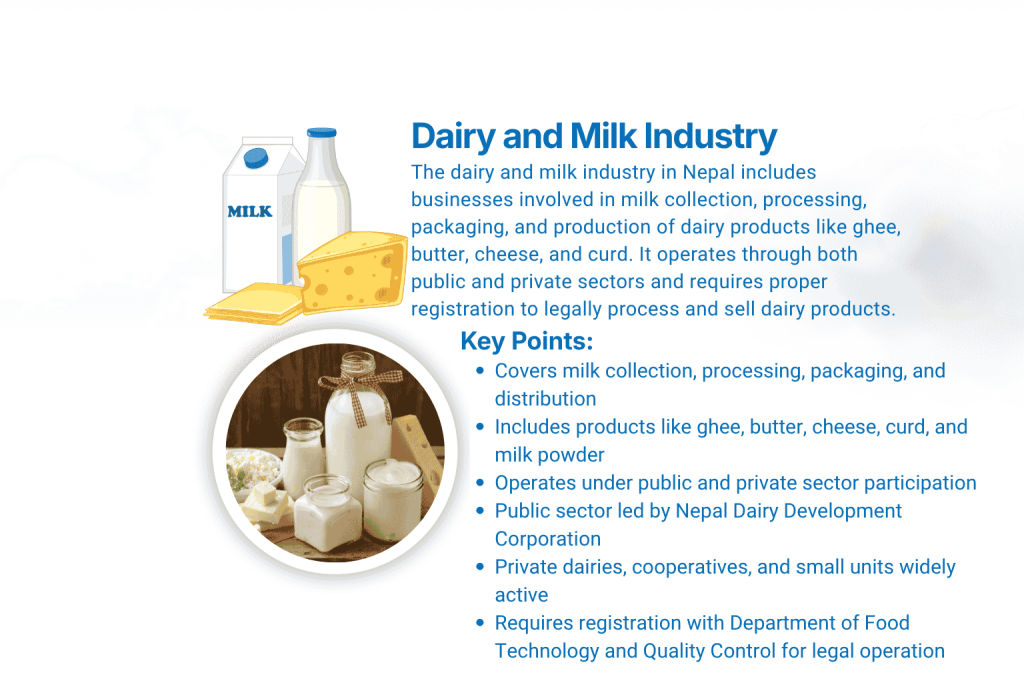
The dairy and milk industry in Nepal covers a wide range of business activities. These include raw milk collection, pasteurization, packaging, manufacturing of dairy products such as ghee, butter, cheese, curd, and powdered milk, and their distribution and retail sale.
Nepal’s dairy sector operates under both public and private participation. The Nepal Dairy Development Corporation (DDC) handles the public sector. Private dairies, cooperatives, and small-scale milk processing units also operate across the Terai, hills, and mountain regions.
According to the Department of Food Technology and Quality Control (DFTQC), any entity that processes, packages, stores, or sells milk and dairy products must obtain a valid food registration and industry registration in Nepal.
What Laws Govern Dairy and Milk Industry Registration in Nepal?
Several laws and regulations apply to dairy and milk industry registration in Nepal.
| Law / Regulation | Relevance |
|---|---|
| Industrial Enterprises Act, 2076 (2020) | Mandatory for industry registration at Department of Industry or District/Province offices |
| Food Act, 2023 BS (1966 AD) | Governs food safety, standards, and licensing for dairy products |
| Food Regulation, 2027 BS | Details licensing, labeling, and quality control requirements |
| Company Act, 2063 (2006) | Required if registering as a private or public limited company |
| Cooperative Act, 2074 (2017) | Required if registering as a dairy cooperative |
| Nepal Standards (Certification Marks) Act, 2037 | Governs Nepal Bureau of Standards and Metrology (NBSM) certification |
| VAT Act, 2052 (1995) | Applies to taxable dairy enterprises |
The DFTQC operates under the Ministry of Agriculture and Livestock Development and is the primary regulatory body for food quality and safety standards in Nepal. You can visit their official site at www.dftqc.gov.np.
Who Are the Regulatory Bodies for Dairy Registration in Nepal?
Multiple government agencies are involved in dairy and milk industry registration.
- Office of the Company Registrar (OCR) – For business entity registration (www.ocr.gov.np)
- Department of Industry (DOI) – For large-scale industry registration (www.doi.gov.np)
- Department of Cottage and Small Industries (DCSI) – For cottage and small-scale dairy units
- Department of Food Technology and Quality Control (DFTQC) – For food registration and quality certification
- Nepal Bureau of Standards and Metrology (NBSM) – For NS (Nepal Standard) certification
- Office of Inland Revenue Department – For PAN/VAT registration
- Local Government / Municipality – For business operating license (Business Registration Certificate)
- Department of Livestock Services – For livestock-related regulations
What Are the Types of Dairy Businesses That Require Registration in Nepal?
Any of the following dairy business types must be registered under applicable law:
- Raw milk collection centers
- Milk chilling centers
- Pasteurization and packaging plants
- Dairy product manufacturing units (ghee, butter, cheese, curd, ice cream, khoa)
- Dairy cooperatives
- Milk distribution and retail businesses
- Milk powder manufacturing plants
Regardless of size, each unit must comply with the Food Act, 2023 BS and hold a valid food enterprise registration from DFTQC.
What Is the Step-by-Step Process for Dairy Industry Registration in Nepal?

Step 1: Choose a Business Structure
First, decide on the legal structure of your dairy business. Options include:
- Sole Proprietorship – Registered at the local municipality or district administration office
- Partnership Firm – Registered under the Partnership Act, 2020 BS
- Private Limited Company – Registered at the Office of Company Registrar under the Company Act, 2063
- Cooperative – Registered at the Department of Cooperatives under the Cooperative Act, 2074
- Public Limited Company – Registered at OCR for large-scale dairy companies
Step 2: Register the Business Entity
- For a Private Limited Company, submit documents to OCR online via www.ocr.gov.np
- For a Sole Proprietorship, visit the local Ward Office or Municipality
- For a Cooperative, register at the District Cooperative Office
Step 3: Obtain Industry Registration
Under the Industrial Enterprises Act, 2076, dairy processing units must obtain industry registration.
- Cottage Industry – Registered at the District Cottage and Small Industries Office
- Small Industry – Registered at the Provincial Ministry of Industry or DCSI
- Medium Industry – Registered at the Department of Industry
- Large Industry – Registered at the Department of Industry with separate investment threshold
Step 4: Obtain PAN and VAT Registration
- Apply at the Inland Revenue Department (IRD) for a Permanent Account Number (PAN)
- If annual turnover exceeds NPR 50 lakhs, VAT registration is required under the VAT Act, 2052
Step 5: Obtain Food Enterprise Registration from DFTQC
This is a mandatory step for all milk and dairy businesses. The DFTQC issues a Food Registration Certificate under the Food Act, 2023 BS.
- Submit the application form at the DFTQC District or Central Office
- The DFTQC inspects the premises, equipment, hygiene standards, and water quality
- Upon passing inspection, they issue a Food Enterprise Registration Certificate
Step 6: Obtain Nepal Standard (NS) Certification (If Applicable)
If you manufacture packaged dairy products for commercial sale, you may require NS Certification from the Nepal Bureau of Standards and Metrology (NBSM) under the Nepal Standards (Certification Marks) Act, 2037.
Step 7: Obtain a Business Operating License from Local Government
Every dairy enterprise must hold a Business Operating License (Byavasaya Anumati Patra) from the local municipality or metropolitan office under the Local Government Operation Act, 2074.
What Documents Are Required for Dairy and Milk Industry Registration in Nepal?

For Company Registration at OCR:
- Memorandum of Association (MOA)
- Articles of Association (AOA)
- Citizenship certificates of all shareholders/directors
- Passport-size photographs
- Address proof of registered office
- Application fee payment receipt
For Industry Registration at DOI/DCSI:
- Company registration certificate
- Project report of the dairy business
- Location map of the industry site
- Land ownership certificate or lease agreement
- Environmental Impact Assessment (EIA) if applicable
For Food Registration at DFTQC:
- Application form (available at DFTQC office or district food office)
- Copy of company/firm registration certificate
- Copy of industry registration certificate
- List of dairy products to be manufactured
- List of machinery and equipment
- Water quality test report
- Layout plan of the processing unit
- Copy of PAN certificate
- Passport-size photo of the proprietor/director
- Site inspection report
For NS Certification at NBSM:
- Application to NBSM
- Product samples for laboratory testing
- Process flow diagram
- Quality control procedures
- DFTQC registration certificate
What Are the Fees for Dairy Industry Registration in Nepal?
Fees vary depending on the scale of the industry and the type of registration.
| Registration Type | Approximate Fee (NPR) |
|---|---|
| Company Registration at OCR (Pvt. Ltd.) | NPR 9,000 – 35,000 depending on authorized capital |
| Cottage Industry Registration | NPR 500 – 2,000 |
| Small Industry Registration | NPR 2,500 – 10,000 |
| Medium Industry Registration | NPR 10,000 – 30,000 |
| Food Enterprise Registration (DFTQC) | NPR 500 – 5,000 depending on scale |
| NS Certification (NBSM) | Varies by product category |
| Business Operating License (Municipality) | Varies by local government |
Fees are subject to revision by the concerned government authority. Always verify current fees at the official offices before proceeding.
What Are the Food Quality and Safety Standards for Dairy Products in Nepal?
The DFTQC enforces quality standards for all dairy products sold in Nepal. These standards are aligned with Nepal Standards (NS) and Codex Alimentarius guidelines.
Key standards applied to dairy products include:
- NS 147 – Pasteurized milk standard
- NS 149 – Ghee standard
- NS 148 – Standard for butter
- Microbial limits for coliform count, total plate count, and pathogen detection
- Fat content, protein content, and solid-not-fat (SNF) standards for milk
All dairy businesses must maintain internal quality control records, laboratory test logs, and batch production registers as required by the Food Regulation, 2027 BS.
What Are the Environmental and Other Compliance Requirements?
Dairy processing units must comply with:
- Environment Protection Act, 2076 – Units with significant wastewater discharge may require Initial Environmental Examination (IEE) or EIA
- Labor Act, 2074 – For employing workers in dairy plants
- Social Security Act, 2074 – For mandatory social security contributions for staff
- Water Resource Act, 2049 – If using groundwater or natural water sources
Dairy plants must have proper effluent treatment systems because milk processing generates high biological oxygen demand (BOD) wastewater.
What Are the Key Challenges in Dairy Industry Registration in Nepal?
Several practical challenges affect dairy entrepreneurs in Nepal:
- Multiple agency visits – Registration involves visits to OCR, DOI/DCSI, DFTQC, NBSM, IRD, and local government
- Infrastructure requirements – DFTQC requires standard cold storage, pasteurization equipment, and clean water sources
- Renewal requirements – Food registration and industry registration must be renewed annually or periodically
- Remote location delays – In hill and mountain areas, reaching DFTQC district offices takes time
- Changing fee structures – Local governments charge different operating license fees
FAQs
1. Is DFTQC registration mandatory for all dairy businesses in Nepal?
Yes. Under the Food Act, 2023 BS, any business that processes, packages, or sells milk and dairy products must obtain a food enterprise registration from DFTQC. This applies to all sizes of dairy businesses in Nepal.
2. Can a dairy cooperative register under the Cooperative Act, 2074?
Yes. Dairy cooperatives can register under the Cooperative Act, 2074 at the District Cooperative Office. They must also obtain food registration from DFTQC if they process or package dairy products for sale.
3. What is the minimum investment for a small dairy industry in Nepal?
Under the Industrial Enterprises Act, 2076, a small industry has fixed assets investment between NPR 1 crore and NPR 15 crore. Below NPR 1 crore, it qualifies as a cottage industry and registers at the District Cottage and Small Industries Office.
4. Do dairy businesses require NS certification for all products?
NS certification is not mandatory for all products but is required for standardized products sold commercially. Products like pasteurized milk and ghee sold in sealed packaging often require NS certification from NBSM for consumer trust and export purposes.
5. How long does the dairy industry registration process take in Nepal?
The total process can take 30 to 90 days depending on the scale of the business, the speed of DFTQC inspection scheduling, and the completeness of submitted documents. Company registration at OCR typically takes 3 to 7 working days online.
6. Is an Environmental Impact Assessment (EIA) required for a dairy plant in Nepal?
For large dairy processing plants with significant wastewater or solid waste generation, an IEE or EIA may be required under the Environment Protection Act, 2076. Small and cottage-level dairy units are generally exempt from this requirement.
References and Official Links:
- Department of Food Technology and Quality Control: www.dftqc.gov.np
- Office of Company Registrar: www.ocr.gov.np
- Department of Industry: www.doi.gov.np
- Nepal Bureau of Standards and Metrology: www.nbsm.gov.np
- Inland Revenue Department: www.ird.gov.np