



Starting a construction company registration in Nepal requires following a structured legal process. The construction sector in Nepal is regulated under the Construction Business Act, 2055 (1999) and the Company Act, 2063 (2006). Every individual or entity that wants to engage in construction business must complete the construction company registration process as per Nepal’s legal framework.
This article covers everything you need to know about registering a construction company in Nepal, including legal requirements, documents, fees, and classification grades.
What Is Construction Company Registration in Nepal?
Construction company registration in Nepal is the official legal process through which a construction business obtains its legal identity. This process involves registering the company at the Office of the Company Registrar (OCR) and obtaining a Construction Business License from the Department of Urban Development and Building Construction (DUDBC) under the Ministry of Urban Development.
Without completing this registration, no entity can legally carry out construction contracts, bid on government tenders, or operate construction projects in Nepal.
What Are the Types of Construction Companies in Nepal?
In Nepal, construction businesses can be registered under the following legal structures:
- Sole Proprietorship Firm – Registered at the Department of Commerce, Supplies and Consumer Protection (DoCSCP)
- Partnership Firm – Registered under the Partnership Act, 2020 (1964)
- Private Limited Company – Registered under the Company Act, 2063 (2006) at the Office of the Company Registrar
- Public Limited Company – Also registered at OCR but with higher capital and shareholder requirements
- Joint Venture Company – Two or more companies partnering for a specific construction project
Most construction businesses in Nepal prefer the Private Limited Company structure due to its limited liability, ease of management, and eligibility for government tenders.
What Laws Govern Construction Company Registration in Nepal?
Several laws and regulations govern construction company registration and operation in Nepal:
- Construction Business Act, 2055 (1999) – Primary law governing construction business licensing
- Construction Business Regulation, 2056 (1999) – Detailed rules for classification and licensing
- Company Act, 2063 (2006) – Governs incorporation of companies
- Income Tax Act, 2058 (2002) – Governs tax obligations including PAN registration
- Value Added Tax Act, 2052 (1996) – Governs VAT registration
- Labor Act, 2074 (2017) – Governs employee relations in construction companies
- Public Procurement Act, 2063 (2007) – Governs government tender participation
You can visit the Office of the Company Registrar and DUDBC official websites for updated information.
What Are the Construction Grade Classifications in Nepal?
DUDBC classifies construction companies into different grades based on their financial capacity, equipment, and technical manpower. This classification directly determines which types of projects a company can bid on.
| Grade | Minimum Paid-Up Capital (NPR) | Project Limit (NPR) | Remarks |
|---|---|---|---|
| A Grade | 50,00,000 and above | Unlimited | National and international projects |
| B Grade | 20,00,000 – 49,99,999 | Up to 5 Crore | Mid-scale projects |
| C Grade | 10,00,000 – 19,99,999 | Up to 2 Crore | Small to medium projects |
| D Grade | 5,00,000 – 9,99,999 | Up to 50 Lakhs | Small-scale local projects |
The grade system is prescribed under the Construction Business Regulation, 2056. Higher grades require more equipment, technical staff, and capital. Companies must renew their license annually at DUDBC.
What Documents Are Required for Construction Company Registration in Nepal?
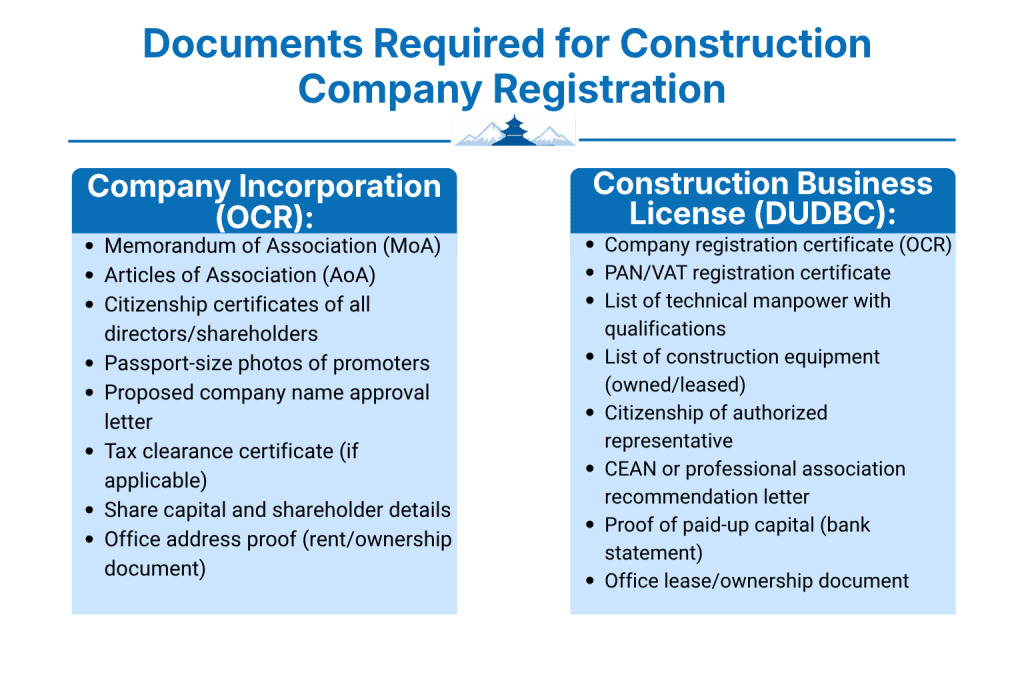
For Company Incorporation at OCR
- Memorandum of Association (MoA)
- Articles of Association (AoA)
- Citizenship certificates of all directors/shareholders
- Passport-size photographs of all promoters
- Proposed company name approval letter from OCR
- Tax clearance certificate (if applicable)
- Details of share capital and shareholders
- Registered office address proof (rent agreement or ownership document)
For Construction Business License at DUDBC
- Copy of company registration certificate from OCR
- PAN/VAT registration certificate
- List of technical manpower with their qualification certificates
- List of construction equipment owned or leased
- Copy of citizenship of the company’s authorized representative
- Recommendation letter from a professional association (e.g., Construction Entrepreneurs’ Association of Nepal – CEAN)
- Proof of paid-up capital (bank statement)
- Office lease agreement or ownership document
- Passport-size photos of the company’s authorized representative
What Is the Step-by-Step Process for Construction Company Registration in Nepal?

Step 1: Name Reservation at OCR
- Visit the OCR website or the OCR office
- Apply for company name approval
- Submit three proposed names in order of preference
- OCR approves one name after verification
Step 2: Prepare Incorporation Documents
- Draft the Memorandum of Association and Articles of Association
- Notarize all documents as required
- Prepare shareholder details and share capital structure
Step 3: Register the Company at OCR
- Submit all documents at the OCR counter or through the online portal
- Pay the company registration fees (based on authorized capital)
- Receive the Company Registration Certificate
Step 4: Obtain PAN/VAT Registration
- Visit the Inland Revenue Department (IRD) or apply online at IRD Nepal
- Submit the company registration certificate, citizenship copies, and office address proof
- Receive the PAN Certificate (mandatory for all businesses)
- Register for VAT if annual turnover exceeds NPR 50 Lakhs
Step 5: Open a Company Bank Account
- Open a corporate bank account in the company’s name
- Deposit the minimum required paid-up capital as per the target grade
Step 6: Apply for Construction Business License at DUDBC
- Submit all required documents to the DUDBC Provincial Office or Central Office
- Technical evaluation of submitted documents takes place
- Inspection of office and equipment may be conducted
- Upon approval, Construction Business License is issued
Step 7: Register with Professional Association
- Register with the Construction Entrepreneurs’ Association of Nepal (CEAN) or relevant district-level association
- This membership is often required for DUDBC license applications and government tender participation
Step 8: Labor and Employee Registration
- Register employees with the Social Security Fund (SSF) under the Labor Act, 2074
- Maintain all employee records as required by law
What Are the Fees for Construction Company Registration in Nepal?
The registration fees depend on the authorized capital of the company. OCR charges fees on a sliding scale as per the Company Act, 2063.
| Authorized Capital (NPR) | OCR Registration Fee (NPR) |
|---|---|
| Up to 1,00,000 | 1,000 |
| 1,00,001 – 5,00,000 | 2,500 |
| 5,00,001 – 25,00,000 | 5,000 |
| 25,00,001 – 1,00,00,000 | 10,000 |
| Above 1,00,00,000 | 20,000 |
Additionally, DUDBC charges annual license renewal fees as per the Construction Business Regulation, 2056. The renewal fees vary by grade and must be paid every fiscal year.
What Are the Renewal Requirements for a Construction Business License?
A construction business license in Nepal must be renewed annually at the DUDBC. To renew the license, a company must submit:
- Renewal application form
- Tax clearance certificate for the previous fiscal year
- Updated technical manpower list with certificates
- Updated equipment list
- Payment of annual renewal fees
- Updated PAN/VAT clearance
- Audited financial statements (for A and B grade companies)
Failure to renew the license on time results in penalties under Section 15 of the Construction Business Act, 2055. A company operating without a valid license can face suspension from government tenders and legal action.
What Are the Common Challenges in Construction Company Registration in Nepal?

Several practical challenges arise during the registration process:
- Document verification delays at OCR and DUDBC
- Technical manpower requirements can be difficult to fulfill for new entrants
- Capital requirements for higher grades are substantial
- Equipment ownership or lease documentation must be properly formatted
- Coordination between multiple government bodies (OCR, IRD, DUDBC, SSF) adds time to the process
Understanding the process in advance reduces delays. Hiring a legal expert or company registration consultant familiar with Nepal’s construction law speeds up the entire process significantly.
Can a Foreign Company Register a Construction Company in Nepal?
Yes, foreign investors can register a construction company in Nepal, but they must comply with the Foreign Investment and Technology Transfer Act, 2075 (2019) and obtain approval from the Department of Industry or the Investment Board Nepal (IBN) depending on the investment size.
Foreign-invested construction companies must also obtain approval from the Nepal Rastra Bank for foreign currency transactions and repatriation of profits. Construction is listed in the negative list for 100% foreign ownership in certain sub-sectors, so investors must verify current regulations at Department of Industry Nepal.
Conclusion
Construction company registration in Nepal involves a multi-step legal process that includes company incorporation at the Office of the Company Registrar, PAN/VAT registration at the Inland Revenue Department, and obtaining a Construction Business License from DUDBC. The Construction Business Act, 2055 and Company Act, 2063 form the legal backbone of this process. Proper understanding of grade classifications, capital requirements, and document preparation ensures a smooth and timely registration. Both Nepali nationals and foreign investors can register construction companies in Nepal, subject to applicable laws and regulations.
FAQs
1. How long does it take to register a construction company in Nepal?
Company registration at OCR typically takes 3 to 7 working days. Obtaining the DUDBC construction business license takes an additional 15 to 30 working days, depending on document completeness and grade applied for.
2. Is it mandatory to have a DUDBC license to operate a construction business in Nepal?
Yes, under Section 3 of the Construction Business Act, 2055, every construction business must obtain a valid license from DUDBC before undertaking any construction work or bidding on government contracts.
3. What is the minimum capital required to register a construction company in Nepal?
The minimum paid-up capital for a D Grade construction company is NPR 5,00,000. Higher grades require proportionally higher capital amounts as specified in the Construction Business Regulation, 2056.
4. Can a single person register a construction company in Nepal?
Yes, a single person can register a Sole Proprietorship construction firm at DoCSCP or a Single Member Private Limited Company at OCR under the amended Company Act, 2063 with at least one director/shareholder.
5. Is PAN registration mandatory for construction companies in Nepal?
Yes, PAN registration is mandatory for all business entities in Nepal under the Income Tax Act, 2058. Construction companies also need PAN to apply for a DUDBC license and participate in government tenders.
6.Where can I apply for a construction business license in Nepal?
You can apply at the Department of Urban Development and Building Construction (DUDBC) at the central office in Kathmandu or the relevant provincial office. Visit dudbc.gov.np for detailed information.