

The casino business in Nepal operates under a strictly regulated legal framework. Nepal allows casino operations within its territory, but the government has placed significant restrictions on who can operate, where casinos can function, and who can play inside them. The casino industry in Nepal is primarily linked to the tourism sector, and the government uses it as a tool to attract foreign tourists and generate foreign exchange earnings.
Nepal currently has around 14 to 17 licensed casinos operating across the country, mostly concentrated in Kathmandu. These casinos are located inside five-star hotels and are primarily intended for foreign nationals visiting Nepal. The casino business in Nepal contributes to government revenue through licensing fees, royalties, and taxes.
Legal Framework Governing Casino Business in Nepal
The Casino Act, 2023 BS (1967 AD)
The primary law governing the casino business in Nepal is the Casino Act, 2023 BS (1967 AD), also known as the Tash Tatha Jantu Khel Sambandhi Ain. This act was one of the earliest pieces of legislation to formally regulate gambling and casino activities in Nepal. The act defines the conditions under which casinos can operate, who can obtain a license, and what types of games are permissible.
Over the years, the Casino Act has been amended multiple times to reflect changes in tourism policy, foreign investment requirements, and government revenue strategies.
Casino Regulations
In addition to the Casino Act, the Casino Regulations issued by the Government of Nepal provide detailed procedural guidelines. These regulations specify:
- The licensing procedure for casino operators
- The fee structure for casino licenses and renewals
- Game rules and casino floor requirements
- Reporting obligations for casino operators
Finance Act and Annual Budget Provisions
Each year, Nepal’s Finance Act updates the royalty rates, license fees, and tax obligations applicable to casino businesses. Casino operators in Nepal must comply with annual changes in the Finance Act as it directly affects their financial obligations to the government.
Income Tax Act, 2058 BS (2002 AD)
Casino businesses in Nepal are also subject to the Income Tax Act, 2058 BS. Casino operators must pay corporate income tax on their net profits. The tax treatment of casino income follows standard business income tax rules with certain sector-specific provisions.
Who Can Operate a Casino in Nepal?
Eligibility for Casino License
Under the Casino Act and related regulations, only specific entities can apply for a casino license in Nepal. The government issues casino licenses to:
- Five-star hotels that meet the minimum infrastructure requirements
- Companies incorporated under the Companies Act, 2063 BS
- Entities with sufficient financial capacity to meet the license fee and royalty obligations
Both Nepali citizens and foreign investors can hold stakes in casino operating companies. Foreign investment in the casino sector is permitted under the Foreign Investment and Technology Transfer Act (FITTA), 2075 BS (2019 AD), subject to the approval of the Investment Board Nepal (IBN) or the Department of Industry.
Restrictions on Casino Operations
- Casinos in Nepal cannot operate as standalone establishments. They must be located inside a licensed five-star hotel.
- Nepali citizens are strictly prohibited from entering and playing in casinos in Nepal under the Casino Act.
- Only foreign nationals holding a valid passport and visa are allowed to play in Nepali casinos.
- Casino operators cannot allow minors to enter the casino premises.
Where Are Casinos Located in Nepal?
Almost all licensed casinos in Nepal are located in Kathmandu Valley, particularly inside five-star hotels in areas such as Lazimpat, Thamel, and Durbar Marg. Some casinos also operate in Pokhara, which is a growing tourist destination.
| Casino Name | Hotel | Location |
|---|---|---|
| Casino Royale | Hotel Yak & Yeti | Kathmandu |
| Casino Anna | Hotel de l’Annapurna | Kathmandu |
| Casino Everest | Hotel Everest | Kathmandu |
| Casino Pride | Hotel Radisson | Kathmandu |
| Casino Mahjong | Hotel Soaltee Crowne Plaza | Kathmandu |
| Casino Shangri-La | Hotel Shangri-La | Kathmandu |
Casino License in Nepal: Application Process
Licensing Authority
The Ministry of Finance and the Ministry of Home Affairs are the primary government bodies involved in granting casino licenses in Nepal. The Nepal Tourism Board also plays a consultative role in casino-related policy matters.
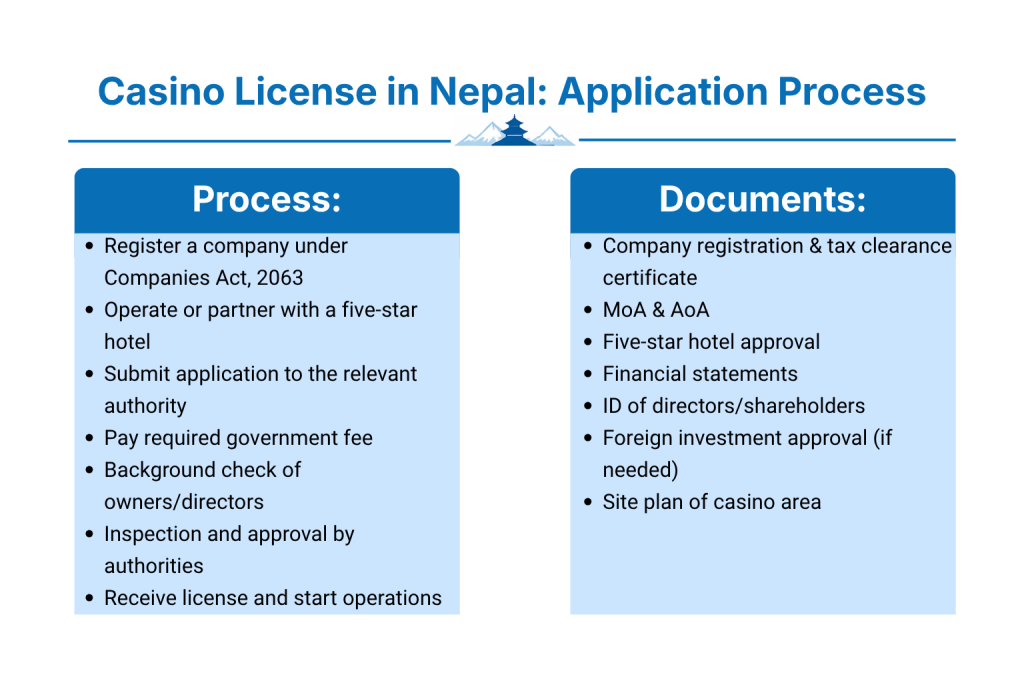
Steps to Obtain a Casino License
- Incorporate a Company under the Companies Act, 2063 BS, in Nepal.
- Secure a five-star hotel partnership or operate within a five-star hotel property that meets government standards.
- Submit a formal license application to the Department of Tourism or the designated government authority along with required documents.
- Pay the prescribed license fee as specified in the Finance Act for the current fiscal year.
- Undergo background verification of directors and shareholders of the applying company.
- Receive inspection and approval from the Ministry of Home Affairs and Ministry of Finance.
- Obtain the casino operation license and begin operations under the prescribed conditions.
Documents Required for Casino License Application
- Company registration certificate
- Tax clearance certificate
- Memorandum and Articles of Association
- Five-star hotel classification certificate
- Financial statements and proof of financial capacity
- List of directors and shareholders with identity documents
- Foreign investment approval (if applicable)
- Site plan and floor layout of the proposed casino area
Casino Royalty and Taxation in Nepal
Annual Royalty Fees
Casino operators in Nepal are required to pay an annual royalty to the Government of Nepal. The royalty amount varies based on the number of gaming tables and slot machines in operation. The Finance Act revises these royalty rates annually.
| Type of Casino Activity | Annual Royalty (Approximate) |
|---|---|
| Per gaming table (per year) | NPR 10,00,000 to NPR 15,00,000 |
| Per slot machine (per year) | NPR 1,00,000 to NPR 3,00,000 |
| Casino license renewal fee | NPR 5,00,000 to NPR 10,00,000 |
Note: Exact figures are revised each fiscal year under the Finance Act. Operators must confirm current rates with the Ministry of Finance.
Income Tax on Casino Business
Casino operating companies in Nepal are subject to corporate income tax under the Income Tax Act, 2058 BS. The standard corporate tax rate applicable to casino businesses is 30% of net taxable income. Additionally, dividend distributions are subject to withholding tax.
Value Added Tax (VAT)
Casino gaming revenue is generally exempt from Value Added Tax (VAT) under Nepal’s VAT Act, 2052 BS, as gaming is not classified as a taxable supply of goods or services in the conventional sense. However, food, beverages, and other hotel services provided within the casino premises remain subject to VAT.
Foreign Investment in Casino Business in Nepal
Under the Foreign Investment and Technology Transfer Act (FITTA), 2075 BS, foreign nationals and foreign companies can invest in the casino sector in Nepal. However, certain conditions apply:
- Foreign investment in the casino business requires approval from the Department of Industry or the Investment Board Nepal, depending on the investment amount.
- The minimum foreign investment threshold set by the government applies.
- Repatriation of profits earned from casino operations is allowed under FITTA after fulfilling tax and regulatory obligations.
- Foreign investors must comply with the Foreign Exchange (Regulation) Act, 2019 BS for financial transactions.
The government of Nepal has been selective about granting fresh casino licenses to foreign investors, and applications are evaluated on a case-by-case basis.
Employment in Casino Business in Nepal
Casino businesses in Nepal employ both Nepali and foreign nationals. However, certain positions require specific approvals:
- Foreign employees working in casinos must obtain a Work Permit from the Department of Labour under the Labour Act, 2074 BS.
- Casino dealers, pit bosses, and technical gaming staff are often hired from countries with established gaming industries due to the lack of formal gaming training institutions in Nepal.
- Casino operators must comply with the Labour Act, 2074 BS regarding minimum wages, working hours, and employee benefits.
- Nepali employees working in casinos cannot participate in the games as players.
Online Casino Business in Nepal
Online casino operations are not legally recognized or permitted in Nepal under the existing Casino Act and Telecommunications Act. The government has not issued any online gaming or online casino licenses as of the current legal framework. Operating an online casino targeting Nepali users is considered illegal under Nepali law.
The Cybercrime law under the Electronic Transactions Act, 2063 BS and the National Penal Code, 2074 BS contain provisions that can be applied to unlicensed online gambling activities.
Key Government Authorities for Casino Business in Nepal
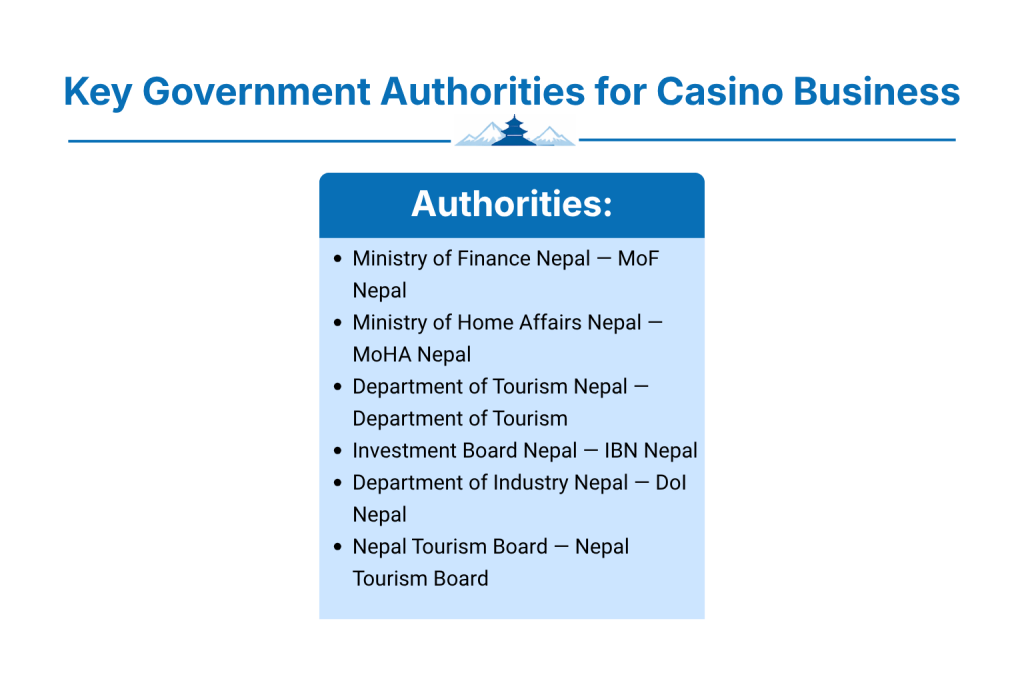
- Ministry of Finance, Nepal – www.mof.gov.np
- Ministry of Home Affairs, Nepal – www.moha.gov.np
- Department of Tourism, Nepal – www.tourism.gov.np
- Investment Board Nepal – www.ibn.gov.np
- Department of Industry, Nepal – www.doind.gov.np
- Nepal Tourism Board – www.welcomenepal.com
Challenges in the Casino Business in Nepal
The casino sector in Nepal faces several operational challenges:
- Restricted player base – Only foreign nationals can play, which limits revenue potential.
- High royalty fees – Annual royalty obligations place significant financial pressure on operators.
- Lack of fresh licensing – The government has been slow to issue new casino licenses, limiting industry growth.
- Absence of a dedicated Casino Regulatory Authority – The distributed oversight between multiple ministries creates compliance complexity.
- Competition from regional markets – Casinos in Goa (India) and other Asian markets attract tourists who might otherwise visit Nepal.
FAQs
1. Can Nepali citizens play in casinos in Nepal?
No. Nepali citizens are strictly prohibited from entering and playing in casinos in Nepal under the Casino Act, 2023 BS. Only foreign nationals with valid passports and visas are permitted to enter and play.
2. What is the main law governing casino business in Nepal?
The Casino Act, 2023 BS (1967 AD) is the primary law. The Finance Act updates royalty and tax rates annually. The Income Tax Act, 2058 BS governs taxation of casino income.
3. Where can a casino be legally operated in Nepal?
Casinos in Nepal can only operate inside licensed five-star hotels. Standalone casino establishments are not permitted under the current legal framework.
4. Can a foreign company invest in a casino in Nepal?
Yes. Foreign investment in the casino sector is permitted under FITTA, 2075 BS. Investors must obtain approval from the Department of Industry or Investment Board Nepal before commencing operations.
5. Are online casinos legal in Nepal?
No. Online casino operations are not legally permitted in Nepal. No online gaming licenses are issued. Operating an unlicensed online casino is subject to penalties under the Electronic Transactions Act, 2063 BS.
6. How much royalty does a casino pay to the government in Nepal?
Casino operators pay annual royalties based on the number of gaming tables and slot machines. The Finance Act revises these rates each fiscal year. Approximate royalties range from NPR 10 lakh to NPR 15 lakh per gaming table annually.
Conclusion
The casino business in Nepal operates under a structured but restrictive legal framework rooted in the Casino Act, 2023 BS. Casinos serve as important contributors to tourism revenue and foreign exchange earnings. However, limitations on the player base, high royalty obligations, and a lack of a dedicated regulatory body continue to constrain the sector’s full potential. Investors and operators must comply fully with the Casino Act, Finance Act, Income Tax Act, FITTA, and Labour Act to run a legally compliant casino business in Nepal.