

Opening a bank account is one of the most important steps for any company operating in Nepal, whether it is owned by Nepali citizens or foreign investors. A company bank account is not just a place to keep money. It is a legal requirement under the Companies Act 2063, the Foreign Investment and Technology Transfer Act (FITTA) 2075, and the Income Tax Act 2058. Without a proper bank account, a company cannot deposit its paid-up capital, receive foreign investment, pay taxes, or carry out normal business transactions.
For foreign investors, the process becomes more detailed because it also involves approval from the Department of Industry and Nepal Rastra Bank (NRB), the central bank of Nepal. This article explains the full bank account opening process for companies in Nepal in simple language, based on the actual laws and official government procedures. At CompanyNP, we assist foreign investors, entrepreneurs, and businesses with company registration, foreign investment approval, and bank account opening, so this guide reflects real practice as well as legal requirements.
Why Is a Bank Account Necessary for Company Registration in Nepal?
Under the Companies Act 2063, every registered company must deposit its share capital in a bank account before it can begin operations. The Office of Company Registrar (OCR) requires proof of capital deposit during incorporation in many cases, and banks act as the official channel through which capital, whether local or foreign, enters the company. A bank account also allows a company to receive an inward remittance certificate, which is mandatory proof that foreign investment has arrived through legal banking channels, as required by FITTA and NRB regulations. Without this certificate, foreign investment is not considered valid under Nepali law.
What Laws Govern Bank Account Opening for Companies in Nepal?
Several laws and regulatory bodies work together to govern how a company opens and operates a bank account in Nepal. These include:
- The Companies Act 2063, which sets out company registration and capital deposit requirements
- FITTA 2075, which governs foreign investment approval and repatriation of profits
- The Income Tax Act 2058, which requires PAN registration before financial transactions
- The Foreign Exchange (Regulation) Act, which controls foreign currency transactions
- NRB Unified Directives and the Foreign Investment and Foreign Loan Management Bye-laws, 2078, which regulate how foreign currency enters and leaves Nepal through banks
These laws apply together, and a company cannot skip any of them when opening a corporate bank account, especially if foreign investment is involved.
Who Can Open a Corporate Bank Account in Nepal?
A corporate bank account in Nepal can be opened by different types of registered entities, including:
- Private limited companies registered under the Companies Act
- Public limited companies
- Branch offices of foreign companies registered with the Department of Industry
- Liaison offices, subject to restrictions on their banking activities
- Foreign investment companies approved under FITTA
Each entity type has slightly different documentation requirements, but the basic legal foundation remains the same across all of them.
What Is the Step-by-Step Process to Open a Company Bank Account in Nepal?
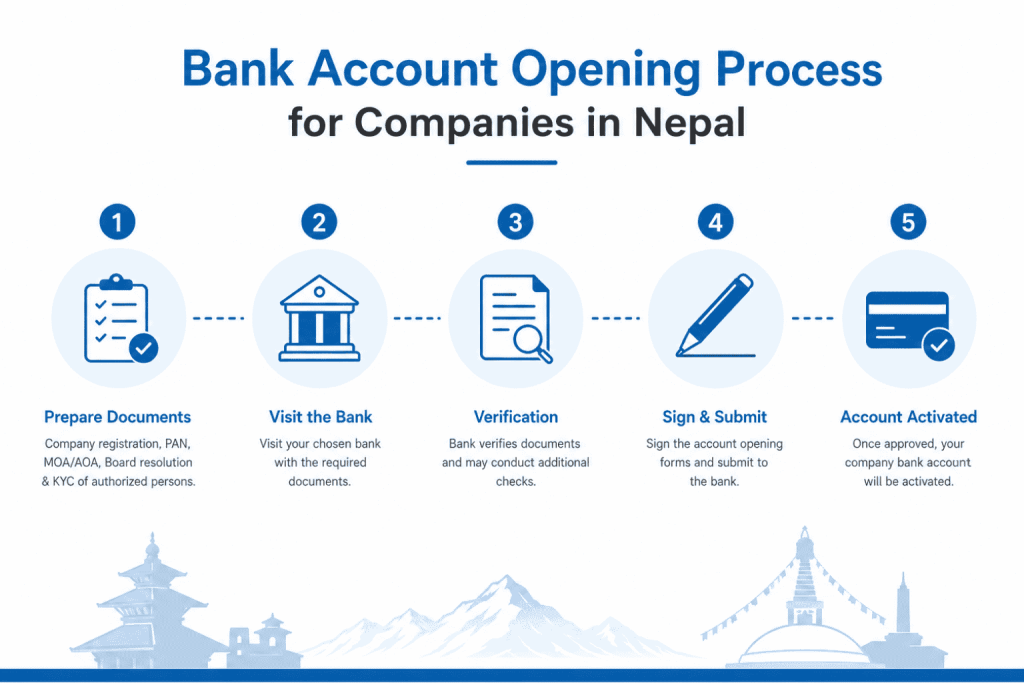
The process of opening a bank account for a company in Nepal, particularly one involving foreign investment, generally follows a fixed sequence of steps required by law and banking practice.
Step 1: Register the Company with the Office of Company Registrar
The first step is company incorporation with the Office of Company Registrar. This involves submitting the company name, memorandum of association, articles of association, and details of shareholders and directors. Once approved, the OCR issues a certificate of incorporation, which is required for all further steps.
Step 2: Obtain a Permanent Account Number from the Inland Revenue Department
After incorporation, the company must register for a Permanent Account Number (PAN) with the Inland Revenue Department. The PAN certificate is compulsory under the Income Tax Act 2058 and is a basic requirement for any bank to open a corporate account.
Step 3: Secure Approval from the Department of Industry for Foreign Investment
If the company involves foreign shareholders, approval must be obtained from the Department of Industry under FITTA before any foreign capital can be brought into Nepal. This approval confirms the investment amount, sector, and shareholding structure.
Step 4: Obtain Approval from Nepal Rastra Bank for Foreign Currency Transactions
Once DOI approval is secured, the company or its bank must notify Nepal Rastra Bank so that the foreign investment amount can be received through proper banking channels. NRB oversees this step under the Foreign Investment and Foreign Loan Management Bye-laws, 2078, to ensure that all incoming foreign currency is properly recorded.
Step 5: Submit Required Documents to the Chosen Commercial Bank
The company then approaches a licensed commercial bank in Nepal and submits all incorporation documents, PAN certificate, DOI approval letter, and identification documents of directors and shareholders to open the account.
Step 6: Activate the Account and Deposit the Minimum Paid-Up Capital
Once the bank verifies all documents, the account is activated. The company can then deposit its paid-up capital, and in the case of foreign investment, the bank issues an inward remittance certificate confirming that the funds arrived from abroad through legal channels.
What Documents Are Required to Open a Company Bank Account?
Banks in Nepal generally require the following documents before opening a corporate account, in line with NRB know-your-customer (KYC) requirements:
- Certificate of incorporation from the Office of Company Registrar
- Memorandum and articles of association
- PAN certificate from the Inland Revenue Department
- Board resolution authorizing account opening and signatories
- Citizenship certificates or passports of directors and shareholders
- Department of Industry approval letter, if foreign investment is involved
- Proof of registered office address
Foreign nationals must also submit valid passports, visa documents, and, in some cases, a recommendation letter from their respective embassy or the Department of Industry.
Can Foreign-Owned Companies Open Foreign Currency Accounts in Nepal?
Yes, foreign-owned companies in Nepal may be permitted to hold foreign currency accounts under specific conditions set by Nepal Rastra Bank. This is generally allowed for companies that need to receive payments in foreign currency, such as export-oriented businesses or those under approved foreign direct investment. However, the use of such accounts is closely monitored, and companies must follow NRB directives regarding conversion, reporting, and repatriation of funds. Ordinary domestic operations are usually conducted through Nepali rupee accounts, while foreign currency accounts are limited to specific approved purposes.
What Is the Role of Nepal Rastra Bank in Company Bank Account Opening?
Nepal Rastra Bank plays a central regulatory role in company bank account opening, especially where foreign investment is involved. Its responsibilities include:
- Approving the inflow of foreign investment through commercial banks
- Issuing guidelines under the Foreign Investment and Foreign Loan Management Bye-laws
- Monitoring compliance with the Foreign Exchange (Regulation) Act
- Approving repatriation of dividends, profits, and capital by foreign investors
- Supervising commercial banks to ensure KYC and anti-money laundering compliance
Every commercial bank in Nepal operates under licenses and directives issued by NRB, so no bank account can be opened or operated outside these regulatory boundaries.
What Are the Common Types of Corporate Bank Accounts Available in Nepal?
Different types of accounts serve different business needs. The table below summarizes the common account types available to companies in Nepal.
| Account Type | Purpose | Currency | Eligible Entity |
|---|---|---|---|
| Current Account | Daily business transactions | Nepali Rupee | All registered companies |
| Capital Deposit Account | Depositing initial paid-up capital | Nepali Rupee or Foreign Currency | Newly incorporated companies |
| Foreign Currency Account | Receiving payments from abroad | US dollar or other approved currency | Export businesses, approved foreign investors |
| Fixed Deposit Account | Holding surplus funds for interest | Nepali Rupee | Companies with idle funds |
| Escrow Account | Holding funds temporarily under agreement | Nepali Rupee or Foreign Currency | Companies involved in specific transactions |
What Is the Minimum Capital Requirement for Foreign Investment Companies?
Under FITTA and its amendments, a minimum threshold of foreign investment applies before an investment can be approved by the Department of Industry. This threshold is periodically revised by the government, so investors should always confirm the current figure with the Department of Industry before proceeding. The table below shows a general overview of common thresholds referenced under current practice.
| Category | Minimum Foreign Investment Threshold | Approving Authority |
|---|---|---|
| General industries | As prescribed under FITTA and its amendments | Department of Industry |
| Large-scale or strategic projects | Higher threshold, case dependent | Investment Board Nepal |
| Information technology sector | Reduced or exempted threshold under specific provisions | Department of Industry |
Because thresholds and exemptions change from time to time, it is advisable to verify the latest figures directly with the Department of Industry before transferring any investment funds.
What Are the Tax Obligations Linked to a Company Bank Account?
A company bank account is directly linked to tax compliance under the Income Tax Act 2058. Some key obligations include:
- Registering for PAN before opening any bank account
- Registering for VAT if the company crosses the prescribed turnover threshold
- Reporting all banking transactions accurately for tax assessment purposes
- Maintaining records of foreign remittances for audit and tax filing
- Obtaining tax clearance certificates when required for repatriation of profits or capital
The Inland Revenue Department may request bank statements during tax assessments, so companies must keep their banking records consistent with their tax filings at all times.
What Challenges Do Foreign Investors Commonly Face When Opening Bank Accounts?
Foreign investors often face certain practical challenges during the bank account opening process, including:
- Delays in receiving approval from the Department of Industry
- Additional documentation requirements from banks under NRB KYC rules
- Confusion regarding minimum investment thresholds under FITTA
- Difficulty coordinating between DOI approval, NRB notification, and bank account opening
- Requirements for physical presence or notarized documents for foreign directors
These challenges can often be reduced by working with a registered consulting firm familiar with the exact procedural requirements of Nepali authorities.
How Can CompanyNP Assist With Bank Account Opening for Companies in Nepal?
CompanyNP works with foreign investors and businesses to complete company registration, FITTA approval, PAN registration, and bank account opening in a structured and compliant manner. Our services are based strictly on the requirements of the Companies Act, FITTA, the Income Tax Act, and NRB regulations, ensuring that clients avoid unnecessary delays or compliance issues. We assist with document preparation, coordination with the Department of Industry and Nepal Rastra Bank, and communication with commercial banks throughout the account opening process.
Frequently Asked Questions
Is a local bank account required before company registration in Nepal?
A bank account is generally required after incorporation to deposit paid-up capital, not before registration. However, some banks may require proof of intended registration before opening a preliminary account for foreign investors.
Can a foreigner open a company bank account without visiting Nepal?
Most banks require in-person verification for signatories, though some processes allow document submission through authorized representatives or legal consultants, subject to bank policy and Nepal Rastra Bank compliance requirements for foreign account holders.
How long does it take to open a company bank account in Nepal?
The process typically takes a few weeks, depending on how quickly Department of Industry approval, PAN registration, and bank verification are completed. Foreign investment cases usually take longer due to additional regulatory approvals.
Do branch offices of foreign companies need separate bank accounts?
Yes, branch offices registered under the Department of Industry must open a separate corporate bank account in Nepal to manage local transactions, tax payments, and any approved foreign currency remittances related to their operations.
Is Nepal Rastra Bank approval required for every foreign investment transaction?
Yes, Nepal Rastra Bank approval or notification is generally required for foreign investment inflows and repatriation of profits, ensuring transactions comply with the Foreign Exchange (Regulation) Act and related NRB directives.
Can a company change its bank after opening an initial account?
Yes, a company may change its bank, but it must update its records with the Inland Revenue Department and, if relevant, notify the Department of Industry regarding any change affecting its foreign investment documentation.