

Public transport is a regulated service industry in Nepal. Any person or entity intending to carry passengers or goods for hire must first obtain a legal identity (firm, company, or cooperative), register the enterprise with the competent authority, and then secure a transport service operating permit and route permit from the concerned Transport Management Office. This article, prepared by CompanyNP, explains public transport business registration in Nepal strictly on the basis of the Companies Act 2063, the Motor Vehicles and Transport Management Act 2049, the Foreign Investment and Technology Transfer Act 2075 (FITTA), the Industrial Enterprises Act 2076, the Income Tax Act 2058, the Value Added Tax Act 2052, and Nepal Rastra Bank (NRB) regulations.
What Legal Framework Governs Public Transport Business Registration in Nepal?
Nepal does not have a single consolidated statute for the transport business. Instead, several laws operate together, and compliance is required under each of them.
Which primary statutes apply to a transport enterprise?
- Motor Vehicles and Transport Management Act, 2049 (1993) and the Motor Vehicles and Transport Management Rules, 2054 (1997): the core law governing vehicle registration, driving licences, transport service permits, route permits, fares, and passenger safety.
- Companies Act, 2063 (2006): governs incorporation of a private limited or public limited transport company at the Office of the Company Registrar.
- Private Firm Registration Act, 2014 and Partnership Act, 2020: govern sole proprietorship and partnership firm registration for purely Nepali-owned transport businesses.
- Industrial Enterprises Act, 2076 (2020): classifies transport as a service industry; registration with the Department of Industry or the Provincial Industry Registration Office may be required depending on scale and capital.
- Foreign Investment and Technology Transfer Act, 2075 (2019) and the Foreign Investment and Technology Transfer Rules, 2077: govern foreign direct investment in Nepal, including in the transport service sector.
- Income Tax Act, 2058 (2002) and Value Added Tax Act, 2052 (1996): govern PAN registration, VAT registration, corporate income tax, and withholding obligations.
- Cooperative Act, 2074 (2017): permits transport cooperatives, a model widely used after the Government of Nepal’s decision to phase out informal transport committees.
Which authorities regulate the sector?
Federal authorities
- Office of the Company Registrar (OCR) — company incorporation under the Companies Act 2063: ocr.gov.np
- Department of Industry (DOI) — foreign investment approval and industry registration: doind.gov.np
- Department of Transport Management (DoTM), under the Ministry of Physical Infrastructure and Transport — vehicle registration, bluebook, driving licences, and transport service regulation: dotm.gov.np
- Inland Revenue Department (IRD) — PAN and VAT registration and tax administration.
- Nepal Rastra Bank — approval and recording of inward foreign investment and repatriation of returns.
Provincial and local authorities
Under the Constitution of Nepal, transport management is exercised concurrently. Provincial Transport Management Offices issue route permits for intra-provincial routes, while inter-provincial and long routes are coordinated at the federal level. Every business must additionally obtain a business operation registration from the concerned Rural Municipality or Municipality and pay local business tax under the Local Government Operation Act, 2074.
Who Can Register a Public Transport Business in Nepal?
Can Nepali citizens register in any form?
Yes. A Nepali citizen or group of citizens may register:
- A sole proprietorship (private firm) at the Ward or Department of Commerce, Supplies and Consumer Protection;
- A partnership firm under the Partnership Act 2020;
- A private limited company under the Companies Act 2063, with a minimum of one shareholder and a maximum of 101 shareholders;
- A transport cooperative under the Cooperative Act 2074.
For organised passenger transport, the company or cooperative model is preferred, because the Government of Nepal has consistently directed transport entrepreneurs to operate through institutional structures rather than route committees or syndicates.
Can foreign investors enter the transport sector under FITTA?
Foreign investment in Nepal is permitted only through an entity registered in Nepal, and only after approval from the Department of Industry (or the Investment Board Nepal for very large projects). The relevant points are:
- Schedule 1 of FITTA 2075 lists sectors closed to foreign investment. Personal service businesses, retail trade, internal courier service, travel and trekking agencies, and certain consultancy services are restricted. Investors must verify the current negative list before committing capital.
- Foreign investment is not permitted in cottage and small industries as defined by the Industrial Enterprises Act 2076.
- The minimum foreign investment threshold notified by the Government of Nepal is NPR 20 million per foreign investor. This figure is fixed by notification in the Nepal Gazette and should be confirmed at the time of application.
- Investment may be routed through the Automatic Route under the Foreign Investment (Automatic Route) Procedure 2078 where the sector and amount qualify.
Nepal Rastra Bank requirements for foreign investors
After DOI approval, the investor must obtain NRB approval or record the investment under the Foreign Investment and Foreign Loan Management Bylaws. Funds must enter Nepal through the banking channel in convertible currency. Only investment properly recorded with NRB is eligible for repatriation of dividends, sale proceeds of shares, and approved royalties: nrb.org.np
What types of transport businesses can be registered?
- Long-route and short-route passenger bus service
- Micro bus, mini bus, and city bus operation
- Taxi service and metered taxi fleets
- Tourist vehicle service (with recommendation from the tourism authority)
- School bus and institutional staff bus service
- Cargo and goods carrier (truck) companies
- Ambulance and specialised vehicle service
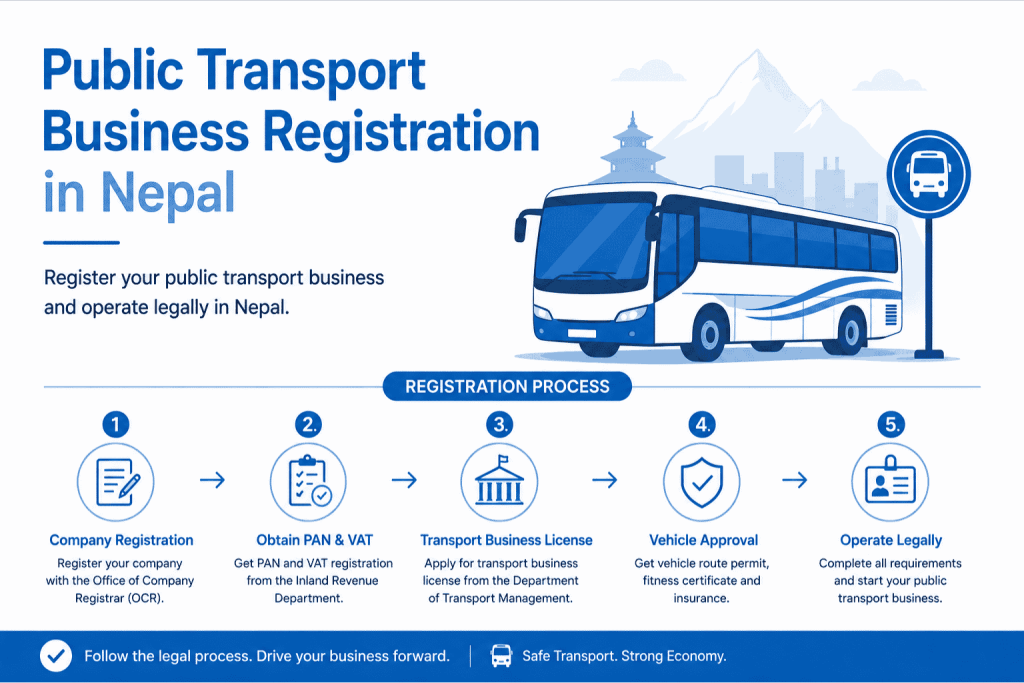
What Is the Step-by-Step Public Transport Business Registration Process?
The following sequence reflects the practice of the OCR, DOI, IRD, and Transport Management Offices.
| Step | Action | Authority |
|---|---|---|
| 1 | Foreign investment approval (if applicable) | Department of Industry |
| 2 | Company name reservation and incorporation | Office of the Company Registrar |
| 3 | Industry registration as a service industry | DOI or Provincial Office |
| 4 | PAN and VAT registration | Inland Revenue Department |
| 5 | Local business registration | Municipality / Rural Municipality |
| 6 | Bank account and capital injection | Commercial bank, NRB recording |
| 7 | Vehicle purchase and public vehicle registration | Transport Management Office |
| 8 | Transport service operating permit | Transport Management Office |
| 9 | Route permit and fare approval | Transport Management Office |
| 10 | Insurance, labour and social security registration | Insurer, Labour Office, SSF |
Step 1 — Obtain foreign investment approval
Foreign investors submit an application to the Department of Industry with the project report, investor’s incorporation documents or passport, financial credibility certificate, board resolution, and joint venture agreement where applicable. Approval specifies the approved amount and sector.
Step 2 — Reserve the name and incorporate the company
An application is filed with the OCR for name reservation, followed by submission of the Memorandum of Association, Articles of Association, consensus agreement (if any), shareholder identity documents, and the prescribed registration fee based on authorised capital. The OCR issues the Certificate of Incorporation.
Step 3 — Register the industry
Transport service falls within the service industry category under the Industrial Enterprises Act 2076. Registration with the Department of Industry or the Provincial Industry Registration Office is completed with the project proposal and incorporation documents.
Step 4 — Complete PAN and VAT registration
Every enterprise must obtain a Permanent Account Number from the Inland Revenue Department. Passenger transport services are listed as VAT-exempt transactions under Schedule 1 of the Value Added Tax Act 2052, whereas transportation of goods is a taxable transaction requiring VAT registration.
Step 5 — Register at the local level
The Municipality or Rural Municipality issues a business operation certificate and collects annual business tax as fixed by its own Finance Act.
Step 6 — Open a bank account and inject capital
Foreign capital must be remitted through a licensed bank in convertible foreign currency, with the bank reporting the inflow to Nepal Rastra Bank for recording purposes.
Step 7 — Register the vehicles as public vehicles
Vehicles must be registered with the Transport Management Office in the name of the company. The registration certificate, commonly known as the bluebook, must classify the vehicle as a public or commercial vehicle, and the vehicle must display the prescribed number plate for public service.
Step 8 — Apply for the transport service permit
Under the Motor Vehicles and Transport Management Act 2049, no person may operate a transport service without a permit. The application includes the registration certificate, bluebook copies, tax clearance, insurance policy, driver licence details, and the prescribed fee.
Step 9 — Obtain the route permit
Route permits authorise operation on a specified route. The Transport Management Office examines route saturation, vehicle condition, and fare compliance before issuing the permit.
Step 10 — Complete insurance and labour compliance
Third-party and passenger insurance is mandatory. Employers must comply with the Labour Act 2074 and enrol employees in the Social Security Fund.
What Are the Tax, Insurance and Annual Compliance Obligations?
How is a transport company taxed?
- A company is taxed at the normal corporate rate of 25 percent on taxable income under the Income Tax Act 2058.
- Natural persons owning public vehicles are taxed under the presumptive vehicle tax rates fixed annually by the Finance Act, based on vehicle type and seating capacity.
- Advance tax withholding, instalment tax payments in Poush, Chaitra and Asar, and annual income tax return filing within three months of the fiscal year end are mandatory.
- Annual vehicle tax and road maintenance charges are payable to the provincial government.
What ongoing filings are required?
| Compliance | Authority | Frequency |
|---|---|---|
| Annual return and financial statements | Office of the Company Registrar | Annually |
| Income tax return (D-03/D-04) | Inland Revenue Department | Annually |
| VAT return (goods transport) | Inland Revenue Department | Monthly or as assigned |
| Vehicle fitness and pollution test | Transport Management Office | Periodic |
| Route permit renewal | Transport Management Office | As specified |
| FDI progress report and repatriation filings | Department of Industry, NRB | Annually / as required |
What practical issues should investors anticipate?
- Route permits are discretionary and may be refused where a route is already saturated.
- Fare structures for public passenger transport are fixed by the Government of Nepal and cannot be varied unilaterally.
- Driver licensing, vehicle age limits, and safety standards are strictly enforced.
- Foreign investors must maintain complete documentation of inward remittance for future repatriation.
Frequently Asked Questions
Is a route permit mandatory for every public vehicle in Nepal?
Yes. Under the Motor Vehicles and Transport Management Act 2049, operating a transport service or carrying passengers on any route without a valid permit issued by the competent Transport Management Office is prohibited and attracts penalties.
Can a foreign investor own one hundred percent of a transport company?
Full foreign ownership is possible only if the specific transport activity is not listed in Schedule 1 of FITTA 2075 and the Department of Industry approves the proposal. Sector-specific verification before investment is strongly advised.
Is VAT registration required for a passenger bus company?
Passenger transportation is exempt under Schedule 1 of the Value Added Tax Act 2052, so VAT registration is generally not required. However, companies transporting goods or providing taxable ancillary services must register for VAT.
What is the minimum capital for foreign investment in Nepal?
The Government of Nepal has notified a minimum foreign investment threshold of NPR 20 million per foreign investor. The threshold is fixed by Nepal Gazette notification and should be confirmed with the Department of Industry before filing.
Can a transport cooperative operate public buses legally?
Yes. Cooperatives registered under the Cooperative Act 2074 may operate transport services after obtaining the same transport service permit and route permit from the Transport Management Office as companies must obtain.
How long does public transport business registration take in Nepal?
Company incorporation generally takes a few working days once documents are complete. Foreign investment approval, industry registration, vehicle registration, and route permits extend the total timeline considerably, depending on authority workload.