

Food and Beverage License Process in Nepal.
Nepal’s hospitality and food processing sectors are among the most active areas for domestic and foreign entrepreneurs. However, no person or company may lawfully produce, process, store, sell, distribute, or serve food and beverages in Nepal without first obtaining the approvals prescribed by law. The food and beverage license process in Nepal involves several authorities, including the Office of the Company Registrar, the Department of Industry, the Department of Food Technology and Quality Control, the Inland Revenue Department, Nepal Rastra Bank, and the concerned local level.
This guide, prepared by CompanyNP for foreign and domestic investors, explains the applicable statutes, the step-by-step licensing procedure, documentation, taxation, and post-registration compliance obligations.
What Is a Food and Beverage License in Nepal, and Which Laws Govern It?
A food and beverage license is not a single document. It is a combination of statutory registrations and permits that together authorize a person or entity to carry on a food-related enterprise, such as a restaurant, café, bar, bakery, catering service, mineral water plant, dairy, or packaged food industry.
Which principal laws apply?
- Food Act, 2023 (1967) and Food Rules, 2027 (1970): prohibit the sale of adulterated or substandard food and require a license or registration before commencing a food business.
- Companies Act, 2063 (2006): governs the incorporation of private limited and public limited companies.
- Industrial Enterprises Act, 2076 (2020): requires registration and classification of industries, including food and beverage production.
- Foreign Investment and Technology Transfer Act, 2075 (2019) (FITTA): governs approval of foreign investment, the negative list, and repatriation rights.
- Income Tax Act, 2058 (2002) and Value Added Tax Act, 2052 (1996): govern PAN, VAT, withholding, and annual return filing.
- Excise Duty Act, 2058 (2002) and Liquor Act, 2031 (1974): govern licensing for the sale and service of alcoholic beverages.
- The Tourism Act, 2035 (1978) and the Hotel, Lodge, Restaurant, Bar, and Tourist Guide Rules, 2038: govern tourist-standard hotels, restaurants, and bars.
- Local Government Operation Act, 2074 (2017): empowers municipalities and rural municipalities to register local businesses and regulate hotel, restaurant, and sanitation matters.
- Foreign Exchange (Regulation) Act, 2019 and the Foreign Investment and Foreign Loan Management Bylaws, 2078 of Nepal Rastra Bank: govern inward remittance, recording of investment, and repatriation.
Which authority issues the food license itself?
The Department of Food Technology and Quality Control (DFTQC), under the Ministry of Agriculture and Livestock Development, is the principal food regulator. It issues food industry registration and food business licenses, conducts inspection and sampling, and enforces national food standards. Applicants should verify the current departmental structure and forms at dftqc.gov.np, as food safety legislation and institutional arrangements may change.
Who Can Obtain a Food and Beverage License in Nepal, and Can Foreigners Apply?
Both Nepali citizens and foreign investors may operate food and beverage enterprises, but the legal route differs.
Domestic applicants
A Nepali citizen may operate as a sole proprietorship registered with the local level or the concerned provincial office, as a partnership firm, or as a private limited company under the Companies Act, 2063. Registration of the business entity is a precondition to obtaining the DFTQC license.
Foreign investors
Under FITTA, 2075, a foreign national or foreign entity must obtain prior foreign investment approval from the Department of Industry before investing. Key points include:
- Minimum foreign investment: the Government of Nepal has, by notification published in the Nepal Gazette, prescribed a minimum foreign investment threshold (presently NPR 20 million per foreign investor). Current figures should be confirmed at doind.gov.np.
- Negative list: Schedule of FITTA lists sectors closed to foreign investment. The law restricts retail trade, certain personal service businesses, and specified small-scale activities. Foreign investors planning restaurants, bars, or catering must confirm with the Department of Industry whether the proposed activity and its industry classification are permissible.
- Approving authority: the Department of Industry approves foreign investment up to the ceiling fixed by law; larger projects fall under the Investment Board Nepal.
- Visa facilities: FITTA provides business visas for investors and their authorized representatives and dependants and a residential visa where a lump-sum investment of one million US dollars or more is retained.
Foreign employment considerations
Where foreign chefs, managers, or technicians are engaged, approval and a work permit must be obtained in accordance with the Labour Act, 2074, and applicable directives, and the enterprise must enrol employees in the Social Security Fund.
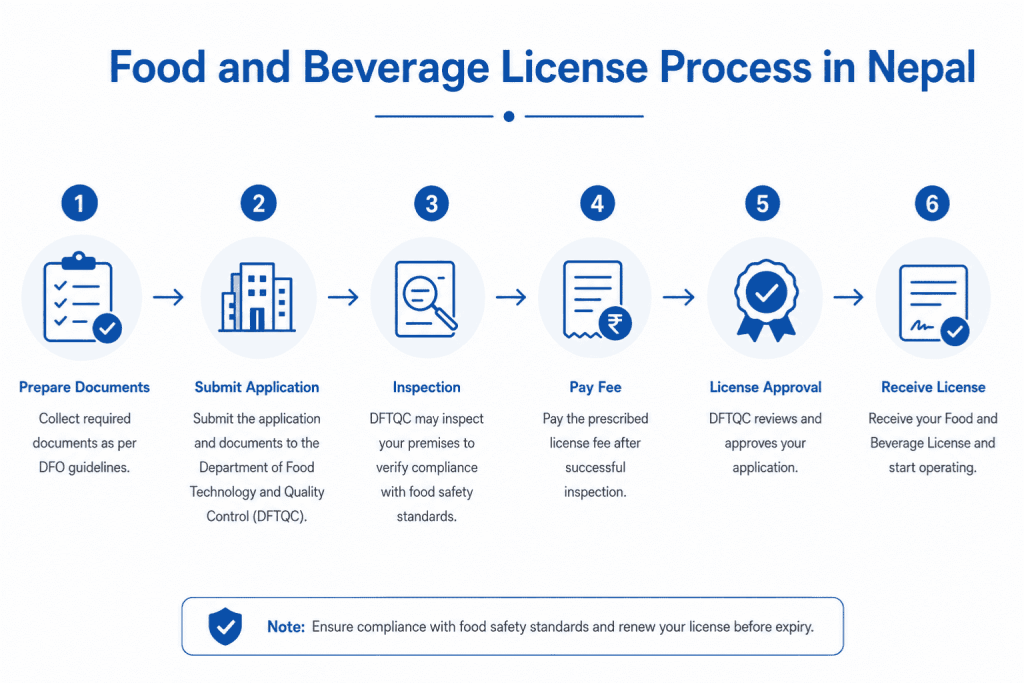
What Is the Step-by-Step Food and Beverage License Process in Nepal?
The following sequence reflects standard practice for a foreign-invested food and beverage enterprise. Domestic applicants may omit Steps 3 and 5.
Step 1: Determine the business activity and legal classification
Identify precisely whether the enterprise is a food production industry (for example, a beverage bottling plant), a food service business (restaurant, café, or bar), or a food trading business. Classification determines the registering authority, the industry category under the Industrial Enterprises Act, 2076, and the DFTQC license category.
Step 2: Reserve the company name with the Office of the Company Registrar
Apply online for name reservation through the Office of the Company Registrar. The proposed name must not be identical or misleading. Details and the electronic system are available at ocr.gov.np.
Step 3: Obtain foreign investment approval from the Department of Industry
Submit the application with the project report, investor documents, and proposed capital structure. The Department of Industry issues a foreign investment approval letter specifying the amount and mode of investment.
Step 4: Incorporate the company
File the Memorandum of Association, Articles of Association, consensus agreement (if applicable), and prescribed forms with the Office of the Company Registrar, and pay the registration fee based on authorised capital. A certificate of incorporation is then issued.
Step 5: Record the investment with Nepal Rastra Bank and remit capital
Under the Foreign Investment and Foreign Loan Management Bylaws, 2078, the foreign investment must be recorded with, or approved by, Nepal Rastra Bank before or upon inward remittance through the banking channel. Proper recording is essential to protect future repatriation of dividends and sale proceeds under FITTA. Refer to nrb.org.np for prevailing circulars.
Step 6: Register the industry or enterprise
Register the enterprise with the Department of Industry (for foreign-invested industries) or with the concerned provincial or local office, as prescribed by the Industrial Enterprises Act, 2076, and obtain the industry registration certificate.
Step 7: Obtain PAN and, where applicable, VAT registration
Apply to the Inland Revenue Department for a Permanent Account Number. Under the Value Added Tax Act, 2052 and the Rules thereunder, certain businesses, including restaurants with bar service, party palaces, and catering services operating in specified urban areas, must register for VAT irrespective of turnover. Others register upon crossing the prescribed threshold.
Step 8: Complete local level registration and sanitation approval
Register the business with the concerned metropolitan city, municipality, or rural municipality, and comply with local requirements on premises suitability, waste management, signboard tax, and local business tax under the Local Government Operation Act, 2074.
Step 9: Apply for the DFTQC food license or food industry registration
Submit the prescribed application to the Department of Food Technology and Quality Control together with entity registration documents, PAN, premises details, layout and machinery details, product list, water test report, and health certificates of food handlers. DFTQC may inspect the premises before issuing the license.
Step 10: Obtain sector-specific licenses
- Liquor and bar: an excise license from the concerned Inland Revenue Office under the Excise Duty Act, 2058, and compliance with the Liquor Act, 2031.
- Tourist-standard restaurant or bar: classification and license from the Department of Tourism under the Tourism Act, 2035.
- Fire, structural, and environmental clearances where required by the nature and scale of the project.
Step 11: Commence operations and maintain records
Display the license at the business premises, maintain purchase and sale records, invoices, and food safety records, and permit inspection by authorised officers.
What Documents, Fees, and Timelines Apply to Food and Beverage Licensing?
Requirements differ by authority. The table below summarizes the principal approvals.
| Approval | Authority | Governing law | Indicative purpose |
|---|---|---|---|
| Foreign investment approval | Department of Industry | FITTA, 2075 | Permission to invest as a foreign investor |
| Certificate of incorporation | Office of the Company Registrar | Companies Act, 2063 | Legal existence of the company |
| Investment recording | Nepal Rastra Bank | Bylaws, 2078 | Lawful inflow and future repatriation |
| Industry registration | Department of Industry or local/provincial office | Industrial Enterprises Act, 2076 | Classification and operation of industry |
| PAN and VAT | Inland Revenue Department | Income Tax Act, 2058; VAT Act, 2052 | Taxpayer registration |
| Food license or registration | DFTQC | Food Act, 2023; Food Rules, 2027 | Authority to produce or sell food |
| Excise license | Inland Revenue Office | Excise Duty Act, 2058 | Sale and service of liquor |
| Tourist restaurant or bar license | Department of Tourism | Tourism Act, 2035 | Tourist-standard classification |
What are the common documentary requirements?
- Passport copies and no-conviction or citizenship documents of promoters
- Company registration certificate, MOA and AOA, and PAN certificate
- Board resolution and project report with proposed investment and capital structure
- Lease agreement or ownership evidence for the business premises
- Premises layout, equipment list, and production or menu details
- Drinking water quality test report and medical or health certificates of food handlers
How long does the process take?
| Stage | Indicative working days |
|---|---|
| Name reservation | 1 to 3 |
| Foreign investment approval | 10 to 25 |
| Company incorporation | 3 to 7 |
| Industry registration and PAN | 3 to 7 |
| DFTQC license | 7 to 20 |
| Excise or tourism license | 7 to 21 |
Timelines are indicative only and depend on the completeness of documents, inspection scheduling, and the discretion of the concerned authority. Fees are those prescribed in the relevant rules and schedules and are payable through authorized channels.
What Ongoing Compliance, Taxation, and Renewal Duties Apply After Licensing?
Obtaining the license is the beginning, not the end, of the legal obligation.
Taxation obligations
- Corporate income tax is levied under the Income Tax Act, 2058, at the applicable rate, with concessional rates and facilities available to special industries and to qualifying tourism enterprises.
- VAT returns must be filed periodically once registered, and tax invoices must be issued for every taxable transaction.
- Withholding tax must be deducted on rent, salary, service payments, and other prescribed payments and deposited within the statutory period.
- Excise records and returns must be maintained where liquor is sold. Filing schedules and forms are published at ird.gov.np.
Renewal and food safety compliance
- Food licenses and registrations require renewal within the period prescribed by the Food Rules, 2027. Operating with an expired license may attract fines and closure.
- Products must conform to national food standards. Labelling, expiry dating, and hygiene requirements apply to packaged food and beverages.
- DFTQC officers may collect samples; adulteration and substandard food carry penalties, including fines and imprisonment, under the Food Act, 2023.
- Many processing industries voluntarily implement HACCP or ISO food safety systems, which assist in export certification.
Corporate and foreign investment compliance
- Annual general meetings, audited financial statements, and annual returns must be filed with the Office of the Company Registrar under the Companies Act, 2063.
- Changes in shareholding, capital, or objectives of a foreign-invested company require prior approval or intimation to the Department of Industry.
- Repatriation of dividends, sale proceeds, or royalties requires prior approval from the Department of Industry and Nepal Rastra Bank, supported by tax clearance and audited accounts.
- Employees must be enrolled with the Social Security Fund and labour records maintained under the Labour Act, 2074.
Why professional assistance matters
The food and beverage license process in Nepal involves parallel filings before multiple regulators, each with its own forms, fee schedules, and inspection practices. CompanyNP assists foreign investors with negative list assessment, company registration, Department of Industry approval, Nepal Rastra Bank recording, DFTQC licensing, tax registration, and post-registration compliance, thereby reducing the risk of rejection, delay, or penalty.
Frequently Asked Questions
Can a fully foreign-owned company operate a restaurant in Nepal?
Foreign ownership is permitted only where the activity is not listed in the Schedule of FITTA, 2075. Because restaurant and bar-related activities may be restricted, prior written confirmation from the Department of Industry is strongly recommended before investing.
What is the minimum capital required for a foreign-invested food business?
The Government of Nepal prescribes the minimum foreign investment amount by Nepal Gazette notification, presently NPR 20 million per foreign investor. This is separate from authorized capital fixed in the Memorandum of Association and registration fees payable to the Office of the Company Registrar.
Is a separate license required to serve alcoholic beverages?
Yes. Beyond the food license, an excise license must be obtained from the concerned Inland Revenue Office under the Excise Duty Act, 2058, with compliance under the Liquor Act, 2031. Bars additionally attract compulsory VAT registration in specified areas.
Does a small café also need DFTQC registration?
Any person engaged in the production, sale, or distribution of food requires licensing or registration under the Food Act, 2023 and Food Rules, 2027. The category, fee, and documentation differ according to scale, activity, and location of the establishment.
How is a tourist-standard restaurant different from an ordinary one?
Tourist-standard restaurants and bars are classified and licensed by the Department of Tourism under the Tourism Act, 2035, and related rules, which impose standards on facilities, service, and hygiene. Ordinary eateries are registered with the local level instead.
Can profits from a food business be sent abroad?
Yes. FITTA, 2075 guarantees repatriation of dividends and sale proceeds, provided the investment was approved and duly recorded with Nepal Rastra Bank, all taxes are cleared, and prior approval is obtained from the concerned authorities before remittance.