


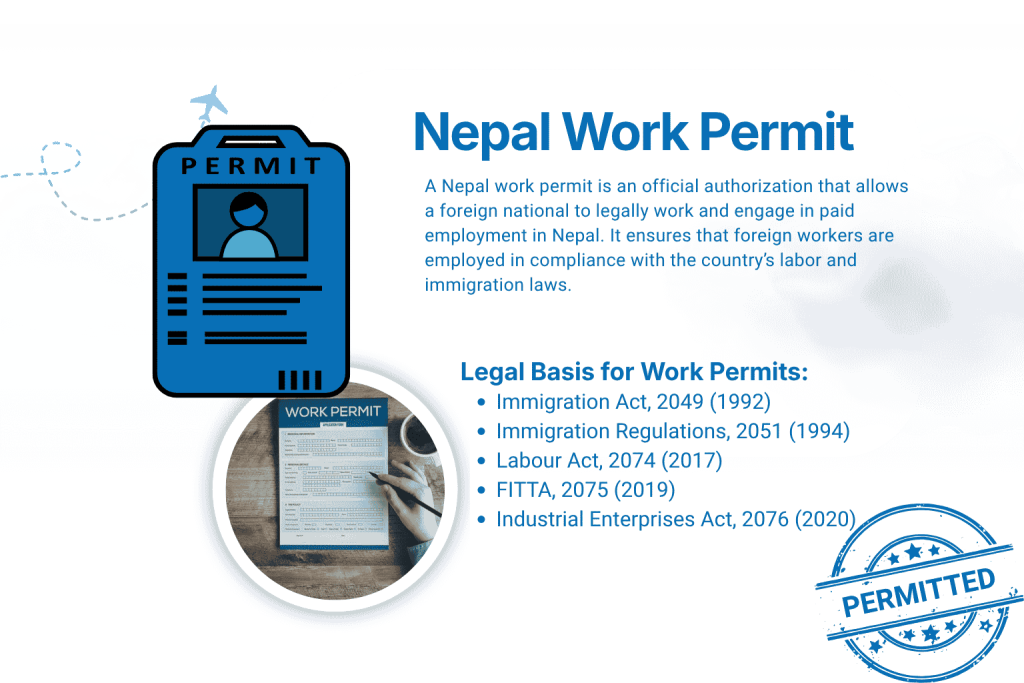
Work Permit for Foreigners in Nepal is governed by a regulated legal framework that all foreign nationals must follow. Nepal allows foreign nationals to work within its territory under rules set by the government, primarily through the Department of Immigration and the Department of Labour, Employment and Social Security, which control the entry and employment of foreign workers. Any foreigner who intends to work in Nepal must obtain a valid work permit before commencing any form of employment.
This article explains every aspect of the Nepal work permit process, applicable laws, required documents, fees, and timelines.
What Is a Work Permit in Nepal?
A work permit in Nepal is an official authorization issued by the government that allows a foreign national to legally work within the country. It is a mandatory document for all foreigners seeking employment in Nepal, whether in private companies, NGOs, INGOs, or foreign-invested firms.
The legal basis for work permits in Nepal comes from several laws:
- The Immigration Act, 2049 (1992)
- The Immigration Regulations, 2051 (1994)
- The Labour Act, 2074 (2017)
- The Foreign Investment and Technology Transfer Act (FITTA), 2075 (2019)
- The Industrial Enterprises Act, 2076 (2020)
Under Section 8 of the Immigration Act 2049, a non-tourist visa or a non-residential visa is required for a foreigner to reside and work in Nepal. The work permit operates alongside the appropriate visa category.
Who Needs a Work Permit in Nepal?
Every foreign national who is employed or intends to be employed in Nepal requires a work permit. This includes:
- Employees of foreign-invested companies registered in Nepal
- Technical experts and consultants hired by Nepali companies
- Staff of international NGOs and INGOs operating in Nepal
- Employees of diplomatic missions (subject to separate rules)
- Foreign nationals employed under bilateral agreements
Indian nationals are an exception. Under the 1950 Treaty of Peace and Friendship between Nepal and India, Indian citizens do not require a work permit to work in Nepal.
What Types of Visas Are Associated with Work Permits in Nepal?

Foreign nationals working in Nepal must hold an appropriate visa category. The Department of Immigration Nepal issues the following relevant visa types:
| Visa Type | Purpose | Validity |
|---|---|---|
| Non-Tourist Visa (Business Visa) | For foreign investors and business persons | Renewable annually |
| Non-Residential Visa | For employees of foreign-invested companies | Based on work permit duration |
| Residential Visa | For long-term residents with employment | Renewable |
| INGO/NGO Visa | For staff of international organizations | Based on affiliation |
The non-tourist visa is the primary visa category linked to work permit holders. It is issued by the Department of Immigration Nepal based on recommendations from relevant ministries.
Which Authority Issues Work Permits in Nepal?
The Department of Labour, Employment and Social Security under the Ministry of Labour, Employment and Social Security is the primary authority for issuing work permits to foreigners in Nepal.
However, the process also involves:
- Department of Immigration Nepal – For visa issuance and extension
- Department of Industry – For companies under FITTA
- Social Welfare Council – For INGO and NGO employees
- Ministry of Foreign Affairs – For diplomatic and UN employees
The applicant must approach the correct authority depending on their employment type.
What Are the Eligibility Criteria for a Nepal Work Permit?
To obtain a work permit in Nepal, the following conditions must be met:
- The employer must be a legally registered entity in Nepal
- The position must require specific technical expertise not available locally
- The employment contract must be valid and notarized
- The foreign worker must hold a valid passport and appropriate visa
- The employer must obtain prior approval from the Department of Labour
Under the Labour Act 2074, an employer must first demonstrate that the position cannot be filled by a Nepali citizen before hiring a foreign national. This condition protects domestic labor under Section 3 of the Labour Act 2074.
What Documents Are Required for a Work Permit in Nepal?

The following documents are generally required when applying for a work permit in Nepal:
For the Employer:
- Copy of company registration certificate
- Copy of PAN/VAT registration
- Copy of tax clearance certificate
- Letter of employment/appointment letter
- Board decision or authorization letter
- Copy of FITTA approval (if applicable)
For the Foreign Employee:
- Valid passport (with minimum 6 months validity)
- Recent passport-sized photographs
- Completed application form
- Employment contract (original and copy)
- Academic and professional certificates (authenticated)
- Police clearance certificate from home country
- Medical fitness certificate
- Copy of existing visa (if already in Nepal)
The documents must be authenticated and may require notarization depending on the country of origin.
What Is the Step-by-Step Process to Apply for a Work Permit in Nepal?

The work permit application process in Nepal follows a defined procedure:
- Employer Registration – The hiring company must be registered under the relevant Nepali law (Companies Act 2006, FITTA 2019, etc.)
- Labor Approval – The employer submits a request to the Department of Labour, Employment and Social Security to hire a foreign national, with justification.
- Document Submission – The employer and employee submit all required documents to the Department of Labour.
- Verification – The Department verifies the documents, the company’s registration, and employment terms.
- Work Permit Issuance – Upon approval, the Department of Labour issues the work permit.
- Visa Application/Extension – The foreign national then applies for a non-tourist visa or extends their visa at the Department of Immigration Nepal based on the work permit.
- Registration – The foreign employee registers with local ward offices if they are staying for an extended period.
Processing time typically ranges from 15 to 30 working days, depending on the completeness of documents and the nature of employment.
What Are the Fees for a Work Permit in Nepal?
The fees for a work permit in Nepal vary depending on the type of employment and duration. Below is a general fee structure as per official guidelines:
| Work Permit Duration | Fee (NPR) |
|---|---|
| Up to 1 Year | NPR 5,000 – NPR 10,000 |
| Renewal (Annual) | NPR 5,000 – NPR 10,000 |
| INGO/NGO Staff (Annual) | As per Social Welfare Council rates |
| Technical Expert | Based on contract duration |
These fees are subject to change. Applicants must confirm the current fee structure at the Department of Labour, Employment and Social Security or the Department of Immigration.
Additionally, the non-tourist visa fee at the Department of Immigration is separate and charged per the visa category and duration.
How Long Is a Work Permit Valid in Nepal?
A work permit in Nepal is generally valid for one year and is renewable annually. The renewal must be initiated before the expiration of the current permit. The work permit duration is linked to the employment contract. If the contract is for two years, the permit may be issued for that duration but is subject to annual renewal in practice.
Under the FITTA 2019, foreign investors who directly invest in Nepal may receive a work permit for a longer period based on the size and nature of investment. Section 7 of FITTA 2019 allows for special provisions for foreign investors.
Can a Work Permit Be Renewed in Nepal?
Yes. A work permit in Nepal can be renewed. The renewal process requires:
- Application for renewal submitted at least 30 days before expiry
- Updated employment contract
- Tax clearance of the employer
- Updated PAN/VAT certificate
- Renewal fee payment
Failure to renew on time may result in a fine or visa complications. The Department of Immigration may also require the foreign national to exit and re-enter Nepal if the visa lapses alongside the work permit.
What Are the Restrictions on Foreign Workers in Nepal?
Nepal’s labor law places several restrictions on the employment of foreign nationals:
- Foreign workers cannot be employed in positions where qualified Nepali candidates are available
- The number of foreign employees in a company may be restricted based on company size and investment type
- Foreign workers cannot engage in political activities while on a work permit
- Employment in sensitive sectors such as defense and certain public services is not permitted for foreigners
- A foreign worker cannot change employers without obtaining a new work permit
Under the Labour Act 2074 and the Immigration Regulations 2051, working without a valid permit is a punishable offense that may result in deportation and blacklisting.
What Happens If a Foreigner Works in Nepal Without a Work Permit?
Working in Nepal without a valid work permit is a violation of the Immigration Act 2049 and the Labour Act 2074. The consequences include:
- Arrest and detention by immigration authorities
- Deportation from Nepal
- Blacklisting, which prevents future entry into Nepal
- Fines imposed on both the employer and employee
- Cancellation of the employer’s business registration in serious cases
The Department of Immigration Nepal conducts periodic checks and raids on businesses to identify undocumented foreign workers. Both the employer and the foreign employee face legal liability under Section 22 of the Immigration Act 2049.
Are There Special Work Permit Rules for INGO and NGO Workers in Nepal?
Foreign nationals working for international NGOs and INGOs in Nepal must follow a separate procedure. The Social Welfare Council (SWC) under the Social Welfare Act 2049 (1992) regulates INGOs operating in Nepal.
Foreign INGO employees must:
- Obtain SWC affiliation for their organization
- Get approval from the SWC for each foreign staff position
- Hold a valid non-tourist visa linked to SWC approval
- Register with the Department of Immigration
The Social Welfare Council Nepal (www.swc.org.np) maintains a roster of affiliated INGOs and their approved foreign staff positions.
Frequently Asked Questions (FAQs)
1. Can Indian nationals work in Nepal without a work permit?
Yes. Indian nationals are exempt from work permit requirements in Nepal under the 1950 Treaty of Peace and Friendship between Nepal and India. They may work freely without obtaining a formal work permit.
2. How long does it take to get a work permit in Nepal?
The processing time for a work permit in Nepal typically takes 15 to 30 working days from the date of submission of complete documents at the Department of Labour, Employment and Social Security.
3. Can a tourist visa be converted into a work visa in Nepal?
No. A tourist visa cannot be directly converted into a work permit visa in Nepal. The applicant must exit Nepal and apply for the appropriate non-tourist visa through the designated process.
4. Who is responsible for applying for the work permit the employer or the employee?
The employer initiates the work permit process in Nepal. The employer submits the application to the Department of Labour on behalf of the foreign employee and takes responsibility for the employment.
5. Is a work permit required for foreign volunteers in Nepal?
Yes. Foreign nationals who volunteer in Nepal for NGOs or INGOs must also obtain proper authorization. Short-term volunteers may hold a tourist visa for limited periods, but formal long-term volunteering requires a work permit.
6. Where can I submit a work permit application in Nepal?
Work permit applications are submitted to the Department of Labour, Employment and Social Security in Kathmandu. Visa-related procedures are handled by the Department of Immigration Nepal at Maitighar, Kathmandu. Official information is available at www.immigration.gov.np.