



Wills and Trust Law in Nepal Nepal has a structured legal framework governing wills and trusts. The laws define how a person can distribute their property during their lifetime or after death. Understanding wills and trust law in Nepal is essential for property owners, legal heirs, and anyone dealing with estate planning or asset protection. This article covers the legal provisions, procedures, requirements, and relevant laws related to wills and trusts in Nepal.
What is a Will Under Nepal Law?
A will is a legal document through which a person expresses their wishes regarding the distribution of their property after their death. In Nepal, the law recognizes a will as a valid instrument of property succession.
The Muluki Civil Code, 2017 (2074 BS) is the primary legislation governing wills in Nepal. Part 4 of the Muluki Civil Code deals with inheritance, property succession, and testamentary matters. Section 521 onwards of the Muluki Civil Code addresses the making and validity of a will in Nepal.
Under Nepal law, a will is a unilateral declaration made by a testator the person making the will expressing how their property should be distributed upon their death. The testator must be of sound mind and legal age at the time of executing the will.
What Are the Legal Requirements for a Valid Will in Nepal?
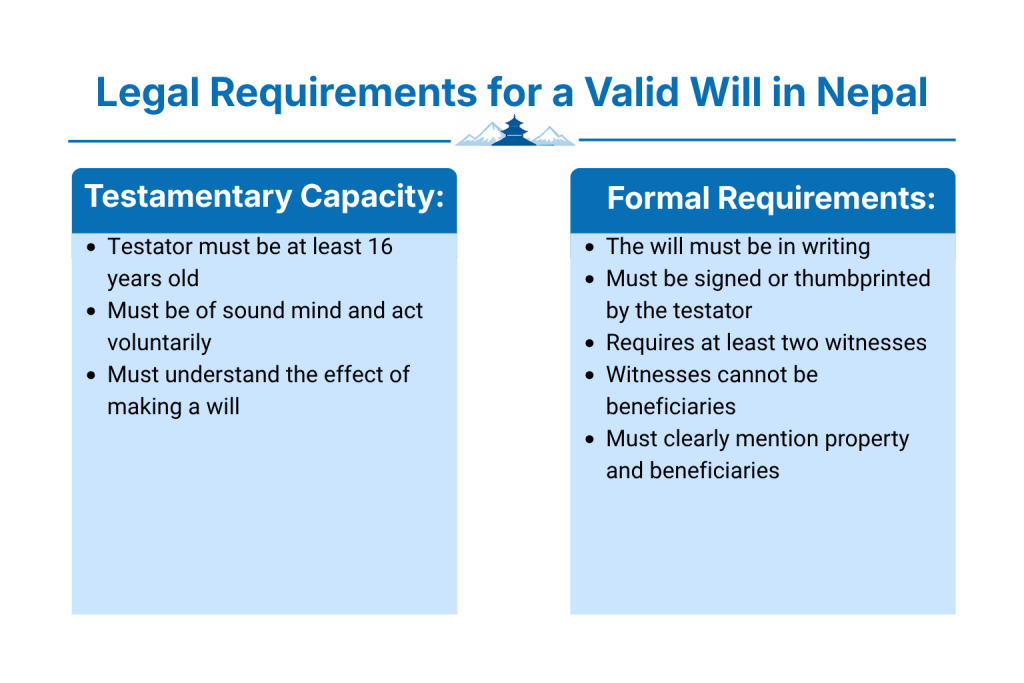
For a will to be legally valid under Nepal law, several conditions must be satisfied.
Testamentary Capacity
- The testator must be at least 16 years of age
- The testator must be of sound mind (mentally competent)
- The testator must not be under undue influence, fraud, or coercion
- The testator must understand the nature and consequences of making a will
Formal Requirements Under Muluki Civil Code 2017
- The will must be made in writing
- The testator must sign or put a thumbprint on the will
- The will must be attested by at least two witnesses
- The witnesses must not be beneficiaries named in the will
- The will must clearly identify the testator, the property, and the beneficiaries
The Registration Act, 2076 BS (2019 AD) allows for the optional registration of a will. While registration is not mandatory in Nepal, registering a will with the District Administration Office (DAO) or relevant registration authority strengthens its legal validity and reduces the risk of disputes.
What Types of Wills Are Recognized in Nepal?
Nepal law recognizes different forms of wills based on their execution.
| Type of Will | Description | Legal Basis |
|---|---|---|
| Written Will | Formally drafted, signed, and witnessed document | Muluki Civil Code, 2074 BS |
| Holographic Will | Entirely handwritten and signed by the testator | Recognized under Civil Code |
| Registered Will | Will registered at the District Administration Office | Registration Act, 2076 BS |
| Oral Will (Deathbed) | Made verbally under special circumstances | Limited recognition under Civil Code |
A registered will carries more legal weight in Nepal as it creates an official record. It reduces the possibility of a will being challenged by legal heirs or other parties after the testator’s death.
How Does Succession Work Under Nepal’s Inheritance Law?
When a person dies without a will (intestate), their property is distributed according to the rules of intestate succession under the Muluki Civil Code, 2017. The law establishes a hierarchy of legal heirs.
Order of Succession Under Muluki Civil Code 2074
- Class I Heirs: Spouse, sons, daughters, daughters-in-law (widow), and grandsons/granddaughters
- Class II Heirs: Father, mother, brothers, sisters
- Class III Heirs: Paternal grandparents and other relatives
When a valid will exists, it overrides the default rules of intestate succession, subject to certain protected shares for compulsory heirs. Nepal law protects the rights of spouses and children even when a will is present. A testator cannot entirely disinherit a spouse or dependent children under the Muluki Civil Code, 2017.
Can a Will Be Challenged or Revoked in Nepal?
Yes, a will can be both challenged and revoked under Nepal law.
Grounds for Challenging a Will
- The testator lacked testamentary capacity at the time of execution
- The will was made under undue influence, fraud, or misrepresentation
- The will does not meet the formal requirements under the Muluki Civil Code
- The will violates the compulsory share of protected heirs
- The witnesses were not qualified or were beneficiaries
Revocation of a Will
A testator can revoke a will at any time before death by:
- Making a new will that explicitly revokes the previous one
- Destroying the will with the intention to revoke
- Executing a formal deed of revocation
Nepal law follows the principle that the last valid will takes precedence over earlier wills. Courts in Nepal adjudicate will disputes through the district courts under civil jurisdiction.
What is a Trust Under Nepal Law?
A trust is a legal arrangement where one party (the settlor) transfers property to another party (the trustee) to hold and manage for the benefit of a third party (the beneficiary).
In Nepal, trusts are primarily governed by the Trust Act, 2063 BS (2006 AD). The Trust Act establishes the legal framework for the creation, registration, administration, and dissolution of trusts in Nepal.
Trusts in Nepal are commonly used for:
- Charitable purposes (schools, hospitals, religious institutions)
- Property management for minors or incapacitated persons
- Estate planning to manage inheritance and assets
- Public benefit organizations and non-governmental purposes
How is a Trust Created and Registered in Nepal?

Creating a trust in Nepal involves several legal steps.
Steps to Create a Trust in Nepal
- Draft a Trust Deed — A trust deed must be prepared specifying the nature of the trust, the settlor, trustee, beneficiaries, purpose, and property transferred
- Identify the Trust Property — Clearly describe the assets being transferred into the trust
- Appoint a Trustee — The trustee can be an individual or a legal entity with legal capacity
- Execute the Trust Deed — The settlor must sign the trust deed before a notary or relevant authority
- Register the Trust — Submit the trust deed for registration at the District Administration Office or the relevant authority under the Trust Act, 2063
- Obtain Registration Certificate — The trust becomes a legally recognized entity upon receiving the registration certificate
Documents Required for Trust Registration in Nepal
- Completed application form
- Trust deed (original and copies)
- Citizenship certificates of settlor and trustees
- Property ownership documents
- Passport-size photographs of trustees
- Tax clearance certificate (if applicable)
- Organizational objectives and rules
The Ministry of Home Affairs and District Administration Offices oversee trust registration in Nepal. For more information, visit the Ministry of Home Affairs, Nepal.
What Are the Duties and Responsibilities of a Trustee in Nepal?
Under the Trust Act, 2063 BS, a trustee carries significant legal responsibilities.
| Duty of Trustee | Legal Requirement |
|---|---|
| Fiduciary Duty | Act in the best interests of beneficiaries |
| Duty of Care | Manage trust property with reasonable care |
| Duty to Account | Maintain records and accounts of trust property |
| Duty of Loyalty | Avoid conflicts of interest |
| Duty to Follow Trust Deed | Act within the scope of the trust document |
| Duty to Preserve Assets | Protect and maintain trust property |
A trustee who violates their duties can be held personally liable under the Trust Act, 2063 BS. Beneficiaries have the right to seek legal remedies through the courts if a trustee mismanages the trust property.
What is the Difference Between a Will and a Trust in Nepal?

Both wills and trusts serve estate planning purposes, but they differ significantly in their legal nature and operation.
- A will takes effect only after the death of the testator, while a trust can operate during the settlor’s lifetime (inter vivos trust) or after death (testamentary trust)
- A will goes through probate proceedings and becomes a public document, while a trust offers greater privacy
- A will is subject to challenge by legal heirs, while a properly constituted trust may be more difficult to challenge
- A trust provides continuous management of assets, particularly useful for minor beneficiaries or incapacitated persons
- A will distributes assets immediately after probate, while a trust can distribute assets over a specified period
Nepal does not have a comprehensive probate court system like some countries, but district courts handle succession and inheritance disputes under the civil jurisdiction established by the Muluki Civil Code, 2017 and the Court Management Act.
What Are the Tax Implications of Wills and Trusts in Nepal?
The Income Tax Act, 2058 BS (2002 AD) and the Property Tax regulations under local government laws apply to trust income and inherited property in Nepal.
- Inherited property through a will may be subject to property registration fees and applicable taxes
- Trust income is taxable under the Income Tax Act, 2058 if the trust generates income
- Charitable trusts may qualify for tax exemption under the Income Tax Act if they fulfill specified public benefit criteria
- Property transferred through a will requires re-registration at the Land Revenue Office, attracting registration fees
The Inland Revenue Department of Nepal (www.ird.gov.np) provides guidelines on tax treatment of trusts and inherited property.
Conclusion
Wills and trust law in Nepal is governed by the Muluki Civil Code, 2017 (2074 BS) and the Trust Act, 2063 BS (2006 AD). These laws establish clear procedures for creating valid wills, registering trusts, managing trust property, and distributing assets to legal heirs and beneficiaries. Proper legal documentation, compliance with formal requirements, and timely registration are essential for securing property rights under Nepal’s succession and trust framework. Consulting a qualified legal professional in Nepal is recommended for estate planning, will drafting, or trust formation to ensure full compliance with applicable laws.
FAQs
1. Is it mandatory to register a will in Nepal?
No, registration of a will is not mandatory under Nepal law. However, registering a will at the District Administration Office under the Registration Act, 2076 BS significantly strengthens its legal validity and reduces the likelihood of disputes among heirs.
2. Can a foreigner make a will for property located in Nepal?
Yes, a foreigner who owns property in Nepal can execute a will for that property. However, the will must comply with the Muluki Civil Code, 2017 and Nepal’s property laws. Foreign nationals are subject to restrictions on property ownership under Nepal’s land laws.
3. What happens if a person dies without a will in Nepal?
If a person dies intestate (without a will), their property is distributed according to the succession rules under the Muluki Civil Code, 2017. The property passes to legal heirs in the order of Class I, Class II, and Class III heirs as established by the code.
4. How long does it take to register a trust in Nepal?
Trust registration in Nepal typically takes 15 to 30 working days after submission of all required documents to the District Administration Office. Processing time may vary depending on the completeness of documents and the workload of the relevant authority.
5. Can a trustee be removed in Nepal?
Yes, a trustee can be removed under the Trust Act, 2063 BS. Removal can occur through a court order, by the terms of the trust deed, or by mutual agreement among beneficiaries if the trustee has breached fiduciary duties or mismanaged trust property.
6. Can a will override the legal share of a spouse or children in Nepal?
No, a will cannot completely override the compulsory share of a spouse and dependent children under the Muluki Civil Code, 2017. Nepal law protects certain minimum rights of immediate family members regardless of the testator’s wishes expressed in a will.