


Nepal is becoming an increasingly popular destination for digital nomads from around the world. The combination of low cost of living, breathtaking landscapes, rich culture, and improving internet infrastructure makes Nepal an attractive base for remote workers. However, many digital nomads ask one fundamental question before booking their flights: What visa do I need to work remotely from Nepal? Understanding the Visa for Digital Nomads in Nepal is essential for remote workers to ensure they choose the right visa type and comply with local immigration regulations.
This article provides a detailed, factual, and straightforward breakdown of everything a digital nomad needs to know about visas, legal frameworks, costs, and procedures for staying in Nepal as a remote worker.
What Is a Digital Nomad Visa?
A digital nomad visa is a special visa category issued by a country that allows foreign nationals to live within its borders while earning income remotely from clients or employers located outside that country. Countries like Portugal, Indonesia (Bali), and Thailand have introduced formal digital nomad visa programs.
Does Nepal have a dedicated Digital Nomad Visa?
As of 2024, Nepal does not have a dedicated digital nomad visa. The Government of Nepal has not formally enacted a specific visa category under the Immigration Act 2049 (1992) or the Immigration Regulations 2051 (1994) that is exclusively designed for remote workers or digital nomads.
However, digital nomads can legally reside in Nepal using existing visa categories, most commonly the Tourist Visa, provided they are earning income from sources outside Nepal and are not engaging in local employment.
Which Visa Do Digital Nomads Use in Nepal?
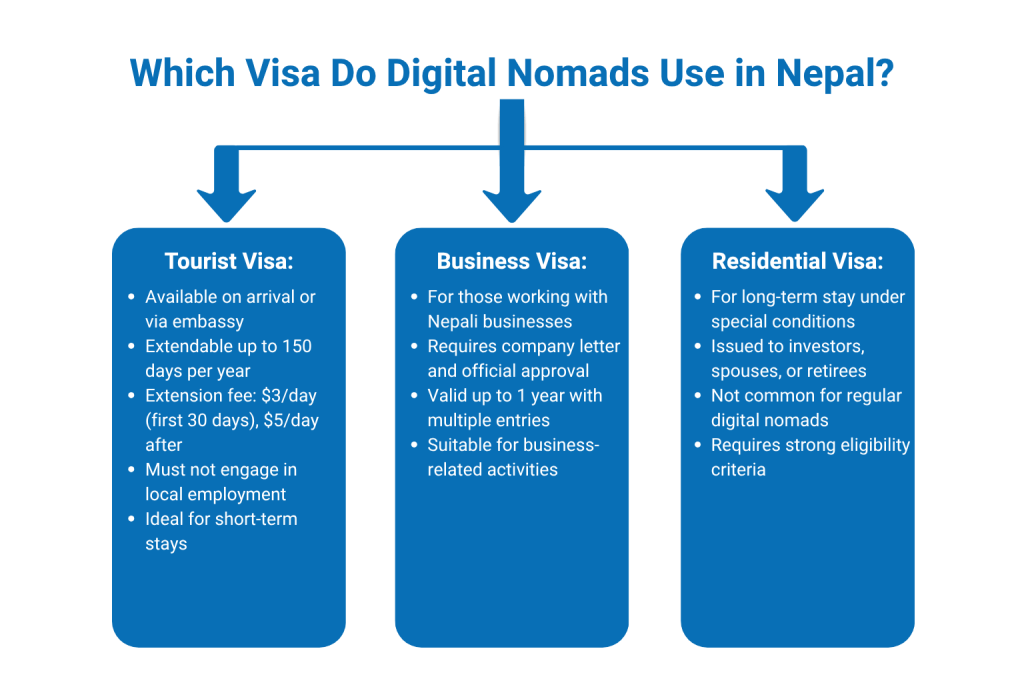
Since there is no specific digital nomad visa for Nepal, remote workers typically rely on the following visa options:
1. Tourist Visa (Most Common for Digital Nomads)
The Tourist Visa is the most widely used visa by digital nomads visiting Nepal. It is issued under the authority of the Department of Immigration, Nepal.
Key Facts:
- Available on arrival at Tribhuvan International Airport (TIA) and major land border crossings
- Available through Nepalese embassies abroad before travel
- Can be extended within Nepal at the Department of Immigration office in Kathmandu
Tourist Visa Duration and Fees:
| Visa Duration | Fee (USD) | Maximum Stay |
|---|---|---|
| 15 Days | $30 | 15 days |
| 30 Days | $50 | 30 days |
| 90 Days | $125 | 90 days |
Citizens of SAARC countries (India, Bangladesh, Bhutan, Maldives, Pakistan, Sri Lanka) receive different fee structures or exemptions.
Tourist Visa Extension:
- Digital nomads can extend their tourist visa up to a maximum of 150 days per calendar year in Nepal.
- Extension fee: $3 per day for up to 30 days; $5 per day beyond 30 days.
- Extensions are processed at the Department of Immigration, Maitighar, Kathmandu.
2. Business Visa
If a digital nomad intends to conduct any business-related activities with Nepalese entities, they may need a Business Visa. This visa is granted to individuals who have legitimate business dealings within Nepal.
Requirements:
- Letter from a registered Nepalese company or organization
- Valid passport with minimum 6 months validity
- Application form from the Department of Immigration
- Recommendation letter from the Nepal Chamber of Commerce or relevant authority
Business visas are typically issued for up to 1 year with multiple entry options.
3. Residential Visa (Non-Tourist Long Stay)
For digital nomads planning an extended stay in Nepal beyond the 150-day annual tourist visa limit, a Residential Visa may be an option. This visa is usually granted to:
- Foreign nationals married to Nepali citizens
- Investors in Nepal
- Certain retired individuals
This visa is not commonly applicable for standard digital nomads but remains an option under specific circumstances defined by the Immigration Act 2049.
Is It Legal to Work Remotely in Nepal on a Tourist Visa?
This is a critical question that many digital nomads raise.
The Legal Position:
Under the Immigration Act 2049 (1992) and Immigration Regulations 2051 (1994), foreign nationals are prohibited from engaging in employment or business activities within Nepal without a valid work permit issued by the Department of Labour, Employment, and Social Security.
However, working remotely for a foreign employer or foreign clients where all income is generated outside Nepal is generally considered to fall outside the definition of “employment in Nepal.” This is the position most digital nomads operate from.
Nepal does not have explicit legislation that criminalizes remote work for foreign companies while on a tourist visa, but there is no official written policy that explicitly permits it either. The legal grey area is similar to that found in most countries without formal digital nomad visa programs.
Practical Reality: Most digital nomads work remotely from Nepal without legal complications as long as:
- They are not employed by or receiving payment from a Nepalese entity
- They are not providing services directly to Nepalese clients for Nepalese Rupees
- They maintain their tax residency in their home country
How to Apply for a Tourist Visa for Nepal?

Option A: Visa on Arrival (At Tribhuvan International Airport)
Steps:
- Fill out the online arrival form at Nepal Immigration Online before travel
- Collect the arrival form at the airport if not filled online
- Proceed to the Visa on Arrival counter at TIA
- Submit passport, photo, and pay the visa fee in USD, EUR, or equivalent
- Collect your visa sticker and proceed to immigration
Documents Required:
- Valid passport (minimum 6 months validity)
- Passport-size photograph
- Visa fee in convertible foreign currency or card payment
- Return ticket or onward travel proof (sometimes requested)
- Proof of sufficient funds
Option B: Visa Through Nepal Embassy Abroad
Steps:
- Locate the nearest Nepalese Embassy or Consulate
- Download and fill the visa application form from the embassy website
- Submit the application with required documents in person or by post
- Pay the applicable visa fee
- Collect the visa within the processing timeframe (usually 3-5 working days)
Internet Connectivity and Infrastructure for Digital Nomads in Nepal
Digital nomads need reliable internet, and Nepal’s connectivity has improved significantly over recent years.
| City/Area | Internet Quality | Average Speed | Coworking Spaces Available |
|---|---|---|---|
| Kathmandu | Good to Excellent | 20–100 Mbps | Yes (Multiple) |
| Pokhara | Good | 15–50 Mbps | Yes (Several) |
| Chitwan | Moderate | 10–30 Mbps | Limited |
| Thamel (Kathmandu) | Excellent | 30–100 Mbps | Yes |
| Rural/Trekking Areas | Poor to None | Under 5 Mbps | No |
Nepal Telecom, Ncell, and private ISPs like WorldLink and Vianet provide broadband and fiber internet services in major urban areas.
Cost of Living for Digital Nomads in Nepal
Nepal offers one of the lowest costs of living in Asia, making it a financially practical destination for remote workers.
Monthly Budget Breakdown (Approximate in USD):
- Accommodation: $200–$600 (furnished apartment or guesthouse)
- Food: $150–$300 (mix of local and international)
- Internet (Home Broadband): $15–$30
- Local Transport: $30–$60
- Coworking Space Membership: $50–$150
- Health Insurance: $50–$100 (recommended, as Nepal lacks high-standard public healthcare)
- Miscellaneous: $50–$100
Estimated Total Monthly Cost: $550 – $1,300 USD depending on lifestyle.
Coworking Spaces for Digital Nomads in Nepal
Several coworking spaces in Kathmandu and Pokhara cater specifically to remote workers and entrepreneurs.
Notable Coworking Spaces:
- Kumaripati Workspace – Kathmandu
- Hive – Thamel, Kathmandu
- StartHub Nepal – Lalitpur
- Idea Studio Nepal – Kathmandu
- Pokhara Cowork – Pokhara Lakeside
These spaces typically offer high-speed internet, meeting rooms, printing facilities, and community networking events.
Tax Obligations for Digital Nomads in Nepal
What are the tax implications for digital nomads in Nepal?
Nepal’s Income Tax Act 2058 (2002) defines tax residency based on physical presence. A foreign national who stays in Nepal for 183 days or more in a fiscal year may be considered a tax resident of Nepal and could be liable for income tax on worldwide income.
Key Points:
- Nepal’s fiscal year runs from mid-July to mid-July (Shrawan to Ashadh in the Nepali calendar)
- The standard income tax rate for individuals ranges from 1% to 36% depending on income bracket
- Digital nomads staying less than 183 days generally do not trigger Nepali tax residency
- Double Tax Avoidance Agreements (DTAAs) exist between Nepal and certain countries, which may provide relief from double taxation
Digital nomads should consult a tax professional in both Nepal and their home country to understand their specific obligations. The Inland Revenue Department of Nepal provides guidance on tax residency and obligations.
Is Nepal Planning a Formal Digital Nomad Visa?
As of 2024, there has been ongoing discussion within the Nepalese tourism and immigration sectors about introducing a formal digital nomad visa or long-term remote worker visa. The Nepal Tourism Board and private sector stakeholders have advocated for such a policy as a means to attract higher-spending, longer-staying visitors.
The Government of Nepal, through the Ministry of Tourism and Civil Aviation, has mentioned digital nomad-friendly policy development in various tourism strategy documents. However, no formal legislation or visa category has been officially enacted as of the date of this publication.
Travelers and remote workers planning a visit to Nepal should regularly check the Department of Immigration Nepal and Nepal Tourism Board websites for any policy updates.
Summary of Visa Options for Digital Nomads in Nepal
| Visa Type | Best For | Max Stay | Cost | Work Remotely? |
|---|---|---|---|---|
| Tourist Visa (30 Days) | Short-term nomads | 30 days (extendable) | $50 | Legally grey but common |
| Tourist Visa (90 Days) | Medium-term stays | 90 days (extendable to 150/year) | $125 | Legally grey but common |
| Business Visa | Business dealings | Up to 1 year | Varies | For Nepali business activity |
| Residential Visa | Long-term residents | Annual renewal | Varies | Requires specific eligibility |
Frequently Asked Questions (FAQs)
1. Does Nepal have a digital nomad visa in 2024?
No. As of 2024, Nepal does not have a dedicated digital nomad visa. Remote workers typically use the tourist visa, which allows stays of up to 150 days per calendar year when extended through the Department of Immigration.
2. Can I legally work remotely from Nepal on a tourist visa?
Working for a foreign employer or foreign clients while on a tourist visa exists in a legal grey area. Nepal’s immigration law prohibits local employment, but remote work for overseas entities is generally not explicitly regulated or prosecuted.
3. How long can a digital nomad stay in Nepal per year?
On a tourist visa, a foreign national can stay a maximum of 150 days per calendar year in Nepal. Extensions are processed at the Department of Immigration office in Maitighar, Kathmandu, at a fee of $3–$5 per day.
4. What is the cost of a Nepal tourist visa for 30 days?
A Nepal tourist visa for 30 days costs $50 USD. It is available on arrival at Tribhuvan International Airport and major border crossings, or through Nepalese embassies abroad before travel.
5. Is Nepal a good destination for digital nomads?
Nepal offers a very low cost of living, improving internet infrastructure, a rich cultural environment, and good coworking spaces in Kathmandu and Pokhara, making it a practical and appealing destination for digital nomads on moderate budgets.
6. Do digital nomads need to pay taxes in Nepal?
Foreign nationals staying fewer than 183 days per fiscal year in Nepal generally do not become tax residents. Those staying longer may be subject to Nepalese income tax under the Income Tax Act 2058. Consulting the Inland Revenue Department is advisable.