

Nepal’s textile and garment industry is one of the oldest and most significant sectors in the country’s economy. From pashmina products to ready-made garments, Nepal has built a strong reputation in global markets. If you plan to start a textile or garment business in Nepal, you must complete the formal company registration process as required by Nepali law.
This article explains everything about textile and garment company registration in Nepal, including the legal framework, procedures, required documents, and applicable licenses.
What Is the Legal Framework for Textile and Garment Company Registration in Nepal?
The registration of a textile or garment company in Nepal is governed by several laws and regulations. You must comply with multiple legal instruments before commencing operations.
The primary laws that apply include:
- Companies Act, 2063 (2006) – Governs the incorporation and operation of private and public limited companies in Nepal.
- Industrial Enterprises Act, 2076 (2020) – Provides the framework for industrial registration, classification, and operation of manufacturing units including textile and garment factories.
- Foreign Investment and Technology Transfer Act (FITTA), 2075 (2019) – Applicable if foreign investment is involved in the textile or garment company.
- Labor Act, 2074 (2017) – Regulates employment, worker welfare, and factory conditions.
- Value Added Tax Act, 2052 (1996) – Applicable for VAT registration.
- Income Tax Act, 2058 (2002) – Governs taxation of business income.
The Office of the Company Registrar (OCR) under the Ministry of Industry, Commerce and Supplies is the primary authority for company registration in Nepal. You can visit the official OCR portal at www.ocr.gov.np.
What Types of Business Structures Can You Choose for a Textile Company in Nepal?
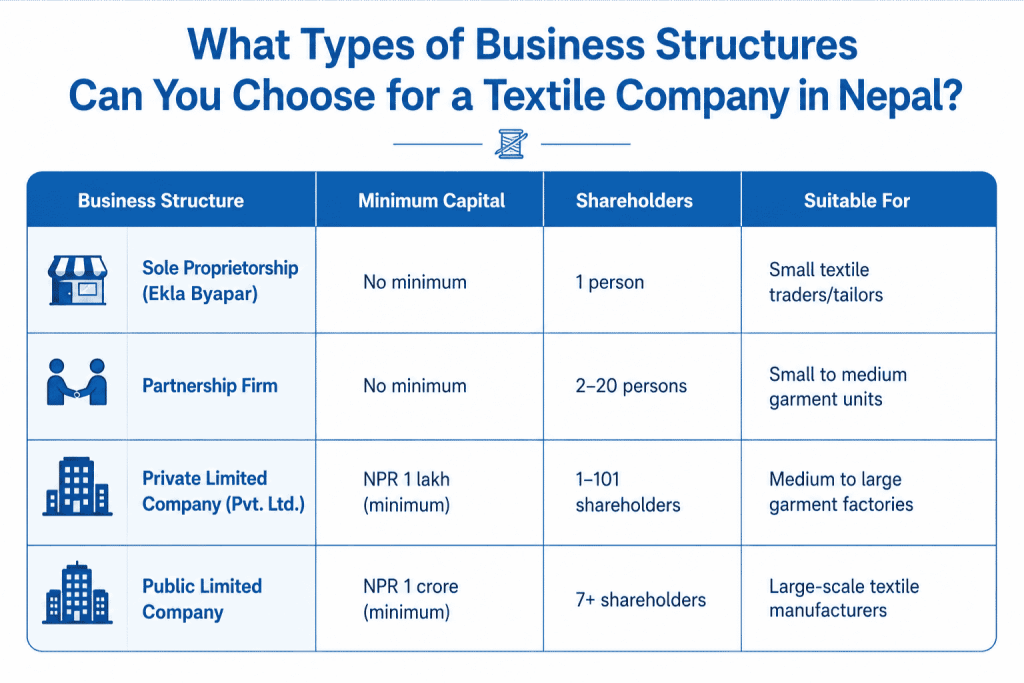
Before registering a textile or garment company in Nepal, you must decide on the business structure. Each structure has different legal, financial, and operational implications.
| Business Structure | Minimum Capital | Shareholders | Suitable For |
|---|---|---|---|
| Sole Proprietorship (Ekla Byapar) | No minimum | 1 person | Small textile traders/tailors |
| Partnership Firm | No minimum | 2–20 persons | Small to medium garment units |
| Private Limited Company (Pvt. Ltd.) | NPR 1 lakh (minimum) | 1–101 shareholders | Medium to large garment factories |
| Public Limited Company | NPR 1 crore (minimum) | 7+ shareholders | Large-scale textile manufacturers |
For most garment manufacturing companies and textile export businesses in Nepal, a Private Limited Company is the most preferred structure because it provides limited liability protection, easier access to bank loans, and better credibility for export purposes.
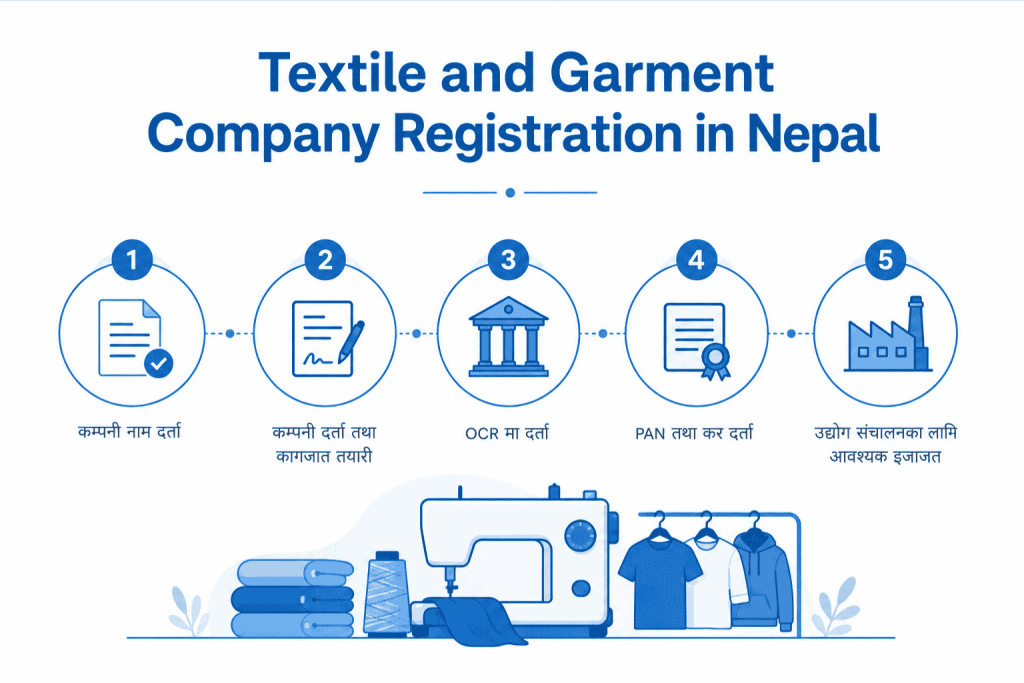
What Are the Steps to Register a Textile and Garment Company in Nepal?
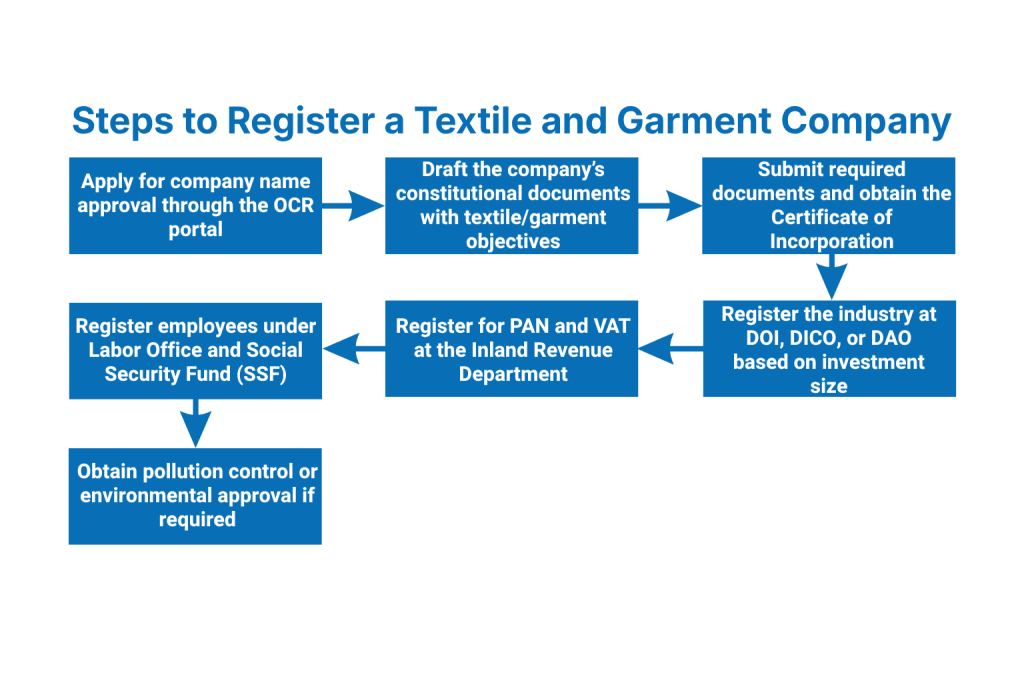
The registration process involves multiple stages across different government offices. The process is structured and sequential.
Step 1: Name Reservation at the Office of the Company Registrar
The first step is to reserve a company name through the OCR’s online portal. The name must be unique and must not conflict with existing registered companies.
- Visit www.ocr.gov.np and apply for name reservation.
- Submit proposed company names (at least 3 options).
- Pay the name reservation fee.
- Receive approval within 3–7 working days.
Step 2: Prepare the Memorandum of Association (MOA) and Articles of Association (AOA)
The MOA and AOA are the constitutional documents of the company. For a textile and garment company, the MOA must clearly state:
- The name and registered address of the company.
- The objectives of the company, including manufacturing, trading, exporting of textile and garment products.
- The authorized and paid-up share capital.
- Details of shareholders and their shareholding percentage.
Step 3: Submit Company Registration Documents at OCR
Once the documents are prepared, submit them to the OCR along with required documents and applicable fees.
Required Documents for Company Registration:
- Duly filled application form (Form No. 1 under Companies Act 2063)
- Memorandum of Association (MOA)
- Articles of Association (AOA)
- Citizenship certificates of all shareholders and directors
- Passport-size photographs of all shareholders and directors
- Proof of registered office address (land ownership certificate or rental agreement)
- PAN card copies of all shareholders
- Consent letter of directors (Form No. 4)
- Declaration by the company promoters
After submission and verification, the OCR issues a Certificate of Incorporation, which is the legal proof of company existence.
Step 4: Register the Industry at the Department of Industry
After company incorporation, you must register your textile or garment business as an industrial enterprise under the Industrial Enterprises Act, 2076. This is done at the Department of Industry (DOI) or the concerned District Administration Office (DAO) depending on the size of the enterprise.
Classification under Industrial Enterprises Act 2076:
| Category | Fixed Capital | Registration Authority |
|---|---|---|
| Cottage Industry | Below NPR 1.5 million | District Administration Office (DAO) |
| Small Industry | NPR 1.5 million to NPR 150 million | District Industry Commerce Office (DICO) |
| Medium Industry | NPR 150 million to NPR 500 million | Department of Industry (DOI) |
| Large Industry | Above NPR 500 million | Department of Industry (DOI) |
The industrial registration certificate is essential for accessing government incentives, tax exemptions, and export benefits available to the textile and garment sector.
Documents Required for Industrial Registration:
- Application form as per DOI format
- Copy of company registration certificate (from OCR)
- MOA and AOA copies
- Land ownership document or lease agreement for factory premises
- Passport photos of the company directors
- PAN/VAT registration certificate
- Project description and feasibility report
Step 5: PAN and VAT Registration at Inland Revenue Department (IRD)
Every company in Nepal must register for a Permanent Account Number (PAN) at the Inland Revenue Department (IRD). If annual turnover exceeds NPR 5 million, VAT registration is mandatory under Section 10 of the VAT Act, 2052.
For textile and garment companies that export products, VAT registration is especially important because exports are zero-rated under Nepali tax law, which allows businesses to claim VAT refunds on inputs used in export production.
Step 6: Labor Registration and Social Security Fund (SSF) Registration
If the textile or garment factory employs workers, you must comply with the Labor Act, 2074. You must:
- Register with the Department of Labor and maintain a labor register.
- Register with the Social Security Fund (SSF) at www.ssf.gov.np.
- Contribute 20% of basic salary toward SSF (employer contributes 20%, employee contributes 11%).
- Maintain minimum wage compliance. As per the Government of Nepal’s 2023 notification, the minimum wage for general workers is NPR 15,000 per month.
Garment factories must also comply with the Factory and Factory Workers Act and maintain proper records of working hours, overtime, and leave policies.
Step 7: Environment and Pollution Clearance
Textile dyeing and processing units may require an Environmental Impact Assessment (EIA) or Initial Environmental Examination (IEE) under the Environment Protection Act, 2076. This is administered by the Ministry of Forests and Environment.
Garment manufacturing units that involve wet processing, dyeing, or chemical usage must obtain pollution control approval from the Department of Environment.
What Licenses and Permits Are Required for a Textile and Garment Business in Nepal?
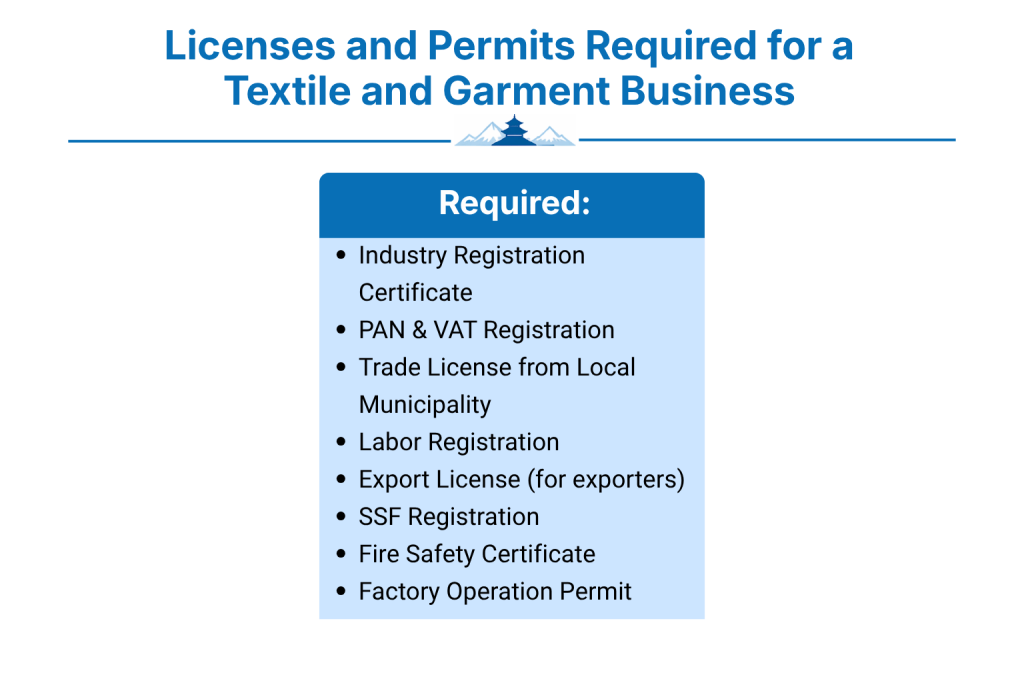
Beyond company registration and industrial registration, a textile and garment company may require multiple permits depending on the nature of operations.
Key Licenses and Registrations:
- Industry Registration Certificate – Department of Industry / DICO
- PAN Certificate – Inland Revenue Department
- VAT Registration Certificate – Inland Revenue Department
- Trade License (Business Registration) – Local Municipality or Metropolitan City Office
- Labor Registration – Department of Labor and Occupational Safety
- Export License (if exporting) – Department of Customs / Trade and Export Promotion Center Nepal (www.tepc.gov.np)
- SSF Registration – Social Security Fund
- Fire Safety Certificate – Nepal Police / Local Authority
- Factory Operation Permit – District Administration Office
What Are the Benefits of Registering a Textile and Garment Company in Nepal?
The Nepali government provides multiple incentives for the textile and garment sector under the Industrial Enterprises Act, 2076 and various fiscal policies.
Key Benefits Include:
- Export-oriented industries in the garment and textile sector receive income tax concessions. Under the Income Tax Act, 2058, export income may receive up to 25% tax rebate.
- Industries established in Special Economic Zones (SEZs) in Nepal enjoy additional tax holidays and duty exemptions.
- The Trade and Export Promotion Centre Nepal (TEPC) provides market access support and export facilitation.
- Cottage and small industries producing handmade textiles and natural fiber products receive special concessions under the Industrial Enterprises Act.
- Foreign investors can invest in the textile and garment sector under the FITTA 2075, subject to minimum investment thresholds and repatriation rights.
- Nepal’s Generalized System of Preferences (GSP) status in several markets including the EU allows duty-free export of garments from Nepal.
What Is the Timeline and Cost for Textile and Garment Company Registration in Nepal?
Approximate Timeline:
- Name Reservation: 3–7 working days
- Company Incorporation at OCR: 7–15 working days
- Industrial Registration at DOI/DICO: 15–30 working days
- PAN/VAT Registration at IRD: 3–7 working days
- Trade License from Municipality: 5–10 working days
- Labor and SSF Registration: 5–7 working days
Total Approximate Timeline: 30–60 working days (depending on the size and nature of the industry)
Approximate Registration Costs:
- OCR company registration fee: Varies by share capital (starts from NPR 9,000 for small capital)
- Industry registration fee: Varies by category (Cottage to Large Industry)
- PAN/VAT registration: Free
- Trade license fee: Varies by municipality
- Government stamp duty and notarization: Applicable on documents
FAQs
1. Can a foreign national register a textile and garment company in Nepal?
Yes. Foreign nationals can register a textile and garment company in Nepal under the Foreign Investment and Technology Transfer Act (FITTA), 2075. A minimum foreign investment threshold applies, and repatriation rights are guaranteed under Nepali law.
2. What is the minimum capital required to register a private limited textile company in Nepal?
Under the Companies Act, 2063, the minimum paid-up capital for a private limited company in Nepal is NPR 1 lakh (100,000). There is no specific higher minimum for textile companies unless additional sectoral rules apply.
3. Is VAT registration mandatory for a textile and garment company in Nepal?
Yes. If annual turnover exceeds NPR 5 million, VAT registration is mandatory under the VAT Act, 2052. Export-oriented garment companies particularly benefit from VAT registration for input tax refund claims.
4. Which government office handles industrial registration for garment factories in Nepal?
The Department of Industry (DOI) handles registration for medium and large garment factories. Small industries register at the District Industry Commerce Office (DICO), and cottage industries register at the District Administration Office (DAO).
5. Does Nepal offer tax incentives for garment export companies?
Yes. Under the Income Tax Act, 2058, export-oriented industries including garment exporters may receive income tax concessions. Industries in Special Economic Zones (SEZs) receive additional tax holidays as per applicable SEZ regulations.
6. What is the role of TEPC for textile and garment businesses in Nepal?
The Trade and Export Promotion Centre Nepal (TEPC) at www.tepc.gov.np supports garment and textile exporters through market research, trade fair participation, export documentation assistance, and buyer-seller meet facilitation.