



Start a Business in Nepal as a Foreigner is a process governed by specific laws, regulations, and approval requirements set by the Government of Nepal. Nepal welcomes foreign investment in many sectors, but the process involves multiple government agencies, legal compliance, and documentation.
This guide explains every step, legal requirement, and restriction that applies to foreign nationals who want to start a business in Nepal.
Can a Foreigner Start a Business in Nepal?
Yes, a foreigner can start a business in Nepal. The Government of Nepal allows foreign nationals and foreign companies to invest and operate businesses in Nepal under specific legal frameworks. However, foreign business ownership is not unconditional. It is regulated by the Foreign Investment and Technology Transfer Act (FITTA), 2019 (2076 BS), the Companies Act, 2006 (2063 BS), the Industrial Enterprises Act, 2020 (2076 BS), and related laws.
Foreign investors must obtain prior approval from the concerned government authority before registering their company or starting operations. Nepal’s investment policy is designed to attract foreign direct investment (FDI) while protecting domestic industries and maintaining national interest.
Legal Framework Governing Foreign Business in Nepal
The following laws directly govern how a foreigner can start a business in Nepal:
- Foreign Investment and Technology Transfer Act (FITTA), 2019 – the primary law regulating foreign investment, repatriation of profit, and technology transfer in Nepal.
- Companies Act, 2006 (2063 BS) – governs the registration and operation of private, public, and foreign companies in Nepal.
- Industrial Enterprises Act, 2020 (2076 BS) – classifies industries and defines the eligibility of foreign investors.
- Income Tax Act, 2002 (2058 BS) – governs taxation on business income, including income earned by foreign-owned entities.
- Foreign Exchange (Regulation) Act, 1962 – regulates foreign currency transactions.
- Special Economic Zone Act, 2016 – provides additional incentives for businesses operating in SEZs.
The Department of Industry (DOI) under the Ministry of Industry, Commerce and Supplies is the primary authority for foreign investment approvals and company registration for foreign investors in Nepal.
Types of Business Structures Available to Foreigners
A foreign national or foreign company can set up the following types of business entities in Nepal:
1. Private Limited Company (Pvt. Ltd.)
This is the most common structure for foreign investors. A private limited company can have foreign shareholders. Under FITTA, the minimum foreign investment requirement is NPR 50 million (approximately USD 380,000) for most sectors.
2. Public Limited Company
Foreign nationals can also invest in a public limited company in Nepal, either by establishing a new company or by purchasing shares in an existing one.
3. Branch Office
A foreign company can establish a branch office in Nepal. The branch operates as an extension of the parent company and must be registered with the Office of the Company Registrar (OCR).
4. Liaison Office / Representative Office
A foreign company may set up a liaison office for non-commercial activities such as market research, coordination, and communication. This type of office cannot engage in direct commercial transactions.
5. Joint Venture Company
A foreign investor can enter into a joint venture with a Nepali partner. This is encouraged in several sectors where 100% foreign ownership is restricted.
Restricted and Prohibited Sectors for Foreign Investment

Not all sectors are open to foreign investment. The Government of Nepal has classified industries into three categories:
| Category | Description | Examples |
|---|---|---|
| Open Sectors | Fully open to foreign investment | IT, tourism, manufacturing, hydropower, education, healthcare |
| Restricted Sectors | Require special approval or limited foreign equity | Media, cooperatives, micro-enterprises |
| Prohibited Sectors | Fully closed to foreign investment | Cottage industries, personal service businesses (beauty parlors, tailoring), poultry farming below threshold, arms and ammunition |
Under FITTA, 2019, certain industries are reserved exclusively for Nepali citizens and cannot receive foreign direct investment. The Negative List of industries is defined by the Ministry of Industry, Commerce and Supplies and is periodically updated.
Minimum Investment Requirements
Under FITTA, 2019 (Section 3), the minimum foreign investment for starting a business in Nepal as a foreigner is:
- NPR 50 million (approximately USD 375,000–380,000) for general industries
- Lower thresholds may apply in Special Economic Zones (SEZs) and certain promoted sectors
- Technology transfer agreements may have separate minimum requirements
This minimum investment requirement is a key barrier for small foreign investors. It is important to verify the current minimum with the Investment Board Nepal (IBN) or the Department of Industry before proceeding.
Step-by-Step Process to Start a Business in Nepal as a Foreigner
The process to start a business in Nepal as a foreigner involves the following steps:
Step 1: Identify the Business Sector
- Verify whether your intended business sector is open to foreign investment
- Check the negative list published by the Ministry of Industry
- Confirm the minimum investment requirement for your sector
Step 2: Obtain Foreign Investment Approval
- Submit an application to the Department of Industry (DOI) at Tripureshwor, Kathmandu
- Applications above a certain threshold go to the Investment Board Nepal (IBN)
- Provide a detailed project proposal, financial plan, and ownership structure
Step 3: Register the Company
- Register the company at the Office of the Company Registrar (OCR)
- Submit the Memorandum of Association (MoA) and Articles of Association (AoA)
- Pay the required registration fees
Step 4: Register with the Department of Industry
- Obtain an Industry Registration Certificate from DOI
- This certificate authorizes the commencement of business activities
Step 5: Tax Registration (PAN/VAT)
- Register with the Inland Revenue Department (IRD) for a Permanent Account Number (PAN)
- If annual turnover exceeds the VAT threshold, register for VAT as well
Step 6: Open a Bank Account
- Open a business bank account in a commercial bank authorized by Nepal Rastra Bank (NRB)
- Foreign currency must be brought through official banking channels
Step 7: Bring Foreign Capital
- Transfer the investment amount through official banking channels in convertible foreign currency
- Report the inward remittance to Nepal Rastra Bank
Step 8: Obtain Business-Specific Licenses
- Obtain sector-specific licenses from relevant ministries or regulatory bodies
- For example: tourism businesses require a license from the Ministry of Culture, Tourism and Civil Aviation
Required Documents to Start a Business in Nepal as a Foreigner

The following documents are generally required:
- Valid passport of the foreign investor
- Project proposal and feasibility report
- Memorandum of Association (MoA) and Articles of Association (AoA)
- Power of Attorney (if applying through an agent)
- Certificate of Incorporation of the parent company (for branch offices)
- Board resolution authorizing investment in Nepal
- Bank statement showing financial capacity
- Technology Transfer Agreement (if applicable)
- Proposed investment plan and timeline
Key Government Authorities for Foreign Business Registration in Nepal
| Authority | Role | Website |
|---|---|---|
| Department of Industry (DOI) | Foreign investment approval, industry registration | DOI Official Website |
| Office of Company Registrar (OCR) | Company registration | OCR Official Website |
| Investment Board Nepal (IBN) | Large-scale foreign investment approval | IBN Official Website |
| Inland Revenue Department (IRD) | PAN/VAT registration, tax compliance | IRD Official Website |
| Nepal Rastra Bank (NRB) | Foreign exchange regulation | NRB Official Website |
| Department of Labor (DoL) | Work permit for foreign employees | DoL Official Website |
Work Permit and Visa Requirements for Foreign Business Owners
A foreign national running a business in Nepal also needs the correct visa and work permit to legally work in Nepal.
- Business Visa: Foreign investors should obtain a business visa from the Department of Immigration Nepal. A business visa is issued for multiple entries and can be renewed.
- Work Permit: Any foreigner working in Nepal, including business owners, must obtain a work permit from the Department of Labor and Occupational Safety. The work permit is renewed annually.
- Non-Tourist Visa: For long-term stay, foreign business owners must convert their visa to a non-tourist visa category.
Failure to obtain a valid work permit is a criminal offense under Nepal’s immigration laws and labor laws.
Taxation on Foreign-Owned Businesses in Nepal
Foreign-owned businesses are subject to the same tax structure as domestic businesses in most cases. Under the Income Tax Act, 2002:
- Corporate Tax Rate: 25% for general industries; 20% for manufacturing industries; 30% for special industries like banks and telecom
- Dividend Tax: 5% withholding tax on dividends distributed to foreign investors
- Repatriation of Profit: Permitted under FITTA, 2019, after payment of all applicable taxes and with approval from Nepal Rastra Bank
- VAT Rate: 13% on applicable goods and services
Nepal has signed Double Taxation Avoidance Agreements (DTAA) with several countries including India, China, Mauritius, Norway, Austria, and others. Foreign investors from these countries may benefit from reduced tax rates on certain income.
Repatriation of Investment and Profit
One of the key protections under FITTA, 2019 is the right of foreign investors to repatriate their profits and capital. Under Section 10 of FITTA, 2019, a foreign investor is entitled to repatriate:
- The principal amount of investment
- Profit and dividends after tax payment
- Royalties from technology transfer agreements
- Proceeds from the sale or liquidation of the company
All repatriation must be done through a licensed commercial bank and with prior approval from Nepal Rastra Bank.
Common Challenges When Starting a Business in Nepal as a Foreigner
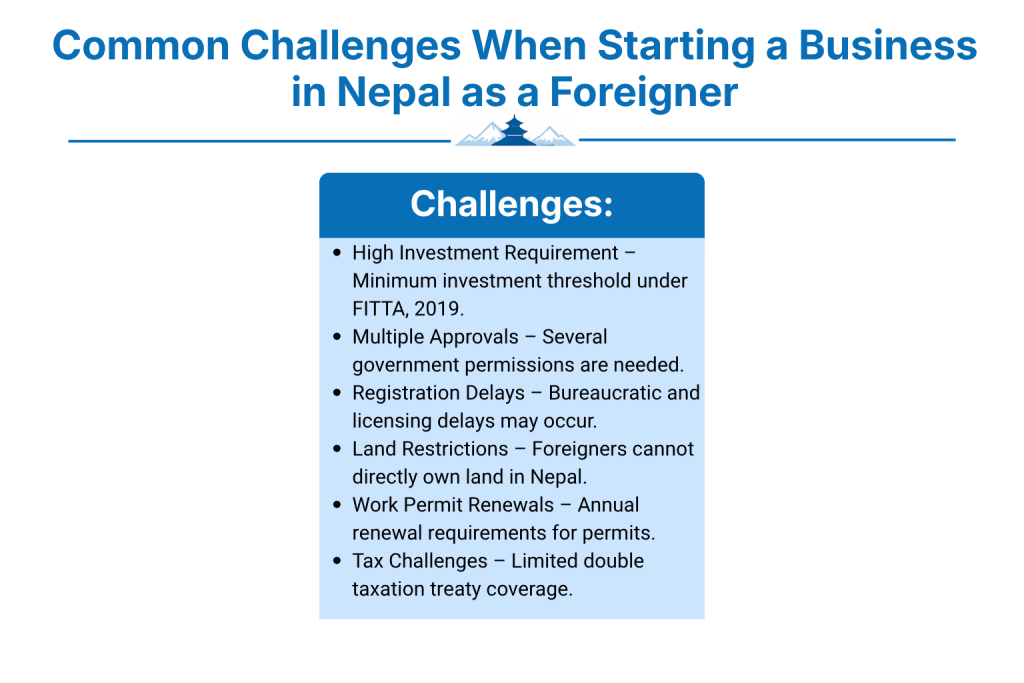
While Nepal has improved its business environment, foreign investors should be aware of the following practical challenges:
- High minimum investment threshold under FITTA, 2019
- Multiple government approvals required before operations begin
- Bureaucratic delays in licensing and registration
- Land ownership restrictions (foreigners cannot own land in Nepal directly)
- Work permit renewal requirements on an annual basis
- Limited double taxation treaty network compared to other investment destinations
Conclusion
To start a business in Nepal as a foreigner, you must comply with FITTA, 2019, the Companies Act, 2006, and the Industrial Enterprises Act, 2020. The process involves obtaining foreign investment approval from the Department of Industry, registering the company with the Office of Company Registrar, completing tax registration with the Inland Revenue Department, and securing a valid work permit. Nepal offers several incentives for foreign investors including profit repatriation rights, tax exemptions in SEZs, and double taxation relief. However, the minimum investment threshold and sector restrictions must be carefully reviewed before proceeding.
For official information, visit the Department of Industry Nepal, Investment Board Nepal, and Office of the Company Registrar.
FAQs
1. Can a foreigner own 100% of a business in Nepal?
Yes, a foreigner can own 100% of a business in Nepal in sectors open to full foreign ownership under FITTA, 2019. However, certain sectors require joint ventures with Nepali partners.
2. What is the minimum investment required for a foreigner to start a business in Nepal?
Under FITTA, 2019, the minimum foreign investment is NPR 50 million (approximately USD 375,000–380,000) for most sectors. Special Economic Zones may have different thresholds.
3. Can a foreigner buy land in Nepal to operate a business?
No, foreigners cannot own land in Nepal directly under current law. However, they can lease land for business operations. A foreign-owned company registered in Nepal may hold property in some specific cases.
4. Which government authority approves foreign investment in Nepal?
The Department of Industry (DOI) approves most foreign investments. The Investment Board Nepal (IBN) handles large-scale investments above NPR 6 billion or in priority sectors.
5. Do foreign business owners need a work permit in Nepal?
Yes, all foreign nationals working in Nepal, including business owners actively managing their company, must obtain a valid work permit from the Department of Labor and Occupational Safety.
6. Can a foreigner start a small business or sole proprietorship in Nepal?
No, foreigners cannot register as sole proprietors in Nepal. Foreign investment is only permitted through registered company structures such as private limited companies, joint ventures, or branch offices under FITTA, 2019.