

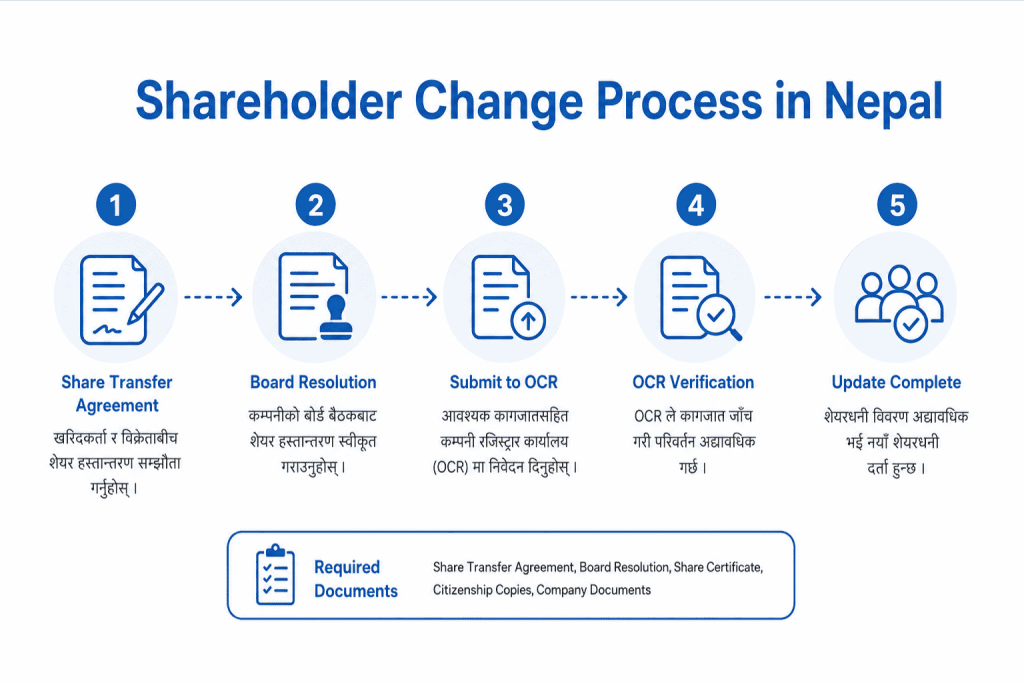
Shareholder change process in Nepal in company registered is a formal legal process governed by the Companies Act, 2063 (2006) and related regulations issued by the Office of the Company Registrar (OCR). Whether you are transferring shares, adding a new shareholder, or removing an existing one, the process requires strict compliance with Nepalese corporate law.
This article explains the shareholder change process in Nepal in detail, covering legal provisions, required documents, step-by-step procedures, applicable fees, and common questions.
What Is a Shareholder Change in Nepal?
A shareholder change in Nepal refers to any alteration in the ownership structure of a registered company. This includes:
- Transfer of shares from one person to another through sale or gift
- Transmission of shares due to death, insolvency, or legal operation
- Addition of new shareholders through fresh share issuance
- Removal of shareholders by buyback or share cancellation
- Change in shareholding percentage due to capital restructuring
The Companies Act, 2063 (2006) of Nepal is the primary law that governs these transactions. Section 30 to Section 46 of the Companies Act specifically deal with the transfer and transmission of shares in private and public companies registered in Nepal.
Legal Framework Governing Shareholder Change in Nepal
The shareholder change process in Nepal is regulated by multiple legal instruments:
| Legal Instrument | Relevance |
|---|---|
| Companies Act, 2063 (2006) | Primary law for share transfer and ownership change |
| Securities Act, 2063 (2007) | Applicable for publicly listed companies |
| Foreign Investment and Technology Transfer Act (FITTA), 2075 (2019) | Governs foreign shareholder changes |
| Income Tax Act, 2058 (2002) | Capital gains tax on share transfer |
| OCR Directives and Circulars | Procedural guidelines by Office of Company Registrar |
The Office of the Company Registrar (OCR) is the government body responsible for registering and processing all changes in shareholder information for companies in Nepal. For publicly listed companies, the Securities Board of Nepal (SEBON) and CDS and Clearing Limited also play regulatory roles.
Types of Shareholder Changes in Nepal
1. Share Transfer
A share transfer is a voluntary process where an existing shareholder sells or gifts their shares to another person. This is the most common form of shareholder change in private limited companies in Nepal. The transferor and transferee must execute a Share Transfer Deed or Share Transfer Agreement.
2. Share Transmission
Share transmission occurs by operation of law. It happens when a shareholder dies and shares pass to legal heirs, or when a shareholder is declared insolvent. Transmission does not require a formal transfer deed but requires legal documentation such as a death certificate and succession certificate.
3. Addition of New Shareholders
A company can increase its shareholder base by issuing new shares to new investors. This requires a board resolution, amendment to the share register, and filing with OCR.
4. Foreign Shareholder Change
If the change involves a foreign national or foreign entity, the process also requires approval from the Department of Industry or the Investment Board of Nepal (IBN) under FITTA, 2075. Foreign ownership limits and sector-specific restrictions also apply.
Who Can Transfer Shares in Nepal?
Under Section 30 of the Companies Act, 2063, any registered shareholder of a company has the right to transfer their shares. However, the following restrictions may apply:
- Articles of Association (AoA) restrictions: The AoA of the company may contain pre-emption rights, meaning existing shareholders have the first right to purchase shares before they are offered to outsiders.
- Board approval: Some companies require board approval before a share transfer is completed.
- Minimum shareholding requirement: Certain companies may have a minimum holding requirement that restricts partial transfers.
- Foreign ownership cap: Sectors like media, cooperatives, and certain financial institutions restrict foreign ownership percentages.
Step-by-Step Shareholder Change Process in Nepal
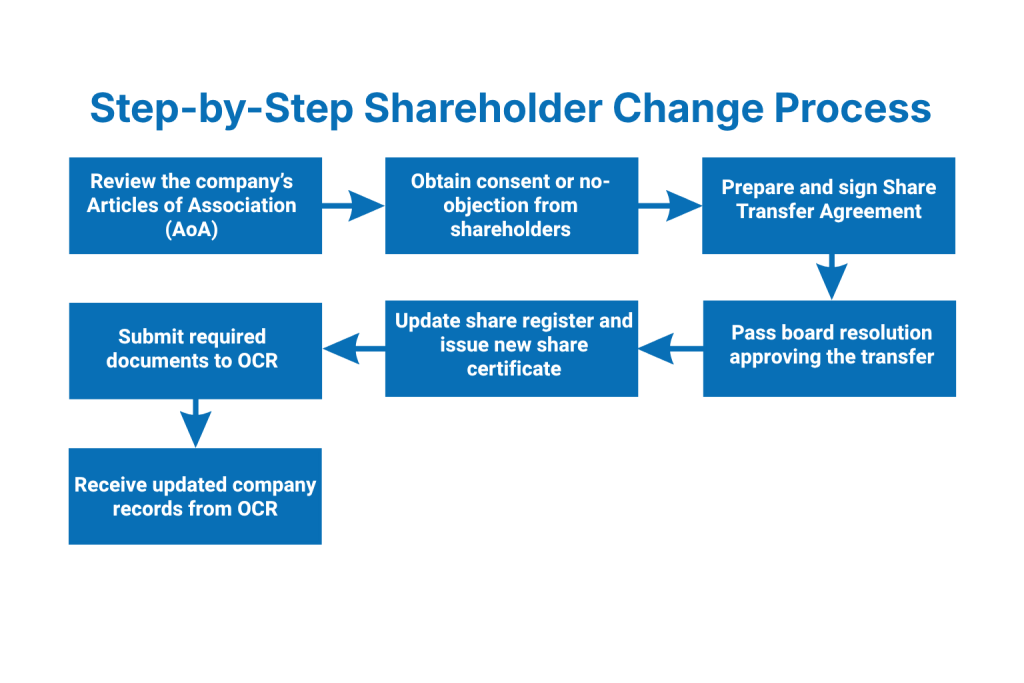
The shareholder change process in Nepal follows a specific sequence of steps. The process differs slightly between private limited companies and public limited companies.
For Private Limited Companies
Step 1: Review the Articles of Association
- Check for any restrictions on share transfer
- Verify pre-emption rights of existing shareholders
- Confirm board approval requirements
Step 2: Obtain No Objection or Consent from Other Shareholders
- If the AoA mandates it, offer shares to existing shareholders first
- Collect written consent or no-objection letters if required
Step 3: Execute a Share Transfer Agreement or Deed
- Draft a Share Transfer Deed between the transferor (seller) and transferee (buyer)
- The deed must specify the number of shares, share value, and date of transfer
- Both parties must sign the deed in the presence of witnesses
Step 4: Pass a Board Resolution
- Hold a Board of Directors meeting
- Pass a resolution approving the share transfer
- Record the resolution in the official minute book
Step 5: Update the Share Register
- Cancel the old share certificate of the transferor
- Issue a new share certificate to the transferee
- Update the company’s Share Register with new ownership details
Step 6: File with the Office of the Company Registrar (OCR)
- Submit the required documents to OCR
- Pay the applicable government fee
- OCR updates the company’s official records
Step 7: Obtain Updated Company Certificate or Acknowledgment
- Receive OCR acknowledgment or updated company registration details reflecting the new shareholder structure
Documents Required for Shareholder Change in Nepal
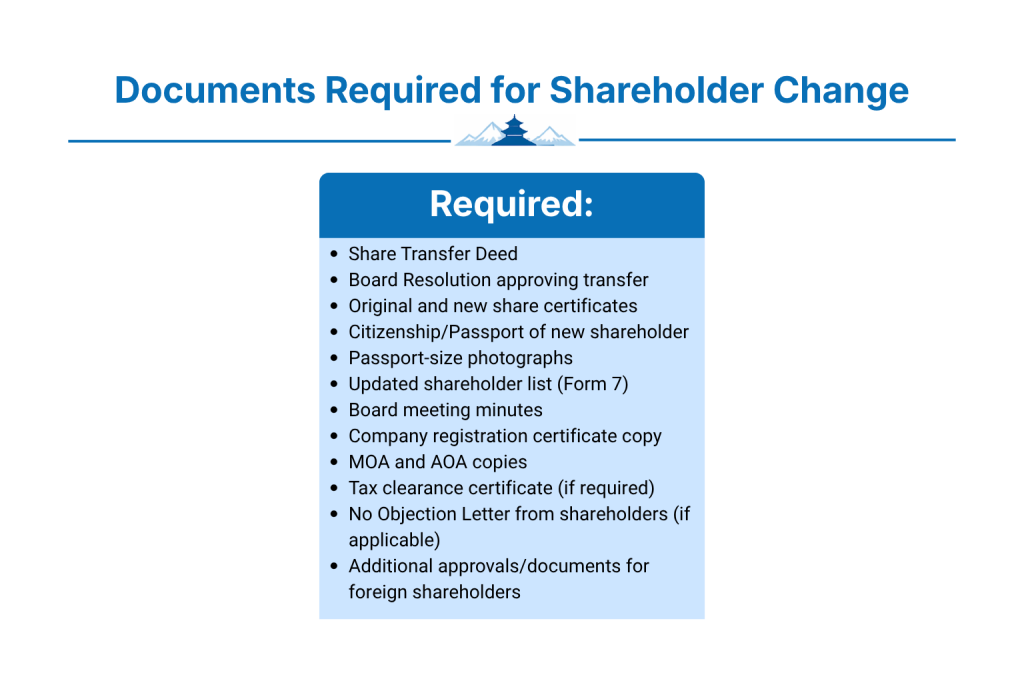
The following documents are required when filing for a shareholder change at the OCR:
- Share Transfer Deed (signed by both transferor and transferee)
- Board Resolution approving the transfer
- Original Share Certificate of the transferor
- New Share Certificate issued to the transferee
- Citizenship Certificate or Passport of the new shareholder
- Passport-sized photographs of the new shareholder
- Updated Shareholder List (Form 7 as per Companies Act)
- Minutes of Board Meeting approving the transfer
- Company Registration Certificate (copy)
- Memorandum and Articles of Association (copy)
- Tax Clearance Certificate (if applicable)
- No Objection Letter from existing shareholders (if required by AoA)
For foreign shareholders, additional documents include:
- Valid passport copy of the foreign national
- Approval from Department of Industry or Investment Board of Nepal
- Foreign Investment approval under FITTA, 2075
- Recommendation from Nepal Rastra Bank (for financial institutions)
Documents Required: Summary Table
| Document | Required For | Issued By |
|---|---|---|
| Share Transfer Deed | All transfers | Parties involved |
| Board Resolution | All transfers | Company Board |
| Original Share Certificate | Transferor | Company |
| Citizenship/Passport Copy | All shareholders | Government/Embassy |
| Form 7 (Shareholder List) | OCR filing | Company |
| Tax Clearance | Capital gains | IRD Nepal |
| Foreign Investment Approval | Foreign shareholders | Department of Industry / IBN |
| Succession Certificate | Transmission cases | District Court |
Fees for Shareholder Change in Nepal
The OCR charges a government fee for registering shareholder changes. The fee is based on the paid-up capital of the company and the nature of the change. As of the latest OCR fee schedule:
- The filing fee for share transfer registration generally starts from NPR 100 to NPR 5,000 depending on the company’s paid-up capital.
- Capital gains tax at the rate of 7.5% for individuals and 15% for entities is applicable on the profit from the share sale under the Income Tax Act, 2058.
- For listed companies, CDSC charges separate transaction fees.
You can verify the latest fee structure at the OCR official website.
Shareholder Change in Public Limited Companies
For public limited companies listed on the Nepal Stock Exchange (NEPSE), the share transfer process is different:
- Shares are held in demat form through CDS and Clearing Limited (CDSC)
- Transfer is executed electronically through the CDSC system
- Buyers and sellers transact through SEBON-licensed stockbrokers
- No physical share certificate is exchanged
- The transfer is settled through the T+3 settlement cycle
- OCR is not directly involved in each individual trade but receives annual updated shareholder reports
Shareholder Change Involving Foreign Nationals in Nepal
When a foreign national or foreign company becomes a shareholder in a Nepalese company, the process involves additional regulatory steps:
- Prior approval from the Department of Industry (DOI) or Investment Board of Nepal (IBN) under FITTA, 2075 is required.
- The foreign investment must be in a permissible sector as per the Negative List of Foreign Investment.
- The minimum foreign investment threshold is USD 50,000 as per FITTA.
- Repatriation of dividends and proceeds must comply with Nepal Rastra Bank foreign exchange regulations.
- The company must be registered as a foreign investment company with the OCR.
Common Issues in the Shareholder Change Process in Nepal
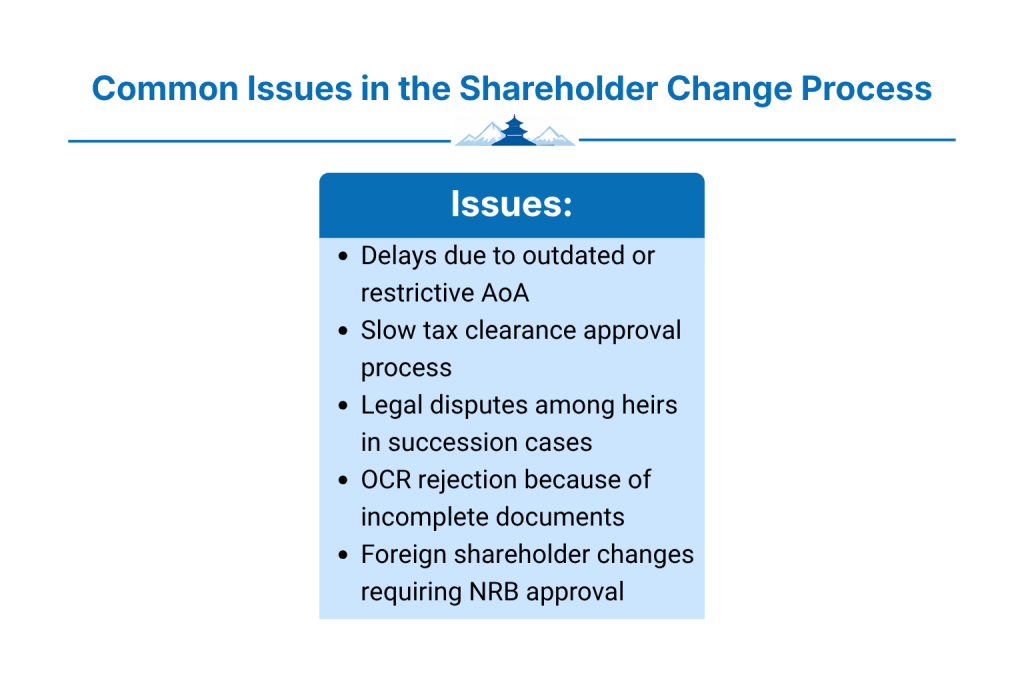
Several practical issues arise during the shareholder change process:
- Outdated AoA: Companies with outdated or restrictive Articles of Association often face delays in share transfer approvals.
- Tax clearance delays: The Income Tax Department may delay issuing clearance certificates, stalling the OCR filing.
- Disputed successions: In transmission cases involving deceased shareholders, disputes among heirs cause legal complications.
- Incomplete documentation: Missing or incorrectly prepared documents result in OCR rejections.
- Foreign exchange compliance: Foreign shareholder changes without NRB approval may be declared void.
Timeline for Shareholder Change in Nepal
The total time required for completing a shareholder change in Nepal varies:
- Board resolution and documentation: 3 to 7 days
- OCR filing and processing: 7 to 15 working days
- Foreign investment approval (if applicable): 30 to 60 days
- Tax clearance: 7 to 21 days
The entire process for a domestic share transfer in a private limited company can typically be completed within 2 to 4 weeks if all documents are in order.
Conclusion
The shareholder change process in Nepal is a legally structured procedure governed primarily by the Companies Act, 2063 and administered by the Office of the Company Registrar. Whether the change involves a domestic transfer, foreign investment, or legal transmission, strict compliance with documentation requirements, tax obligations, and OCR filing procedures is necessary. Companies and shareholders must ensure their Articles of Association are current, their tax filings are complete, and all approvals are secured before initiating the process. For foreign shareholders, FITTA, 2075 compliance adds another layer of regulatory requirement that must be addressed through the Department of Industry or Investment Board of Nepal.
FAQs
1. What law governs the shareholder change process in Nepal?
The Companies Act, 2063 (2006), specifically Sections 30 to 46, governs the transfer and transmission of shares. The FITTA, 2075 governs foreign shareholder changes. OCR processes all registrations.
2. Is board approval mandatory for share transfer in a private limited company in Nepal?
Yes, in most private limited companies, the Articles of Association require board approval before a share transfer is valid. The board must pass a resolution accepting the transfer and authorizing the update to the share register.
3. What is the capital gains tax on share transfer in Nepal?
Under the Income Tax Act, 2058, capital gains tax is 7.5% for individuals and 15% for entities on the profit earned from selling shares. Tax clearance from the Inland Revenue Department is required before OCR registration.
4. Can a foreign national become a shareholder in a Nepalese company?
Yes, a foreign national can become a shareholder if the sector is open to foreign investment under FITTA, 2075 and required approvals are obtained from the Department of Industry or Investment Board of Nepal.
5. How long does the shareholder change process take at OCR Nepal?
For a private limited company with all documents in order, OCR typically processes shareholder change filings within 7 to 15 working days. Foreign investment cases may take 30 to 60 days due to additional regulatory approvals.
6. What happens if a shareholder dies in Nepal? How are shares transferred?
When a shareholder dies, shares are transmitted to legal heirs through a process called transmission. The heirs must submit a death certificate, succession certificate from the District Court, and apply to the company and OCR for updating the share register.