


Nepal is one of the most preferred destinations for foreign retirees who seek a peaceful, affordable, and culturally rich place to spend their retirement years. The country offers a special visa category for retired foreign nationals who wish to reside in Nepal for an extended period. This article covers everything about the Retiree Residence Visa in Nepal, including eligibility, required documents, the application process, fees, renewal procedures, and more.
What Is a Retiree Residence Visa in Nepal?
The Retiree Residence Visa (also referred to as the Residential Permit for Retired Foreigners) is a long-stay visa issued by the Department of Immigration Nepal to foreign nationals who are retired and wish to live in Nepal. This visa falls under the broader category of Non-Tourist Residence Permits and is governed by the Immigration Act, 2049 (1992) and the Immigration Regulations, 2051 (1994).
Unlike a tourist visa, which limits a foreigner’s stay to a maximum of 150 days per calendar year, a retiree residence visa allows the holder to reside in Nepal for one full year, with the option for annual renewal. The Department of Immigration Nepal is the primary authority responsible for issuing, renewing, and managing retiree residence permits.
Who Is Eligible for a Retiree Residence Visa in Nepal?
Basic Eligibility Criteria
To qualify for a Retiree Residence Visa in Nepal, the applicant must meet the following eligibility conditions:
- The applicant must be a foreign national (non-Nepali citizen)
- The applicant must be 50 years of age or older
- The applicant must be officially retired from their profession or employment
- The applicant must have sufficient financial means to support themselves during their stay in Nepal
- The applicant must not engage in any employment or business activity within Nepal
- The applicant must maintain a clean criminal record
- The applicant must be in good health and not carry any communicable diseases
Nepal does not restrict this visa to nationals of specific countries. Any foreign national who meets the above conditions may apply for this permit at the Department of Immigration.
What Are the Financial Requirements for a Retiree Residence Visa?
Financial stability is a key requirement for the retiree residence visa in Nepal. Applicants must demonstrate that they can financially support themselves without working in Nepal. The general financial requirements include:
- Deposit of USD 25,000 or equivalent foreign currency in a Nepali commercial bank, OR
- Proof of a regular pension income of at least USD 2,000 per month from a foreign government, organization, or employer
- Alternatively, proof of regular remittances or steady retirement income that meets the minimum threshold
Applicants who deposit USD 25,000 in a Nepali bank receive a fixed deposit receipt, which serves as financial proof. This amount must remain in the bank throughout the duration of their stay in Nepal.
Required Documents for Retiree Residence Visa Application

The following documents are required when applying for a Residential Permit for Retirees in Nepal:
- Completed Application Form (available at the Department of Immigration or online)
- Valid Passport with a minimum of 6 months validity
- Recent Passport-Size Photographs (usually 2-4 photographs)
- Current Visa Copy (tourist or other valid visa at the time of application)
- Proof of Retirement – official retirement letter, pension certificate, or document from employer
- Proof of Financial Sufficiency – fixed deposit certificate from a Nepali bank (USD 25,000) or pension payment proof
- Medical Certificate issued by a recognized hospital or doctor confirming good health
- Police Clearance Certificate from the applicant’s home country
- Tax Clearance Certificate if the applicant has previously stayed or done business in Nepal
- Recommendation Letter from the Embassy of the applicant’s country (in some cases)
- Bank Statement showing regular pension income (if applicable)
Step-by-Step Application Process for Retiree Residence Visa
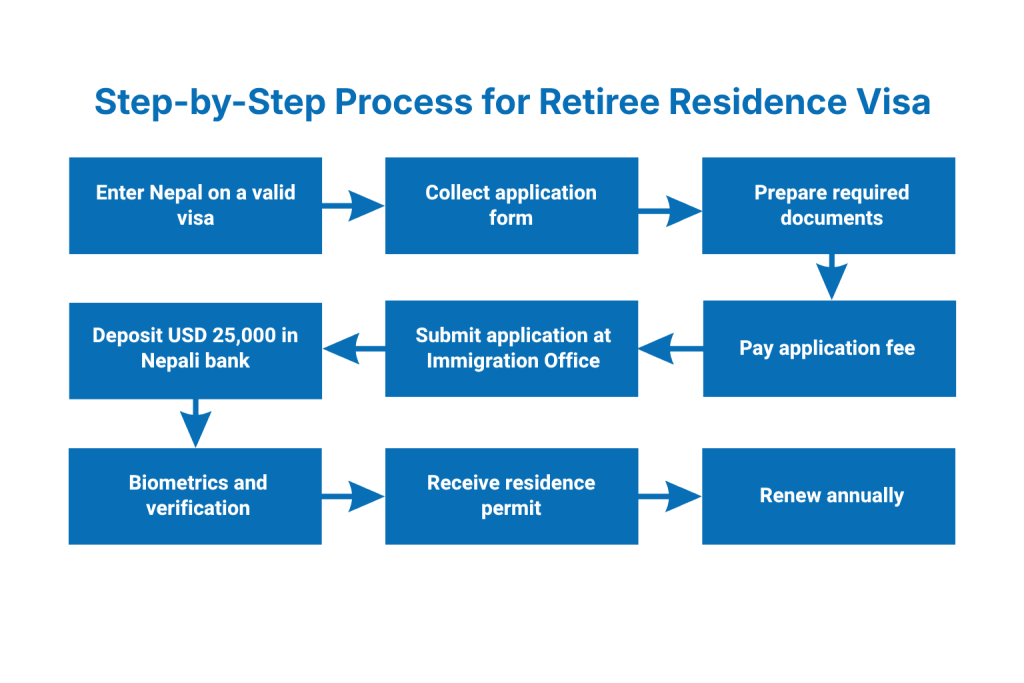
The application process for a Retiree Residence Permit in Nepal involves the following steps:
- Enter Nepal on a Valid Visa – The applicant must first enter Nepal on a valid tourist visa or other applicable visa
- Collect Application Form – Obtain the residence permit application form from the Department of Immigration, Maitighar, Kathmandu, or download it from the official website
- Prepare All Required Documents – Gather all necessary documents including proof of retirement, financial statements, medical certificate, and police clearance
- Open a Bank Account in Nepal – Deposit USD 25,000 or equivalent in a Nepali commercial bank and obtain the fixed deposit receipt
- Submit the Application – Submit the completed form along with all supporting documents at the Department of Immigration
- Pay the Application Fee – Pay the prescribed fee at the immigration office
- Biometric Registration – Provide fingerprints and photograph for biometric registration
- Verification Process – The Department of Immigration verifies all documents and may request additional information
- Permit Issuance – Upon approval, the retiree residence permit is stamped in the passport or issued as a separate document
- Annual Renewal – Renew the permit each year before expiry by following the same process
Retiree Residence Visa Fees in Nepal
| Fee Type | Amount (Approximate) |
|---|---|
| Residence Permit Application Fee | NPR 5,000 – NPR 10,000 per year |
| Extension/Renewal Fee | Similar to initial application fee |
| Late Renewal Penalty | Additional charges apply per day |
| Bank Deposit Requirement | USD 25,000 (refundable) |
Note: Fees are subject to change. Always verify the current fee structure at the Department of Immigration Nepal before applying.
Duration and Renewal of Retiree Residence Visa
The Retiree Residence Permit in Nepal is valid for one year from the date of issuance. It is renewable annually as long as the applicant continues to meet all the eligibility and financial requirements.
Renewal Requirements
- Submit renewal application before the expiry of the current permit
- Provide updated bank statement or pension proof
- Submit updated medical certificate
- Pay the renewal fee
- Confirm that the USD 25,000 deposit remains in the Nepali bank
Failure to renew on time results in overstay penalties under the Immigration Act, 2049. The overstay fine is charged on a daily basis and can accumulate significantly.
Rights and Restrictions Under Retiree Residence Visa
What a Retiree Residence Visa Holder CAN Do
- Reside in Nepal for the permitted duration
- Travel within Nepal (except restricted areas, which require a special permit)
- Open a bank account in Nepal
- Rent private accommodation
- Access private healthcare facilities
- Leave and re-enter Nepal multiple times during the permit validity
What a Retiree Residence Visa Holder CANNOT Do
- Engage in employment – working for a Nepali company or individual is prohibited
- Start a business or invest commercially in Nepal without a separate business visa
- Purchase land or property in Nepal (foreign nationals are prohibited from owning land under the Land Act of Nepal)
- Vote or participate in political activities
- Stay in restricted areas without a separate Restricted Area Permit (RAP)
Comparison: Retiree Residence Visa vs. Tourist Visa in Nepal
| Feature | Retiree Residence Visa | Tourist Visa |
|---|---|---|
| Maximum Stay Duration | 1 Year (Renewable) | 150 days per calendar year |
| Eligible Age | 50+ years | No age restriction |
| Financial Requirement | USD 25,000 deposit or pension proof | Proof of sufficient funds for travel |
| Work Authorization | Not permitted | Not permitted |
| Renewal | Annual renewal available | Not renewable beyond 150 days |
| Application Authority | Department of Immigration | Immigration office or embassy |
| Purpose | Long-term retirement residence | Tourism and short-term visits |
Legal Framework Governing Retiree Residence Visa in Nepal
The Retiree Residence Visa in Nepal is regulated under the following legal instruments:
- Immigration Act, 2049 BS (1992) – The primary legislation governing all immigration matters, including visa issuance, residence permits, and overstay penalties
- Immigration Regulations, 2051 BS (1994) – The implementing regulations that set out the procedures, fees, and conditions for various visa categories including residential permits
- Foreign Exchange (Regulation) Act, 2019 BS (1962) – Governs the financial transactions and bank deposit requirements for foreign nationals
- Nepal Rastra Bank Guidelines – Provide specific rules for foreign currency deposits in Nepali banks
Under Section 4 of the Immigration Act, 2049, the Department of Immigration holds the authority to issue, deny, or revoke any visa or residence permit in Nepal.
Why Do Retirees Choose Nepal?
Nepal remains a preferred destination for foreign retirees for several strong reasons:
- Low cost of living compared to Western countries
- Warm and welcoming culture with diverse traditions
- Scenic landscapes including the Himalayas, hills, and Terai plains
- Affordable healthcare with quality private hospitals in urban areas
- Spiritual environment with Buddhist and Hindu heritage sites
- Stable climate in cities like Pokhara and Kathmandu
- Active expat community providing social support
Frequently Asked Questions (FAQs)
1. What is the minimum age requirement for a Retiree Residence Visa in Nepal?
The minimum age requirement for a Retiree Residence Visa in Nepal is 50 years. Applicants below this age do not qualify for this specific visa category and must explore other visa options such as a business or study visa.
2. Can a retiree work in Nepal on a Retiree Residence Visa?
No. Retiree Residence Visa holders are strictly prohibited from engaging in any form of employment or business activity in Nepal. Working without authorization violates the Immigration Act, 2049 and can result in visa cancellation and deportation.
3. Is it mandatory to deposit USD 25,000 in a Nepali bank?
Not necessarily. Applicants who can demonstrate a regular pension income of at least USD 2,000 per month may use pension proof as an alternative. However, the USD 25,000 fixed deposit in a Nepali bank is the most common method used by applicants.
4. Can a retiree buy property in Nepal on this visa?
No. Foreign nationals, including retiree residence visa holders, cannot purchase land or property in Nepal under the existing legal framework. The Land Act of Nepal restricts property ownership by foreigners.
5. How do I renew my Retiree Residence Visa in Nepal?
Renewal is done annually at the Department of Immigration, Kathmandu. You must submit updated financial documents, a medical certificate, and pay the renewal fee before the current permit expires to avoid overstay penalties.
6. Where do I apply for a Retiree Residence Visa in Nepal?
Applications are submitted at the Department of Immigration Nepal, located at Maitighar, Kathmandu. The official website is www.immigration.gov.np. Some applications may also be initiated through Nepali embassies abroad.