


Foreign nationals who wish to live in Nepal long-term often ask two fundamental questions: Can I get a residential visa? And can I own property in Nepal? These two topics are deeply connected, and understanding the legal framework surrounding both is essential for anyone planning to settle or invest in Nepal. This article covers everything you need to know about Residential Visa Property Ownership in Nepal based on the current laws and regulations.
What Is a Residential Visa in Nepal?
A Residential Visa in Nepal is a long-term visa issued to foreign nationals who want to live in Nepal for extended periods beyond the standard tourist visa duration. The Department of Immigration Nepal governs the issuance of residential visas under the Immigration Act 2049 (1992) and the Immigration Rules 2051 (1994).
Nepal’s residential visa is not a single category. It covers several sub-categories depending on the applicant’s purpose and background.
Types of Long-Term Visas Available in Nepal
| Visa Type | Eligible Applicants | Duration |
|---|---|---|
| Non-Tourist Visa (Residential) | Foreigners married to Nepali citizens | Annual Renewal |
| Non-Resident Nepali (NRN) Visa | Nepali-origin foreign nationals | 10 Years (Multiple Entry) |
| Business/Investment Visa | Foreign investors under FITTA 2019 | Annual Renewal |
| Retirement Visa | Foreign nationals aged 50+ with financial means | Annual Renewal |
| Study Visa | Students enrolled in Nepali institutions | Duration of Course |
| Diplomatic/Official Visa | Government-level personnel | As per agreement |
Under Section 4 of the Immigration Act 2049, the Government of Nepal has the authority to issue different categories of visas based on the purpose of stay. The residential visa falls under the non-tourist category.
Who Can Apply for a Residential Visa in Nepal?

The Department of Immigration, located in Kathmandu, processes residential visa applications. Foreign nationals can apply based on several eligibility criteria.
Eligibility Categories
- Foreign nationals married to Nepali citizens – They can apply for a non-tourist residential visa under Immigration Regulation 2051.
- Non-Resident Nepalis (NRN) – Those of Nepali origin who hold foreign citizenship can apply for a 10-year NRN visa under the Non-Resident Nepali Act 2064 (2008).
- Foreign investors – Those investing in Nepal under the Foreign Investment and Technology Transfer Act (FITTA) 2019 can apply for a business/investment visa.
- Retired foreign nationals – Those above 50 years with a monthly income of at least USD 2,000 can apply for a retirement visa.
- Family members of visa holders – Dependents of visa holders may also receive residential visa status.
Required Documents for Residential Visa Application
- Valid passport with a minimum of 6 months validity
- Completed visa application form from the Department of Immigration
- Passport-sized photographs (recent)
- Proof of financial means (bank statements, income proof)
- Marriage certificate (if applying as a spouse of a Nepali citizen)
- NRN registration certificate (for NRN visa applicants)
- Recommendation letter from the relevant ministry or department
- Proof of business investment (for investment visa applicants)
- Police clearance certificate from the home country
- Medical certificate in certain cases
Can Foreign Nationals Own Property in Nepal?
This is one of the most asked questions by expats and investors interested in Nepal. The short and legal answer is: No, foreign nationals generally cannot own land or immovable property in Nepal.
Nepal’s Land Act 2021 (Land Act Amendment) and the Land (Survey and Measurement) Act strictly prohibit the ownership of land and immovable property by foreign nationals. This restriction applies regardless of whether the foreign national holds a residential visa in Nepal.
What Does the Law Say?
Under Section 3 of the Land (Restriction on Acquisition) Act, foreigners, foreign companies, and foreign organizations are barred from acquiring land or immovable property in Nepal. This restriction is also reflected in Article 51(d) of the Constitution of Nepal 2015, which emphasizes protection of national land from foreign ownership.
The Foreign Exchange Regulation Act 2019 further reinforces this restriction by controlling capital outflows and preventing property-related financial transactions that could benefit foreign property buyers.
Property Rights for Non-Resident Nepalis (NRNs)
Non-Resident Nepalis (NRNs) occupy a unique legal position in Nepal. Under the Non-Resident Nepali Act 2064 (2008), NRNs have limited property rights in Nepal that go beyond what regular foreign nationals are allowed.
What Can NRNs Do?
- NRNs can purchase residential property in Nepal for personal use.
- They can inherit property from their family members in Nepal.
- They can invest in businesses and industries under the provisions of FITTA 2019.
- They can repatriate income and dividends earned from investments in Nepal.
However, NRNs still cannot purchase agricultural land or land beyond the prescribed limits. Their property rights are governed by both the NRN Act and the Land Act.
Can a Foreign National Lease Property in Nepal?
Yes. While foreign nationals with a residential visa in Nepal cannot own property outright, they can lease property for long-term use. Leasing is the primary legal route for foreign nationals to occupy residential or commercial property in Nepal.
Key Points About Property Leasing for Foreign Nationals
- Long-term lease agreements are permitted under Nepali law.
- Lease terms are typically negotiated between the parties and registered with the local government authority or Land Revenue Office.
- The lease must comply with the Contract Act 2056 (2000) of Nepal.
- Foreign-owned companies registered in Nepal under FITTA 2019 may lease commercial property in the name of the company.
- Residential visa holders often use lease agreements for multi-year housing arrangements.
Foreign Investment and Property-Related Rights Under FITTA 2019
The Foreign Investment and Technology Transfer Act (FITTA) 2019 provides a legal framework for foreign nationals and companies to invest in Nepal. While it does not grant property ownership rights, it allows foreign investors to operate businesses that may involve property use.
| Feature | FITTA 2019 Provision |
|---|---|
| Minimum Investment | USD 50,000 for most sectors |
| Visa Eligibility | Business/Investment visa for investors |
| Repatriation of Profit | Allowed under Foreign Exchange Regulation Act 2019 |
| Property Ownership | Not permitted; leasing allowed |
| Company Registration | Mandatory through the Office of Company Registrar |
| Restricted Sectors | Agriculture, cottage industry, tourism (partial) |
Foreign investors must register their business with the Department of Industry or the Investment Board Nepal (IBN) depending on the investment size. Property used for business purposes must be leased, not owned.
You can visit the official Department of Immigration Nepal or the Investment Board Nepal for updated procedures.
Step-by-Step Process to Apply for a Residential Visa in Nepal
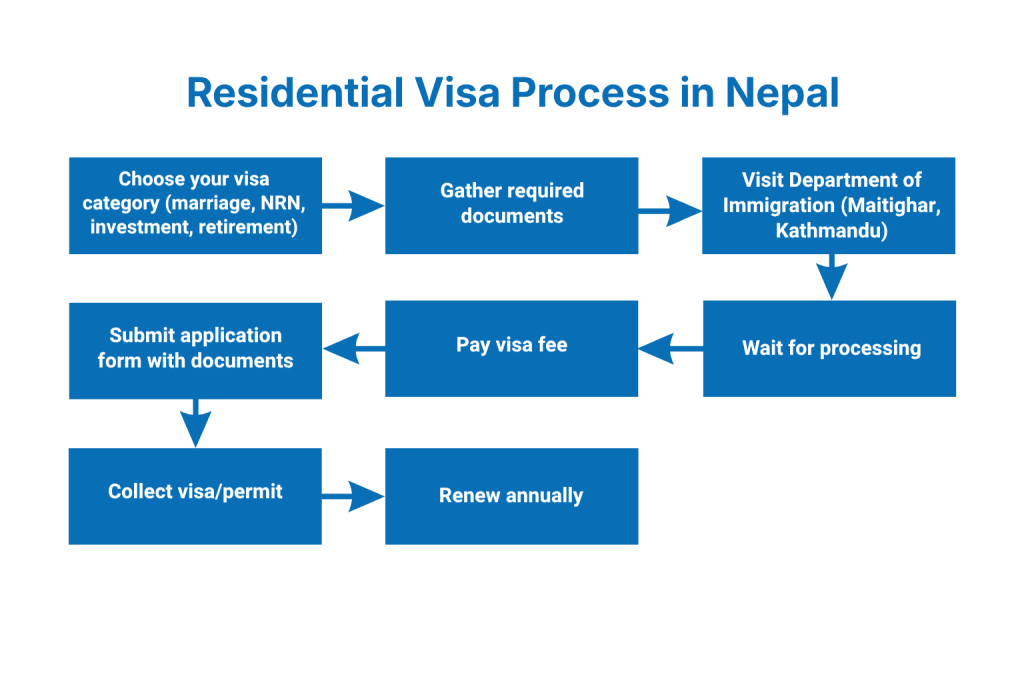
- Determine your visa category – Identify whether you qualify for a residential visa based on marriage, NRN status, investment, or retirement.
- Gather required documents – Compile all the necessary documents listed under your specific visa category.
- Visit the Department of Immigration – The main office is located in Maitighar, Kathmandu. Regional offices also exist.
- Submit the application form – Fill out and submit the visa application form along with all supporting documents.
- Pay the visa fee – Fees vary based on visa category and duration.
- Wait for processing – Processing time may range from a few days to a few weeks.
- Collect the visa – Once approved, collect the visa stamp or residence permit.
- Renew annually – Most residential visas require annual renewal with updated documentation.
Common Misconceptions About Property Ownership with a Residential Visa
Many foreign nationals mistakenly believe that a residential visa grants them the right to purchase property in Nepal. This is incorrect. A residential visa only grants the right to reside in Nepal legally for the permitted duration. It does not confer any additional civil rights related to land or property ownership.
Similarly, some individuals assume that registering a company in Nepal allows foreign ownership of property in the company’s name. This is also not entirely correct. While a Nepal-registered company can lease property, it cannot own land if the majority of its ownership rests with foreign nationals, as per the Land Act restrictions.
Legal Penalties for Unauthorized Property Transactions
Foreign nationals who attempt to purchase land or immovable property in Nepal through indirect means, such as benami transactions (putting property under a Nepali national’s name), may face severe legal consequences.
Under the Anti-Corruption Laws and the Asset (Money) Laundering Prevention Act 2064 (2008), such transactions can be treated as criminal offenses. The property may be seized by the government, and both the buyer and the Nepali party involved may face prosecution.
Conclusion
Residential visa and property ownership in Nepal are two separate legal matters governed by distinct laws. The Immigration Act 2049, FITTA 2019, Non-Resident Nepali Act 2064, and Land Act 2021 collectively define the rights and limitations of foreign nationals in Nepal. Foreign nationals can legally reside in Nepal through appropriate visa categories but cannot own land or immovable property. Leasing property remains the most practical and legally sound option for long-term residents. NRNs enjoy broader rights than regular foreign nationals, though even they are subject to specific restrictions. Always consult a qualified immigration lawyer in Nepal before making any legal or financial decisions related to residency or property in Nepal.
Frequently Asked Questions (FAQs)
1. Can a foreigner with a residential visa own land in Nepal?
No. The Land Act 2021 and related laws prohibit foreign nationals from owning land or immovable property in Nepal, regardless of their visa status, including residential visa holders.
2. Can Non-Resident Nepalis (NRNs) buy property in Nepal?
Yes, partially. NRNs can purchase residential property for personal use under the Non-Resident Nepali Act 2064 (2008), but they cannot purchase agricultural land or exceed prescribed property limits.
3. What is the minimum investment for a business visa in Nepal?
Under FITTA 2019, the minimum foreign investment for most sectors is USD 50,000. Investors who meet this threshold can apply for a business/investment visa through the Department of Immigration.
4. Can a foreign national lease property in Nepal?
Yes. Leasing property is the legal alternative for foreign nationals in Nepal. Long-term lease agreements can be registered with the Land Revenue Office under the Contract Act 2056.
5. How long is a residential visa valid in Nepal?
Most residential visas in Nepal, including non-tourist and retirement visas, are valid for one year and must be renewed annually. The NRN visa is valid for 10 years with multiple entries.
6. Where do I apply for a residential visa in Nepal?
Applications are submitted to the Department of Immigration Nepal, located in Maitighar, Kathmandu. Regional immigration offices also handle applications across Nepal.