


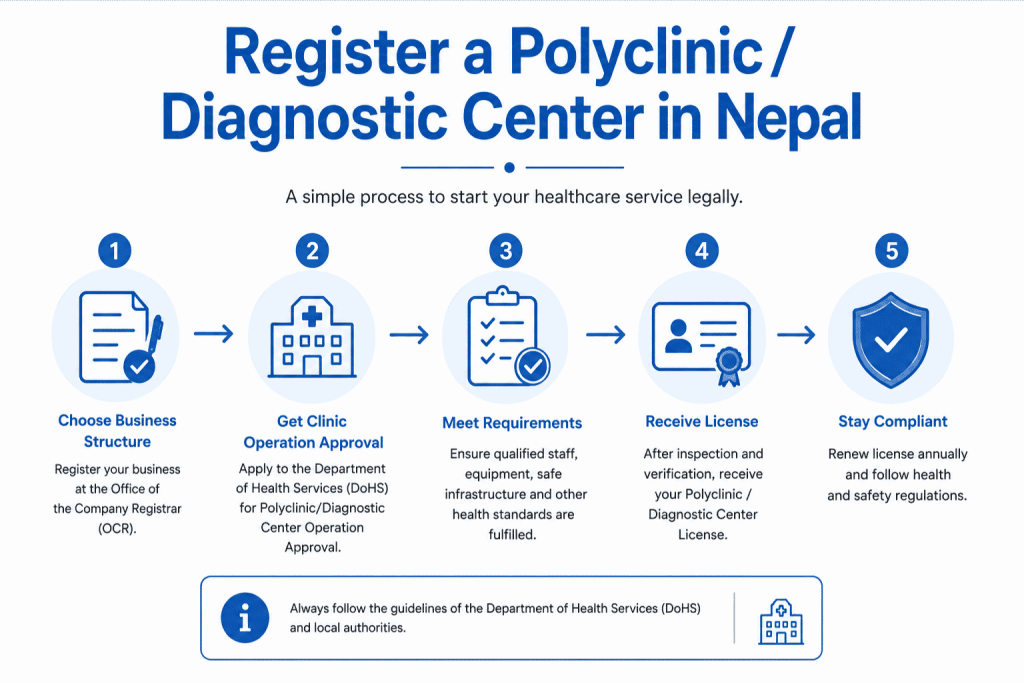
Register a polyclinic / diagnostic center in Nepal requires following a structured legal and administrative process. The Government of Nepal regulates all private health institutions under specific laws and guidelines. Any person or entity that operates a polyclinic or diagnostic center without proper registration is liable to legal action under Nepali law.
This article covers everything you need to know about the registration process, required documents, applicable laws, fees, and renewal procedures for polyclinics and diagnostic centers in Nepal.
What is a Polyclinic and a Diagnostic Center in Nepal?
A polyclinic is a health facility that provides outpatient medical services across multiple specialties under one roof. It typically includes general physicians, specialist consultations, minor surgical procedures, and basic diagnostic services. A diagnostic center, on the other hand, is a health facility primarily focused on conducting laboratory tests, imaging (X-ray, ultrasound, CT scan, MRI), pathology, and other investigative procedures to support clinical diagnosis.
Both polyclinics and diagnostic centers fall under the category of private health institutions in Nepal and are governed by the same regulatory framework under the Ministry of Health and Population (MoHP).
Legal Framework for Registering a Health Institution in Nepal
The primary law governing the registration and regulation of polyclinics and diagnostic centers in Nepal is:
- Private Health Institution Registration and Regulation Act, 2038 BS (1981 AD) and its amendments
- Private Health Institution Registration and Regulation Rules, 2041 BS (1984 AD)
- Health Institution Operation Standard and Categorization Guidelines issued by the Department of Health Services (DoHS)
- Nepal Medical Council Act, 2020 BS for medical professionals involved in operations
- Local Government Operation Act, 2074 BS for municipality-level approval
The Department of Health Services (DoHS) under the Ministry of Health and Population is the primary regulatory authority for health institutions at the federal level. Depending on the type and scale of services, registration may also involve provincial health directorates and local government bodies (municipalities or rural municipalities).
You can visit the official Department of Health Services website at https://dohs.gov.np for updated guidelines and forms.
Types of Health Institutions: Classification Table
| Type of Institution | Services Offered | Registration Authority |
|---|---|---|
| Polyclinic | Multi-specialty outpatient consultation, minor procedures | DoHS / Provincial Health Directorate |
| Diagnostic Center (Basic) | Lab tests, basic imaging | Local Government / DoHS |
| Diagnostic Center (Advanced) | CT Scan, MRI, Nuclear Medicine | DoHS / Ministry of Health |
| Combined Polyclinic + Diagnostic | Full outpatient + investigation services | DoHS / Provincial Directorate |
Who Can Apply for Registration?
Under the Private Health Institution Registration and Regulation Act, 2038 BS, the following entities are eligible to apply for registration of a polyclinic or diagnostic center in Nepal:
- Nepali citizens (individual or partnership)
- Private limited companies registered under the Companies Act, 2063 BS
- Non-Governmental Organizations (NGOs) with health mandates
- Cooperatives with a health services objective
- Foreign investment is subject to Foreign Investment and Technology Transfer Act, 2075 BS and requires prior approval from the relevant ministry
The applicant must ensure that at least one registered medical practitioner under the Nepal Medical Council is involved in the clinical operations of the polyclinic.
Pre-Registration Requirements

Before submitting an application, the applicant must fulfill several pre-conditions:
- Physical Infrastructure: The facility must meet minimum space requirements as per DoHS standards. A basic polyclinic typically requires a minimum floor area as specified in the categorization guidelines.
- Equipment: Diagnostic centers must have approved, functional, and calibrated equipment. Radiology units require radiation safety approval from the Department of Electricity Development or DOAENP (Department of Atomic Energy and Alternative Energy Promotion) for X-ray machines.
- Human Resources: At least one licensed medical doctor must be available for polyclinic services. Laboratory services must be supervised by a licensed lab technician or pathologist.
- Building Approval: A valid land ownership certificate or lease agreement along with a building completion certificate from the concerned municipality.
- Company/Firm Registration: Business registration from the Office of Company Registrar or Department of Commerce, Supplies and Consumer Protection (for firms/partnerships).
Required Documents for Registration
The following documents must be submitted with the application form to the relevant authority:
For Polyclinic Registration:
- Completed application form (available at DoHS or provincial health directorate)
- Citizenship certificate of the owner/proprietor or incorporation certificate (for companies)
- Company/firm registration certificate
- PAN/VAT registration certificate from the Inland Revenue Department
- Land ownership certificate or lease deed
- Building blueprint and floor plan (approved by municipality)
- Building completion certificate from the local government
- Proposed organizational structure of the polyclinic
- List of medical equipment and instruments
- List of proposed staff with their professional license copies
- Nepal Medical Council registration certificate of the responsible physician
- Proof of water supply and sanitation facilities
- Fire safety certificate (from Nepal Police or Fire Department where applicable)
Additional Documents for Diagnostic Center:
- List of diagnostic equipment with technical specifications
- Calibration certificates of equipment
- Radiation safety license from DOAENP (for X-ray/CT/fluoroscopy units)
- Agreement with a licensed pathologist or laboratory officer
- Waste management plan (biomedical waste disposal plan)
Step-by-Step Registration Process

Follow these steps to register a polyclinic or diagnostic center in Nepal:
- Prepare all required documents as listed above and ensure the physical site meets DoHS minimum standards.
- Register your business at the Office of Company Registrar (for companies) or the concerned office (for firms/individuals).
- Obtain PAN/VAT registration from the Inland Revenue Department.
- Get municipal approval for the building, sanitation, and land use for health facility purposes.
- Submit the application form along with all required documents to the Department of Health Services (for national-level registration) or the Provincial Health Directorate (for provincial-level institutions).
- Pay the prescribed registration fee as per the current fee schedule issued by DoHS or the provincial government.
- Site inspection by DoHS officials a team from DoHS or the provincial health authority will physically inspect the premises to verify compliance with standards.
- Receive the registration certificate upon approval, which is valid for a specified period (usually one year, renewable annually).
- Display the registration certificate visibly at the facility premises as required by law.
- Obtain ward-level recommendation from your local municipality ward office before final submission if required by local government.
Registration Fee Structure
| Institution Type | Registration Fee (Approximate) | Renewal Fee (Annual) |
|---|---|---|
| Basic Polyclinic | NPR 5,000 – 10,000 | NPR 3,000 – 5,000 |
| Diagnostic Center (Basic Lab) | NPR 3,000 – 8,000 | NPR 2,000 – 5,000 |
| Advanced Diagnostic Center (Imaging) | NPR 10,000 – 25,000 | NPR 7,000 – 15,000 |
| Combined Polyclinic + Diagnostic | NPR 15,000 – 30,000 | NPR 10,000 – 20,000 |
Note: Fees are subject to change based on government orders and provincial regulations. Always confirm the current fee schedule with DoHS or the provincial health directorate before applying.
Annual Renewal of Registration

Under the Private Health Institution Registration and Regulation Act, 2038 BS, every registered polyclinic and diagnostic center must renew its registration annually. The renewal must be completed before the expiry date mentioned on the registration certificate.
For renewal, the following are required:
- Application form for renewal
- Original registration certificate
- Tax clearance certificate from the Inland Revenue Department
- Updated list of staff and their professional license renewals
- Updated equipment list with calibration certificates (for diagnostic centers)
- Inspection clearance (if required by the regulatory authority)
Failure to renew the registration on time may result in fines, penalties, or cancellation of the registration certificate. The institution cannot legally operate without a valid registration.
Role of Local Government in Registration
After the Constitution of Nepal, 2072 BS and the Local Government Operation Act, 2074 BS, local governments (municipalities and rural municipalities) have been given concurrent authority over basic health services. As a result, many municipalities now require a separate recommendation letter or local registration before DoHS or the provincial health authority processes the application. Some municipalities issue their own operational permits for small-scale health facilities.
You should contact your local municipality office to determine whether they require a prior recommendation or local registration before proceeding with the DoHS application.
Biomedical Waste Management Compliance
All polyclinics and diagnostic centers in Nepal must comply with biomedical waste management regulations under the Environment Protection Act, 2076 BS and the Health Care Waste Management Strategy of the Ministry of Health and Population. Institutions must:
- Maintain a biomedical waste disposal plan
- Use color-coded bins for waste segregation
- Have a contract with an approved waste disposal service
- Train staff in safe handling of biological waste
Non-compliance with biomedical waste rules can result in suspension of the registration certificate.
Penalties for Operating Without Registration
Under Section 17 of the Private Health Institution Registration and Regulation Act, 2038 BS, any person or institution operating a polyclinic or diagnostic center without valid registration is subject to:
- Fine up to NPR 10,000 or more depending on the severity
- Closure of the health facility by authorities
- Seizure of equipment
- Criminal liability in cases of repeated violations or patient harm
Conclusion
Registering a polyclinic or diagnostic center in Nepal follows a clear legal process governed primarily by the Private Health Institution Registration and Regulation Act, 2038 BS. The applicant must prepare documents, register the business, secure municipal approvals, and pass a physical inspection by DoHS or the provincial health authority. Compliance with equipment standards, professional licensing, and biomedical waste management is mandatory. Annual renewal keeps the institution legally operational. For official forms and updated guidelines, visit the Department of Health Services or your Provincial Health Directorate.
FAQs
1. Which authority registers polyclinics in Nepal?
The Department of Health Services (DoHS) under the Ministry of Health and Population registers polyclinics. Provincial Health Directorates also handle registrations depending on the location and type of institution. Visit dohs.gov.np for details.
2. Can a foreign national open a diagnostic center in Nepal?
Foreign nationals can invest in a diagnostic center in Nepal, but must comply with the Foreign Investment and Technology Transfer Act, 2075 BS and obtain prior approval from the Ministry of Industry, Commerce and Supplies before applying for health institution registration.
3. Is a separate radiation license required for X-ray units?
Yes. Any diagnostic center operating X-ray, CT scan, or fluoroscopy equipment must obtain a radiation safety license from the Department of Atomic Energy and Alternative Energy Promotion (DOAENP) in Nepal, separate from the DoHS registration.
4. How long does the registration process take?
The registration process typically takes 30 to 90 days after submitting the complete application. Duration depends on the completeness of documents, site inspection scheduling, and the workload of the concerned authority.
5. Is annual renewal mandatory for diagnostic centers?
Yes. Under the Private Health Institution Registration and Regulation Act, 2038 BS, all diagnostic centers must renew their registration every year. Operating with an expired certificate is a legal violation and can result in fines or closure.
6. Does a polyclinic need a Nepal Medical Council registered doctor?
Yes. Every polyclinic must have at least one physician registered with the Nepal Medical Council responsible for clinical operations. Operating without a licensed physician violates both the Private Health Institution Act and the Nepal Medical Council Act.