



Real estate business in Nepal has grown significantly over the past two decades. Property development, housing projects, land plotting, and apartment construction have become major economic activities. If you want to start a real estate company in Nepal, you must follow a structured legal registration process. This article covers the entire process of real estate company registration in Nepal, applicable laws, required documents, fees, and regulatory requirements.
What Is a Real Estate Company in Nepal?
A real estate company in Nepal is a business entity that engages in buying, selling, developing, leasing, or managing land and buildings. Real estate businesses in Nepal include:
- Land plotting and subdivision companies
- Housing development and apartment construction companies
- Real estate brokerage and consulting firms
- Property management companies
- Integrated township development companies
The Real Estate Business (Regulation) Act, 2076 (2019) is the primary law governing real estate businesses in Nepal. This Act was introduced to regulate the real estate sector, protect homebuyers, and bring accountability to developers and promoters.
What Laws Govern Real Estate Company Registration in Nepal?
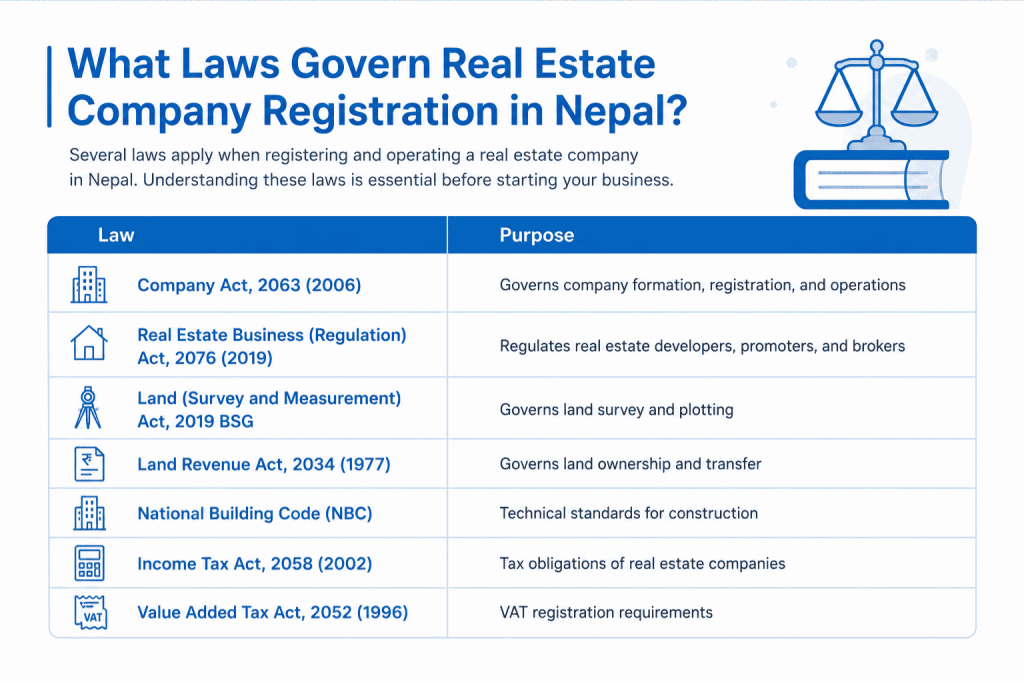
Several laws apply when registering and operating a real estate company in Nepal. Understanding these laws is essential before starting your business.
| Law | Purpose |
|---|---|
| Company Act, 2063 (2006) | Governs company formation, registration, and operations |
| Real Estate Business (Regulation) Act, 2076 (2019) | Regulates real estate developers, promoters, and brokers |
| Land (Survey and Measurement) Act, 2019 BS | Governs land survey and plotting |
| Land Revenue Act, 2034 (1977) | Governs land ownership and transfer |
| National Building Code (NBC) | Technical standards for construction |
| Income Tax Act, 2058 (2002) | Tax obligations of real estate companies |
| Value Added Tax Act, 2052 (1996) | VAT registration requirements |
The Office of the Company Registrar (OCR) under the Ministry of Industry, Commerce and Supplies is the primary authority for company registration in Nepal. You can visit the official OCR website at www.ocr.gov.np for registration-related information.
The Department of Land Management and Archive and the Department of Urban Development and Building Construction (DUDBC) also play important regulatory roles in the real estate sector.
What Type of Company Should You Register for Real Estate Business in Nepal?
Most real estate companies in Nepal register as a Private Limited Company or a Public Limited Company under the Company Act, 2063.
Private Limited Company
- Suitable for small and medium real estate businesses
- Minimum 1 shareholder, maximum 101 shareholders
- Minimum paid-up capital as prescribed by the government
- Restricted share transfer
Public Limited Company
- Suitable for large real estate developers and housing companies
- Minimum 7 shareholders required
- Can issue shares to the public
- Required for large-scale real estate projects under Real Estate Business (Regulation) Act, 2076
Under Section 5 of the Real Estate Business (Regulation) Act, 2076, real estate promoters who intend to sell more than a certain number of housing units must obtain a license from the Department of Urban Development and Building Construction (DUDBC). Large developers are often required to form a public limited company.
What Are the Steps for Real Estate Company Registration in Nepal?
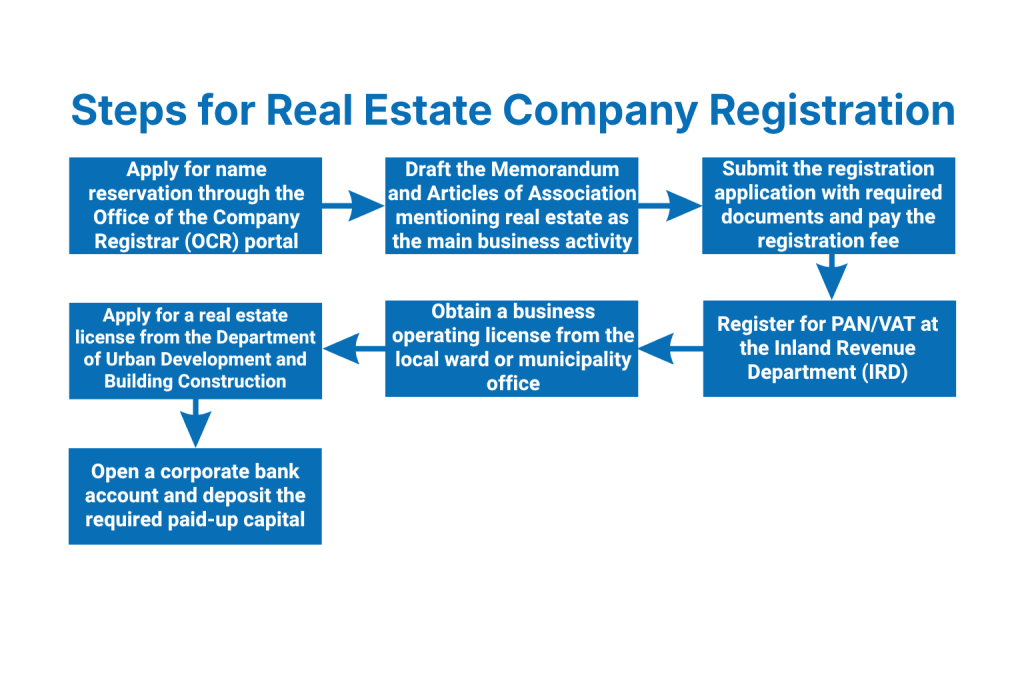
The registration process follows multiple stages involving different government bodies.
Step 1: Name Reservation at OCR
- Visit the OCR online portal at www.ocr.gov.np
- Submit an application for company name reservation
- The name must not conflict with existing registered companies
- OCR approves or rejects the name within a few working days
- Pay the name reservation fee
Step 2: Prepare Memorandum of Association (MOA) and Articles of Association (AOA)
- Draft the Memorandum of Association clearly mentioning real estate as the main business objective
- Draft the Articles of Association defining internal governance rules
- Both documents must comply with the Company Act, 2063
Step 3: Submit Registration Application at OCR
- Submit completed Form 1 (Application for Registration) at OCR
- Attach all required documents
- Pay the prescribed registration fee based on authorized capital
Step 4: Obtain PAN/VAT Registration at Inland Revenue Department (IRD)
- After OCR registration, apply for Permanent Account Number (PAN) at the Inland Revenue Department (IRD)
- Real estate companies with annual transactions exceeding the VAT threshold must also register for VAT
- Visit www.ird.gov.np for tax registration
Step 5: Register with Local Municipality or Metropolitan Office
- Register the company’s business address with the local municipality
- Obtain a business operating license from the local ward and municipality office
Step 6: Obtain Real Estate Business License from DUDBC
- Apply for a real estate business license at the Department of Urban Development and Building Construction
- This is mandatory under the Real Estate Business (Regulation) Act, 2076 for developers and promoters
- Submit project details, land ownership documents, and financial capability proof
Step 7: Open a Company Bank Account
- Open a corporate bank account in the company’s name
- Deposit the required paid-up capital as stated in the MOA
What Documents Are Required for Real Estate Company Registration in Nepal?
The following documents are required for registering a real estate company at OCR:
- Completed application form (Form 1) in the prescribed format
- Memorandum of Association (MOA) signed by all shareholders
- Articles of Association (AOA) signed by all shareholders
- Citizenship certificates of all shareholders and directors
- Passport-size photographs of all shareholders and directors
- Proof of registered office address (rental agreement or ownership certificate)
- Tax clearance or PAN of existing shareholders (if applicable)
- Bank voucher confirming payment of registration fee
For the Real Estate Business License from DUDBC, additional documents include:
- Company registration certificate from OCR
- PAN/VAT certificate from IRD
- Land ownership documents (Lalpurja) of the project site
- Land use approval from concerned municipality
- Detailed project plan and design approved by DUDBC
- Environmental Impact Assessment (EIA) or Initial Environmental Examination (IEE) if required
- Financial statement or capital sufficiency proof
What Is the Minimum Capital Requirement for a Real Estate Company in Nepal?
The Company Act, 2063 and OCR guidelines specify minimum capital requirements for different types of companies.
| Company Type | Minimum Authorized Capital | Minimum Paid-Up Capital |
|---|---|---|
| Private Limited Company | NPR 1,00,000 (1 Lakh) | As per MOA |
| Public Limited Company | NPR 1,00,00,000 (1 Crore) | As per MOA |
| Real Estate Developer (Large Scale) | As specified by DUDBC | Project-dependent |
However, under the Real Estate Business (Regulation) Act, 2076, real estate promoters may be required to maintain significantly higher capital based on the scale of their housing or land development project. The DUDBC has the authority to prescribe minimum capital requirements for licensing purposes.
What Are the Compliance Requirements for a Real Estate Company in Nepal?
Once registered, real estate companies in Nepal must maintain ongoing compliance.
- Annual General Meeting (AGM): Must be held within 6 months of the fiscal year-end as per Section 76 of the Company Act, 2063
- Annual Return Filing: File annual returns with OCR including financial statements
- Tax Filing: Submit annual income tax returns to IRD
- Project Registration: Register each real estate project with DUDBC before selling units
- Escrow Account: Under the Real Estate Business (Regulation) Act, 2076, developers must maintain a separate escrow account for each project to protect buyers
- Disclosure Obligations: Provide buyers with complete project details, timelines, and costs
- Building Permit: Obtain building permits from the local municipality before construction
- Completion Certificate: Obtain a completion certificate from DUDBC or municipality after project completion
Failure to comply with these requirements can lead to penalties, suspension of the real estate license, or deregistration of the company under the provisions of the Real Estate Business (Regulation) Act, 2076.
What Is the Role of the Real Estate Business (Regulation) Act, 2076?
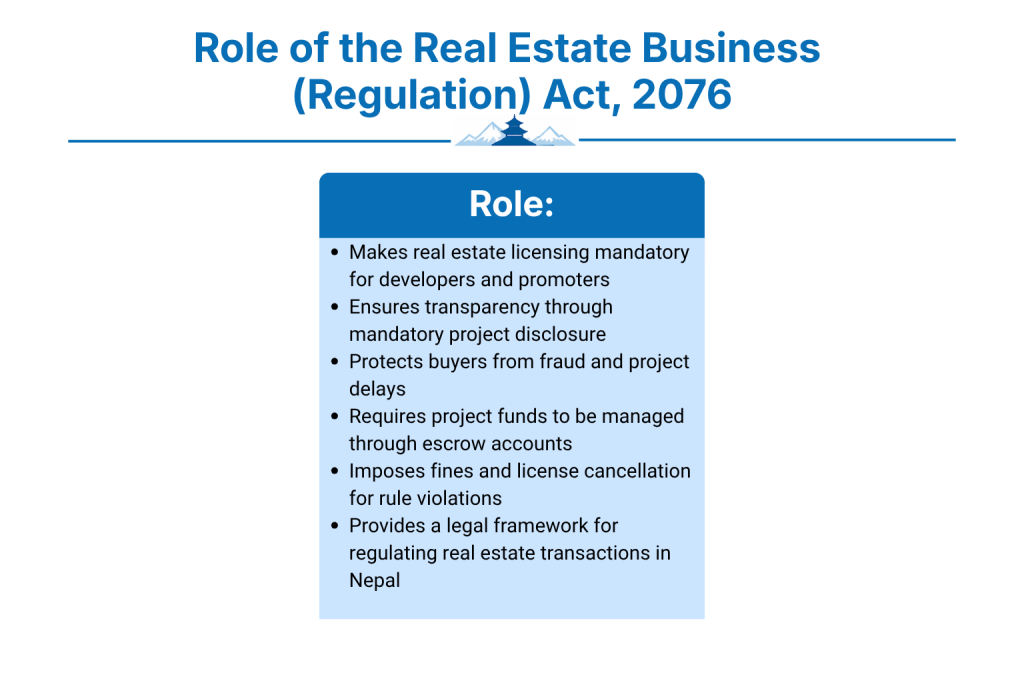
The Real Estate Business (Regulation) Act, 2076 (2019) is the most significant legislation specifically targeting real estate companies in Nepal. Before this Act, the real estate sector operated without clear regulations, leading to consumer fraud, project abandonment, and financial disputes.
Key provisions of this Act include:
- Mandatory Licensing: All real estate promoters and developers must obtain a license from DUDBC
- Project Disclosure: Developers must publicly disclose project details before selling
- Buyer Protection: Buyers can claim refunds if the developer fails to deliver on time
- Escrow Mechanism: Project funds must be kept in an escrow account
- Penalty Provisions: Non-compliant companies face heavy fines and license cancellation
- Real Estate Regulatory Authority: The Act establishes a framework for a regulatory authority to oversee real estate transactions
This Act applies to housing, apartment, integrated housing complex, and land development projects. Brokerage companies are also regulated under this legislation.
How Much Does It Cost to Register a Real Estate Company in Nepal?
Registration fees at OCR are based on the authorized capital of the company. The fee structure is updated periodically by OCR.
- Name Reservation Fee: Approximately NPR 100 – 500
- Company Registration Fee: Varies from NPR 1,000 to several lakhs based on capital
- PAN Registration: Free at IRD
- Municipality Business License: Varies by municipality (typically NPR 2,000 to 10,000+)
- DUDBC Real Estate License: Fee depends on the type and scale of the project
For the latest OCR fee structure, visit www.ocr.gov.np.
Can a Foreign Investor Register a Real Estate Company in Nepal?
Foreign direct investment (FDI) in real estate in Nepal is restricted under the Foreign Investment and Technology Transfer Act, 2075 (2019). Generally, foreign individuals cannot directly own land in Nepal. However, foreign investors can invest in Nepalese real estate companies under specific conditions approved by the Investment Board Nepal (IBN) or the Department of Industry.
Foreign investors must obtain approval from the Department of Industry and comply with the minimum investment threshold for FDI in Nepal.
Conclusion
Real estate company registration in Nepal involves multiple legal steps including OCR company registration, PAN/VAT registration, municipality licensing, and DUDBC real estate licensing. The Real Estate Business (Regulation) Act, 2076 adds strict compliance requirements to protect buyers and regulate developers. Following all legal requirements from the beginning ensures smooth operations and avoids penalties. Consulting a legal expert or chartered accountant familiar with Nepalese company law and real estate regulations is strongly advised before starting the registration process.
FAQs
1. Which office registers a real estate company in Nepal?
The Office of the Company Registrar (OCR) under the Ministry of Industry, Commerce and Supplies registers real estate companies in Nepal. Additionally, a real estate license must be obtained from the Department of Urban Development and Building Construction (DUDBC).
2. Is a separate real estate license required after company registration in Nepal?
Yes. Under the Real Estate Business (Regulation) Act, 2076, all real estate developers and promoters must obtain a separate license from DUDBC before starting any real estate project or selling housing units.
3. What is the minimum capital to register a private limited real estate company in Nepal?
The minimum authorized capital for a private limited company under the Company Act, 2063 is NPR 1 Lakh. However, DUDBC may impose higher capital requirements based on the real estate project’s scope.
4. How long does it take to complete real estate company registration in Nepal?
OCR company registration typically takes 3 to 7 working days if all documents are in order. Obtaining a DUDBC real estate license may take additional weeks depending on project documentation and approvals.
5. Can a single person register a real estate company in Nepal?
Yes. Under the Company Act, 2063, a single shareholder can register a Single Shareholder Private Limited Company. This applies to real estate businesses as well.
6. What happens if a real estate company operates without a license in Nepal?
Operating without a license under the Real Estate Business (Regulation) Act, 2076 can result in heavy fines, project suspension, and criminal liability for directors and promoters of the company.
Conclusion
Real estate company registration in Nepal involves multiple legal steps including OCR company registration, PAN/VAT registration, municipality licensing, and DUDBC real estate licensing. The Real Estate Business (Regulation) Act, 2076 adds strict compliance requirements to protect buyers and regulate developers. Following all legal requirements from the beginning ensures smooth operations and avoids penalties. Consulting a legal expert or chartered accountant familiar with Nepalese company law and real estate regulations is strongly advised before starting the registration process.