


Radio and TV Broadcasting License Process in Nepal Broadcasting media in Nepal including radio stations and television channels must obtain proper licenses before starting operations. The government of Nepal regulates all broadcasting activities through specific laws, authorities, and procedures. Whether you want to start an FM radio station, a community radio, or a television channel, understanding the legal requirements and the step-by-step process is essential.
This article explains the entire Radio and TV Broadcasting License process in Nepal in a clear and factual manner.
What Is the Legal Framework for Broadcasting in Nepal?
The broadcasting sector in Nepal is governed by several laws and regulations. The most important legal instruments include:
- National Broadcasting Act, 2049 (1993) – This is the primary law that governs broadcasting in Nepal. It establishes the framework for issuing licenses to radio and television broadcasters.
- National Broadcasting Regulation, 2052 (1995) – This regulation provides detailed rules for implementing the Broadcasting Act.
- Telecommunications Act, 2053 (1997) – This law regulates the use of radio frequency spectrum in Nepal.
- Press and Publications Act, 2048 (1991) – This act governs print and certain media-related registration activities.
- Electronic Transaction Act, 2063 (2006) – This act covers digital media and electronic communications.
Under the National Broadcasting Act, 2049, no person or organization can operate a radio or television broadcasting service in Nepal without a valid license issued by the government. Operating without a license is a punishable offense under Section 20 of the Act.
Who Regulates Broadcasting Licenses in Nepal?
In Nepal, broadcasting licenses are issued and regulated by the Ministry of Information and Communication (MoIC). However, the frequency spectrum allocation is done in coordination with the Nepal Telecommunications Authority (NTA).
The National Broadcasting Act, 2049 places the authority to grant, renew, and cancel broadcasting licenses under the Ministry of Information and Communication. The Ministry evaluates applications, checks eligibility, and grants approval for radio and television channels.
For frequency allocation specifically, applicants must also obtain clearance from the Nepal Telecommunications Authority, which operates under the Telecommunications Act, 2053.
You can visit the Ministry of Information and Communication at: https://moic.gov.np
You can visit the Nepal Telecommunications Authority at: https://nta.gov.np
What Are the Types of Broadcasting Licenses in Nepal?

Nepal categorizes broadcasting licenses into different types based on the nature of broadcasting services. The main categories are:
1. Radio Broadcasting License
- Commercial FM Radio License – For private companies and individuals operating commercial FM radio stations.
- Community Radio License – For non-profit community organizations operating radio stations for public benefit.
- Campus Radio License – For educational institutions operating radio stations for educational purposes.
- Government/Public Radio License – For Radio Nepal, operated by the government.
2. Television Broadcasting License
- Commercial Television License – For private companies operating commercial TV channels.
- Cable Television License – For operators distributing TV channels through cable networks.
- Community Television License – For non-profit community television services.
- Satellite Television License – For channels broadcasting via satellite.
- Government/Public Television License – For Nepal Television, operated by the state.
| Type of License | Category | Regulatory Body |
|---|---|---|
| Commercial FM Radio | Radio | Ministry of Information and Communication |
| Community Radio | Radio | Ministry of Information and Communication |
| Campus Radio | Radio | Ministry of Information and Communication |
| Commercial Television | Television | Ministry of Information and Communication |
| Cable Television | Television | Ministry of Information and Communication |
| Satellite Television | Television | Ministry of Information and Communication |
Who Is Eligible to Apply for a Broadcasting License in Nepal?
Under the National Broadcasting Act, 2049 and the National Broadcasting Regulation, 2052, the eligibility criteria for obtaining a broadcasting license in Nepal are as follows:
For Individuals:
- Must be a Nepali citizen.
- Must not have been convicted of any criminal offense.
- Must have the financial capacity to operate a broadcasting station.
For Organizations/Companies:
- Must be a legally registered company or organization in Nepal.
- Must be registered under the Company Act, 2063 (2006) or the Cooperative Act or the Association Registration Act as applicable.
- The majority shareholding or ownership must belong to Nepali citizens.
- Foreign ownership is restricted in media sectors as per the Foreign Investment and Technology Transfer Act, 2075 (2019).
For Community Radio:
- Must be a non-profit community-based organization.
- Must demonstrate community interest and participation.
- Must be registered under the relevant laws governing non-profit organizations.
What Documents Are Required for a Radio Broadcasting License in Nepal?

To apply for an FM Radio or Community Radio license in Nepal, the applicant must submit the following documents:
- Completed application form as prescribed by the Ministry of Information and Communication.
- Copy of company registration certificate or organizational registration certificate.
- Copy of the applicant’s citizenship certificate (for individuals) or registration documents (for companies).
- Memorandum of Association and Articles of Association of the company.
- Proposed frequency and coverage area details.
- Technical feasibility study of the proposed radio station.
- Financial statement or proof of financial capability.
- Details of studio and transmission equipment.
- Tax clearance certificate from the Inland Revenue Department.
- Proposed broadcasting content plan and schedule.
- Land ownership or lease agreement for the proposed studio location.
What Documents Are Required for a TV Broadcasting License in Nepal?
For a Television Broadcasting License in Nepal, the following documents are required:
- Application form prescribed by the Ministry of Information and Communication.
- Company registration certificate under the Company Act, 2063.
- PAN/VAT registration certificate from the Inland Revenue Department.
- Memorandum of Association and Articles of Association.
- Detailed project report of the proposed television channel.
- Financial capacity proof or bank statements.
- Studio location and infrastructure details.
- Technical specifications of broadcasting equipment.
- Citizenship certificates of all directors and key personnel.
- Tax clearance certificate.
- Content policy and programming schedule.
- For satellite TV: agreement with satellite service provider.
- For cable TV: proposed network coverage details.
What Is the Step-by-Step Process to Obtain a Broadcasting License in Nepal?
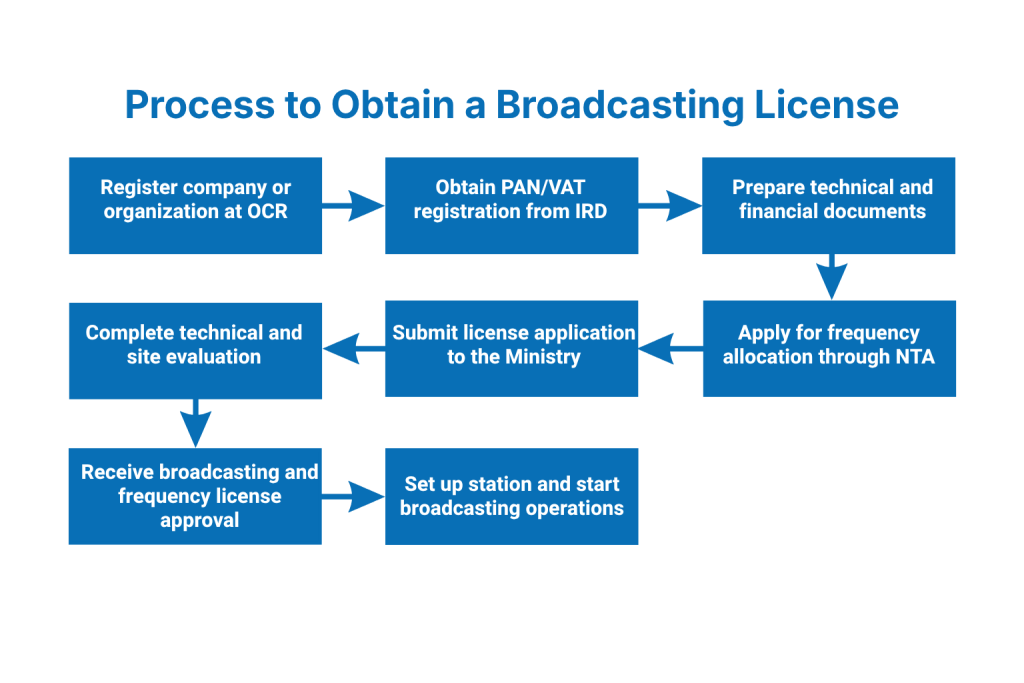
Step 1: Company Registration
Register a company or organization under the Company Act, 2063 or the relevant organizational law through the Office of the Company Registrar at https://ocr.gov.np.
Step 2: Obtain PAN/VAT Registration
Register for PAN/VAT at the Inland Revenue Department (https://ird.gov.np).
Step 3: Prepare Technical and Financial Documents
Prepare a detailed technical feasibility study, financial plan, and infrastructure plan for the broadcasting station.
Step 4: Apply for Frequency Allocation (for Radio)
Submit a frequency allocation request to the Nepal Telecommunications Authority (NTA). The NTA evaluates the request and assigns a suitable frequency based on spectrum availability.
Step 5: Submit Application to Ministry of Information and Communication
Submit the completed application along with all required documents to the Ministry of Information and Communication. The application must be in the prescribed format as per the National Broadcasting Regulation, 2052.
Step 6: Technical Evaluation
The Ministry reviews the technical feasibility, financial capacity, and content plan. A technical committee may inspect the proposed studio and transmission site.
Step 7: Approval and License Issuance
If the application meets all criteria, the Ministry of Information and Communication issues the broadcasting license. For radio, a frequency license is also issued by the NTA simultaneously.
Step 8: Begin Broadcasting Operations
After receiving the license, the broadcaster must set up the station as per the approved plan and begin operations within the time limit specified in the license.
What Are the Fees for Broadcasting Licenses in Nepal?
The fees for broadcasting licenses in Nepal are determined by the Ministry of Information and Communication as per the National Broadcasting Regulation, 2052 and its subsequent amendments. The fee structure differs based on the type and coverage of the broadcasting service.
| Type of License | Initial License Fee (Approx.) | Annual Renewal Fee (Approx.) |
|---|---|---|
| Commercial FM Radio (Local) | NPR 50,000 – 1,00,000 | NPR 25,000 – 50,000 |
| Commercial FM Radio (National) | NPR 1,00,000 – 3,00,000 | NPR 50,000 – 1,00,000 |
| Community Radio | NPR 10,000 – 25,000 | NPR 5,000 – 10,000 |
| Commercial Television (Local) | NPR 1,00,000 – 3,00,000 | NPR 50,000 – 1,00,000 |
| Commercial Television (National) | NPR 3,00,000 – 5,00,000 | NPR 1,00,000 – 2,00,000 |
| Cable Television | NPR 50,000 – 1,00,000 | NPR 25,000 – 50,000 |
Note: The exact fees are subject to change as per government notifications. Applicants should verify the current fee structure with the Ministry of Information and Communication.
How Long Is a Broadcasting License Valid in Nepal?
Under the National Broadcasting Act, 2049, a broadcasting license in Nepal is typically valid for a period of five years from the date of issuance. The licensee must apply for renewal before the expiration of the license to continue operations legally.
What Is the Process for Renewing a Broadcasting License in Nepal?
Renewal of a broadcasting license in Nepal requires:
- Submission of a renewal application to the Ministry of Information and Communication before the license expiry date.
- Payment of the prescribed renewal fee.
- Submission of updated documents including tax clearance certificate and financial statements.
- Compliance report showing that the broadcaster has operated within the terms and conditions of the original license.
Failure to renew the license within the prescribed period may result in penalties or cancellation of the license under Section 14 of the National Broadcasting Act, 2049.
What Are the Penalties for Operating Without a Broadcasting License in Nepal?
Operating a radio or television broadcasting service without a valid license is a punishable offense under Section 20 of the National Broadcasting Act, 2049. The penalties include:
- Fines as determined by the court.
- Seizure of broadcasting equipment.
- Cancellation of registration of the organization.
- Criminal charges against the responsible individuals.
The Ministry of Information and Communication has the authority to take action against unlicensed broadcasters in coordination with law enforcement agencies.
What Content Regulations Must Broadcasters Follow in Nepal?
All licensed broadcasters in Nepal must comply with content regulations under the National Broadcasting Act, 2049 and National Broadcasting Regulation, 2052. Broadcasters are prohibited from broadcasting:
- Content that threatens national sovereignty and integrity.
- Content that incites ethnic, religious, or communal hatred.
- Obscene or indecent content.
- False or misleading information.
- Content that violates the privacy or dignity of individuals.
The Ministry of Information and Communication monitors compliance with these content standards and can take action against broadcasters that violate them.
Conclusion
Obtaining a Radio or TV Broadcasting License in Nepal requires compliance with the National Broadcasting Act, 2049, National Broadcasting Regulation, 2052, and related laws. The process involves company registration, frequency allocation through the Nepal Telecommunications Authority, and formal application to the Ministry of Information and Communication. Applicants must meet financial, technical, and legal requirements to receive approval. All broadcasters must follow content regulations and renew their licenses every five years to remain legally compliant. Understanding and following the prescribed legal process ensures smooth and lawful broadcasting operations in Nepal.
FAQs
1. Can a foreign company obtain a broadcasting license in Nepal?
No. Under the National Broadcasting Act, 2049 and the Foreign Investment and Technology Transfer Act, 2075, foreign companies cannot directly obtain broadcasting licenses in Nepal. Majority ownership must remain with Nepali citizens.
2. How long does it take to get a broadcasting license in Nepal?
The process typically takes three to six months depending on document completeness, technical evaluation, and frequency availability. Delays can occur if additional information is required by the Ministry of Information and Communication.
3. Is a separate frequency license required for FM radio in Nepal?
Yes. Frequency allocation is handled by the Nepal Telecommunications Authority (NTA) under the Telecommunications Act, 2053, separate from the broadcasting license issued by the Ministry of Information and Communication.
4. Can a community radio station broadcast advertisements in Nepal?
Community radio stations in Nepal operate on a non-commercial basis. Advertisements are restricted or limited under the community radio license terms as per the National Broadcasting Regulation, 2052.
5. What happens if a broadcasting license expires and is not renewed?
If a broadcasting license is not renewed before expiry, the broadcaster must stop operations. Continued broadcasting without a valid license is punishable under Section 20 of the National Broadcasting Act, 2049.
6. Where can I submit the broadcasting license application in Nepal?
Applications for broadcasting licenses in Nepal are submitted to the Ministry of Information and Communication (MoIC), Singha Durbar, Kathmandu. More details are available at https://moic.gov.np.