


Long Term Residential Visa in Nepal Nepal is a landlocked country in South Asia that attracts thousands of foreign nationals every year, not only for tourism but also for long-term residence. Whether a person plans to retire in Nepal, marry a Nepali citizen, or stay for an extended period, the Long Term Residential Visa in Nepal is the formal legal route to do so.
This article covers everything a foreign national needs to know about the long-term residential visa, including eligibility, required documents, the application process, fees, and the governing laws.
What Is a Long Term Residential Visa in Nepal?

A Long Term Residential Visa in Nepal is a special category of visa issued to foreign nationals who intend to reside in Nepal for a period exceeding the standard tourist visa duration. Unlike a tourist visa, which allows a stay of up to 150 days per calendar year, the residential visa grants the holder the legal right to live in Nepal for an extended period, subject to regular renewal.
The Department of Immigration Nepal (www.immigration.gov.np) is the primary government authority responsible for issuing, renewing, and regulating all types of visas in Nepal, including the long-term residential visa. The visa system in Nepal operates under the Immigration Act, 2049 (1992) and the Immigration Rules, 2051 (1994), which define the categories, conditions, and procedures for issuing residential visas to foreign nationals.
Nepal does not have a permanent residency program similar to many Western countries. However, it does offer long-term residential visas that allow foreign nationals to legally reside within the country for extended durations. The visa requires periodic renewal and is subject to the conditions set by the Government of Nepal.
Who Is Eligible for a Long Term Residential Visa in Nepal?
The Government of Nepal grants long-term residential visas to specific categories of foreign nationals. Not every foreign national qualifies for this type of visa. The following categories of individuals are generally eligible:
- Spouses of Nepali citizens: A foreign national who is legally married to a Nepali citizen can apply for a residential visa. This is one of the most common routes to obtaining a long-term residential visa in Nepal.
- Persons of Nepali origin: Individuals who were once Nepali citizens or who have parents or grandparents who were Nepali citizens may qualify under certain conditions.
- Foreign nationals with significant investments in Nepal: Those who invest a substantial amount in Nepal’s economy can apply for a non-tourist, long-term residential visa.
- Retired foreign nationals: Individuals over the age of 65 who wish to retire in Nepal may apply for a retirement-based residential visa.
- Researchers and scholars: Those engaged in long-term academic or research activities in Nepal, with prior approval from the concerned government body, may also be eligible.
The eligibility criteria are strictly defined under the Immigration Act, 2049, and the Department of Immigration holds the authority to approve or reject applications based on these criteria.
Types of Long Term Residential Visa in Nepal
Nepal does not have a single unified “residential visa” category. Instead, several visa sub-types allow for long-term stay. Understanding each type helps a foreign national choose the correct category.
Non-Tourist Visa (Residential Visa)
The non-tourist visa, commonly referred to as the residential visa, is issued to foreign nationals who qualify under specific eligibility conditions. It is typically issued for one year at a time and must be renewed annually at the Department of Immigration. This visa does not automatically grant work rights. A separate work permit is required if the visa holder intends to be employed in Nepal.
Spousal Residential Visa
This visa is issued specifically to foreign nationals married to Nepali citizens. The applicant must provide proof of marriage and the Nepali citizenship of the spouse. This visa is issued for one year and is renewable. The spouse holds the right to reside in Nepal but must comply with all immigration conditions. The spousal residential visa is governed under Section 10 of the Immigration Act, 2049.
Retirement Visa
Nepal offers a retirement visa to foreign nationals who are 65 years of age or older. The applicant must be able to demonstrate sufficient financial means to support themselves during their stay. This visa is issued for one year at a time and is renewable. It is ideal for older foreign nationals who wish to spend their retirement years in Nepal’s peaceful environment.
Investment-Based Residential Visa
Foreign nationals who make a qualifying investment in Nepal may apply for a long-term residential visa on the basis of their investment. The minimum investment threshold is set by the Government of Nepal and is subject to change. The Department of Industry and the Department of Immigration jointly process such applications.
Documents Required for Long Term Residential Visa in Nepal
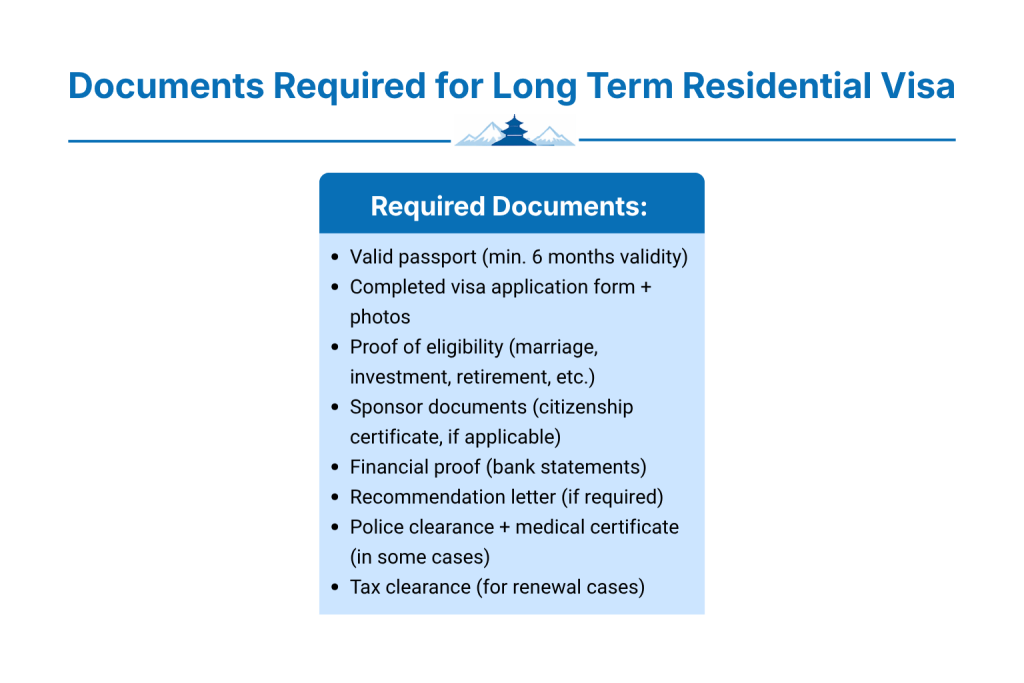
The documentation required for a long-term residential visa in Nepal varies based on the visa category. However, the following are the standard documents required across most categories:
- Valid passport with at least six months of remaining validity
- Completed visa application form (available at the Department of Immigration or online)
- Recent passport-sized photographs (as specified by the Department)
- Proof of eligibility (marriage certificate, investment proof, retirement age proof, etc.)
- Nepali citizenship certificate of the sponsoring Nepali citizen (for spousal visa)
- Recommendation letter from the concerned government ministry or department (where applicable)
- Bank statements or proof of financial means
- Medical certificate (in some cases)
- Police clearance certificate from the applicant’s home country
- Tax clearance certificate (for existing residential visa holders seeking renewal)
All foreign documents must be officially translated into Nepali or English and authenticated by the relevant authorities. Documents from outside Nepal may require apostille certification or notarization from the Nepali embassy or consulate in the applicant’s home country.
Step-by-Step Process to Apply for a Long Term Residential Visa in Nepal

The application process for a long-term residential visa in Nepal follows a structured procedure. Below are the steps a foreign national must follow:
- Determine eligibility: Confirm that you fall under one of the eligible categories defined by the Department of Immigration Nepal.
- Gather all required documents: Collect all necessary documents based on your visa category, ensuring that they are valid, properly translated, and authenticated.
- Visit the Department of Immigration: Go to the Department of Immigration in Maitighar, Kathmandu, or the nearest immigration office in your district.
- Submit the application form: Fill out the visa application form accurately and submit it along with all supporting documents at the designated counter.
- Pay the visa fee: Pay the applicable visa fee at the fee counter. Keep the receipt as proof of payment.
- Attend biometric registration: Provide biometric data, including fingerprints and a photograph, as required by the Department.
- Wait for processing: The Department of Immigration reviews the application. Processing time may vary from a few days to a few weeks depending on the visa category and document completeness.
- Receive the visa: Once approved, the visa is stamped into the applicant’s passport. The residential visa is typically valid for one year from the date of issue.
- Register with the local authority: After receiving the visa, the foreign national may be required to register with the local ward office or district administration office.
Fees for Long Term Residential Visa in Nepal
The fee for a long-term residential visa in Nepal varies based on the visa type and the applicant’s nationality. The Department of Immigration Nepal sets the official fee schedule. As a general reference:
- Spousal Residential Visa: Approximately NPR 5,000 to NPR 10,000 per year
- Retirement Visa: Fees vary; applicants must check the current fee schedule at the Department of Immigration
- Investment-Based Residential Visa: Higher fees apply based on the investment category
The Government of Nepal periodically revises visa fees. Applicants should always verify the current fee structure directly from the Department of Immigration’s official website or visit the office in person.
Legal Framework Governing Long Term Residential Visa in Nepal
The issuance and regulation of long-term residential visas in Nepal fall under the following legal instruments:
- Immigration Act, 2049 (1992): This is the primary legislation that governs all immigration matters in Nepal. It defines visa categories, conditions for entry and stay, and penalties for violations.
- Immigration Rules, 2051 (1994): These rules provide operational details for implementing the Immigration Act, including procedural requirements for visa applications.
- Foreign Investment and Technology Transfer Act, 2075 (2019): This act governs investment-related visa matters for foreign nationals investing in Nepal.
- Directives and Circulars from the Ministry of Home Affairs: The Ministry of Home Affairs, Nepal, issues periodic directives that may affect visa policies and procedures.
Foreign nationals must comply with all conditions attached to their residential visa. Any violation, including overstaying or engaging in unauthorized activities, may lead to fines, deportation, or blacklisting under Section 23 of the Immigration Act, 2049.
Renewal of Long Term Residential Visa in Nepal
A long-term residential visa in Nepal is not permanent. It requires annual renewal. The renewal process is similar to the initial application process and must be completed before the visa expires. Overstaying beyond the visa validity period attracts a fine per day and may result in legal complications.
The renewal application must be submitted to the Department of Immigration along with the updated documents, including a tax clearance certificate and a recommendation letter if required. The fee for renewal is the same as or similar to the initial issuance fee.
Rights and Restrictions of Long Term Residential Visa Holders in Nepal
A long-term residential visa holder in Nepal enjoys the right to reside within the country but does not automatically gain citizenship rights, voting rights, or the right to own land. The Constitution of Nepal, 2072 (2015), restricts land ownership by foreign nationals. A residential visa holder cannot purchase land directly in their name.
For employment, a separate work permit issued by the Department of Labour is required. The residential visa alone does not authorize a foreign national to engage in employment or business activities in Nepal.
Frequently Asked Questions (FAQs)
1. Can a foreign national get permanent residency in Nepal?
Nepal does not offer a formal permanent residency program. Foreign nationals can only obtain long-term residential visas that require annual renewal. Citizenship through naturalization is possible under strict conditions defined in the Nepal Citizenship Act, 2063.
2. How long does it take to process a long-term residential visa in Nepal?
Processing time varies from a few days to several weeks. It depends on the visa category, the completeness of the application, and the current workload at the Department of Immigration, Maitighar, Kathmandu.
3. Can a residential visa holder work in Nepal?
A residential visa does not grant the right to work in Nepal. A foreign national must obtain a separate work permit from the Department of Labour, Employment and Training before engaging in any employment or professional activity.
4. What happens if a residential visa expires without renewal?
If a residential visa expires without renewal, the foreign national is considered an overstay. A daily fine is imposed under the Immigration Act, 2049. Continued overstay may result in deportation and blacklisting from re-entry.
5. Can children of a Nepali citizen apply for a residential visa?
Children born abroad to a Nepali citizen may apply for a residential visa. However, they may also be eligible for Nepali citizenship under the Nepal Citizenship Act, 2063, if they meet the applicable legal requirements for citizenship by descent.
6. Where can I apply for a long-term residential visa in Nepal?
Applications are submitted at the Department of Immigration Nepal, located at Maitighar, Kathmandu. Regional immigration offices also handle applications in some districts. Visit www.immigration.gov.np for official information.