

Livestock farming company registration in Nepal is one of the oldest and most economically significant agricultural sectors. From poultry and dairy to goat farming and fisheries, the livestock sector contributes approximately 11% to Nepal’s Gross Domestic Product (GDP) and supports the livelihoods of millions of rural households. Registering a livestock farming company in Nepal gives entrepreneurs legal standing, access to government subsidies, bank loans, and the ability to operate at a commercial scale.
This guide covers the complete process, legal requirements, documents, applicable laws, and regulatory compliance for livestock farming company registration in Nepal.
What Is Livestock Farming Company Registration in Nepal?
Livestock farming company registration in Nepal is the formal legal process of incorporating a business entity that engages in the rearing, breeding, trading, or processing of animals such as cattle, buffalo, goats, poultry, pigs, fish, and bees. The registration grants the business a legal identity under Nepali law. Without proper registration, a livestock business cannot open corporate bank accounts, obtain government subsidies, enter contracts, or apply for agricultural loans.
The registration process in Nepal falls under the jurisdiction of the Office of Company Registrar (OCR) under the Companies Act, 2063 (2006) and is further governed by sector-specific regulations from the Department of Livestock Services (DLS) under the Ministry of Agriculture and Livestock Development (MoALD).
What Are the Types of Business Structures Available for Livestock Farming in Nepal?
Entrepreneurs in Nepal can register a livestock farming business under several legal structures. Each structure has different legal, financial, and operational implications.
| Business Structure | Governing Law | Minimum Members | Suitable For |
|---|---|---|---|
| Private Limited Company | Companies Act, 2063 | 1–101 shareholders | Medium to large livestock farms |
| Public Limited Company | Companies Act, 2063 | 7+ shareholders | Large-scale agribusiness |
| Sole Proprietorship (Private Firm) | Private Firm Registration Act, 2014 BS | 1 owner | Small livestock operations |
| Partnership Firm | Partnership Act, 2020 BS | 2–20 partners | Small to medium farms |
| Cooperative | Cooperative Act, 2074 (2017) | Minimum 25 members | Community livestock projects |
| Agricultural Enterprise | Industrial Enterprises Act, 2076 | As applicable | Agro-processing and farming |
For most commercial livestock farming ventures, registering as a Private Limited Company under the Companies Act, 2063 is the most preferred option due to limited liability protection, ease of raising capital, and access to government programs.
What Laws Govern Livestock Farming Company Registration in Nepal?
Nepal has several laws that directly and indirectly regulate livestock farming businesses. Knowing these laws helps business owners maintain full compliance.
- Companies Act, 2063 (2006): This is the primary law governing company formation, operation, and dissolution in Nepal. It is administered by the OCR.
- Industrial Enterprises Act, 2076 (2020): Livestock and agro-processing businesses qualify as industrial enterprises under this Act and can access industrial incentives.
- Animal Health and Livestock Services Act, 2055 (1998): This Act regulates animal health, veterinary services, and livestock movement in Nepal. It is the foundation for sector-specific licensing.
- Food Act, 2023 BS (1966) and Food Regulations, 2027 BS: Applicable when livestock businesses engage in meat, dairy, or egg processing and trade.
- Private Firm Registration Act, 2014 BS: Governs the registration of sole proprietorship livestock businesses.
- Cooperative Act, 2074 (2017): Applicable when registering a livestock cooperative.
- Foreign Investment and Technology Transfer Act (FITTA), 2075 (2019): Applicable when foreign investors participate in livestock farming ventures in Nepal.
- Income Tax Act, 2058 (2002): Tax obligations for livestock farming enterprises fall under this Act.
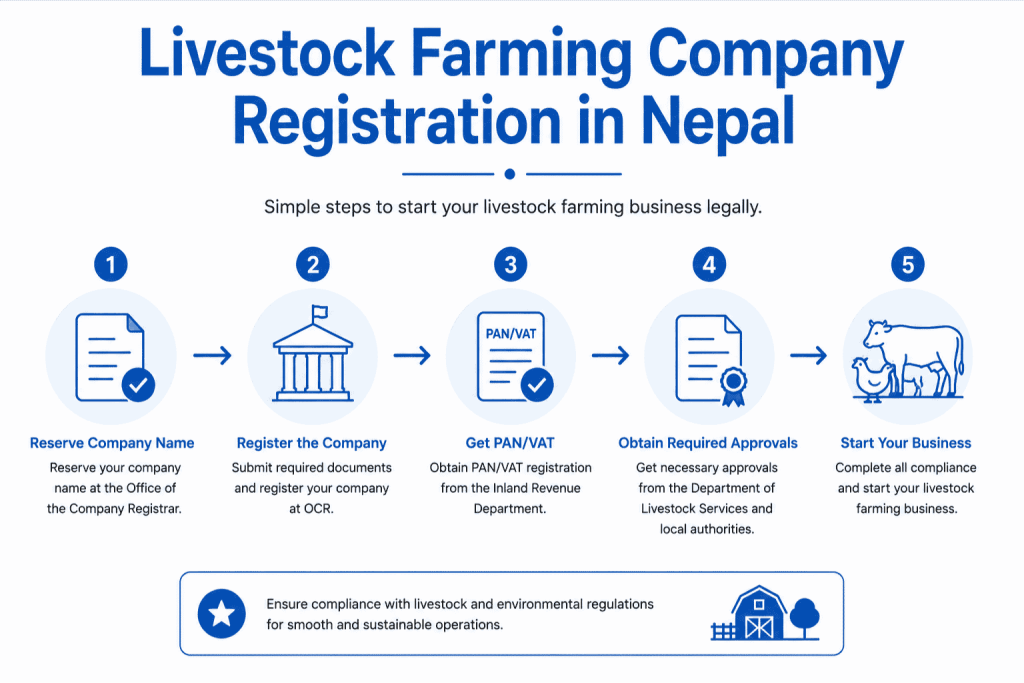
What Are the Steps to Register a Livestock Farming Company in Nepal?
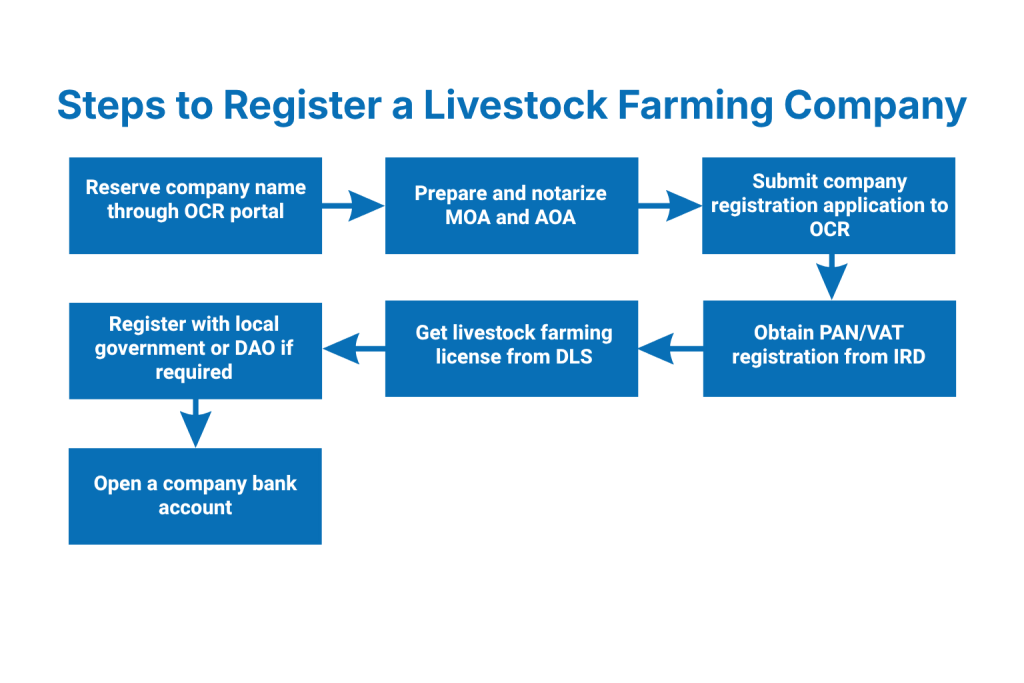
The registration process for a livestock farming company in Nepal follows a structured sequence of steps across multiple government offices.
Step 1: Name Reservation at the Office of Company Registrar (OCR)
- Visit the OCR portal at https://ocr.gov.np and apply for name reservation.
- Submit three proposed company names related to your livestock farming business.
- The OCR checks for uniqueness and approves the name within 7 working days.
- The name approval is valid for 30 days.
Step 2: Prepare the Memorandum of Association (MOA) and Articles of Association (AOA)
- Draft the MOA clearly stating that the company’s business object is livestock farming, poultry farming, dairy production, goat farming, fisheries, or related activities.
- The AOA defines the internal governance of the company.
- Both documents must be notarized by a certified Notary Public in Nepal.
Step 3: Submit the Company Registration Application at OCR
- Submit the completed application along with all required documents to the OCR office.
- Pay the prescribed registration fee based on the authorized capital of the company.
- The OCR issues the Certificate of Incorporation after verification.
Step 4: Register at the Inland Revenue Department (IRD)
- Obtain a Permanent Account Number (PAN) or Value Added Tax (VAT) registration from the Inland Revenue Department.
- PAN is mandatory for all businesses; VAT registration is required if annual turnover exceeds NPR 5 million (as per Income Tax Act, 2058).
Step 5: Obtain a Livestock Farming License from the Department of Livestock Services (DLS)
- Apply for a livestock farming operation license from the Department of Livestock Services (DLS) at https://dls.gov.np.
- The DLS verifies farm site, animal welfare standards, veterinary infrastructure, and biosecurity measures before issuing the license.
Step 6: Register with the District Administration Office and Local Government
- Some livestock operations also require registration with the District Administration Office (DAO) and the respective local municipal or rural municipality office.
- Local governments in Nepal have authority over land use and zoning for agricultural and livestock purposes under the Local Government Operation Act, 2074 (2017).
Step 7: Open a Company Bank Account
- Open a corporate bank account in the company’s name using the Certificate of Incorporation, PAN certificate, and company seal.
What Documents Are Required for Livestock Farming Company Registration in Nepal?
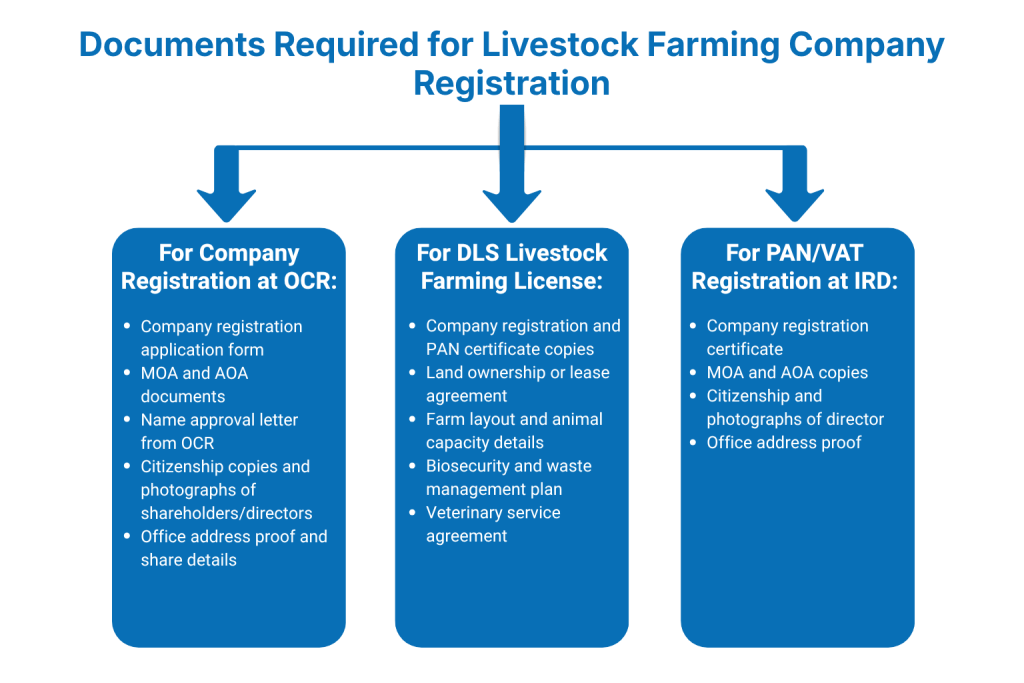
The following documents are required for registering a livestock farming company in Nepal:
For Company Registration at OCR:
- Completed company registration application form
- Memorandum of Association (MOA) and Articles of Association (AOA)
- Name approval letter from OCR
- Citizenship certificates of all shareholders and directors
- Passport-sized photographs of all shareholders and directors
- Proof of registered office address (ownership deed or rental agreement)
- Share allocation details among shareholders
- Board resolution (if applicable)
- Payment receipt of registration fee
For DLS Livestock Farming License:
- Copy of company registration certificate
- Copy of PAN certificate
- Land ownership certificate or land lease agreement for the farm
- Farm layout and infrastructure details
- Proposed animal species and rearing capacity
- Biosecurity and waste management plan
- Veterinary services agreement
- Citizenship copies of key management personnel
For PAN/VAT Registration at IRD:
- Company registration certificate
- MOA and AOA
- Citizenship of director
- Passport-sized photographs
- Proof of office address
What Are the Fees for Livestock Farming Company Registration in Nepal?
Registration fees at the OCR are determined by the authorized capital of the company. The table below outlines the standard fee structure.
| Authorized Capital (NPR) | Registration Fee (NPR) |
|---|---|
| Up to 1,00,000 | 1,000 |
| 1,00,001 to 5,00,000 | 4,500 |
| 5,00,001 to 25,00,000 | 9,500 |
| 25,00,001 to 1,00,00,000 | 18,000 |
| 1,00,00,001 to 2,50,00,000 | 28,000 |
| Above 2,50,00,000 | Additional charges apply |
These fees are subject to revision by the OCR and the Government of Nepal. Additional fees apply for the DLS license, local municipality registration, and IRD registration.
What Government Incentives Are Available for Livestock Farming Companies in Nepal?
The Government of Nepal provides several incentives to registered livestock farming companies under the Industrial Enterprises Act, 2076 and the Agriculture Development Strategy (ADS), 2015–2035.
- Tax Exemption: Income from livestock farming is partially or fully exempt from income tax for certain periods under Income Tax Act, 2058. Specifically, agro-based industries receive tax holidays of up to 10 years depending on location.
- Subsidized Loans: Registered livestock companies can access subsidized agricultural loans through Nepal Rastra Bank’s directed lending policy and the Agriculture Development Bank Nepal (ADBN).
- Government Grants: The Ministry of Agriculture and Livestock Development offers grants for poultry, dairy, goat, pig, and fishery enterprises through various government programs.
- Insurance Coverage: Nepal has a livestock insurance subsidy program where the government pays 75% of the insurance premium for registered livestock farmers.
- Priority Sector Lending: Banks and financial institutions are required to allocate a defined percentage of their loan portfolio to agriculture and livestock under NRB directives.
What Are the Annual Compliance Requirements for a Livestock Farming Company in Nepal?
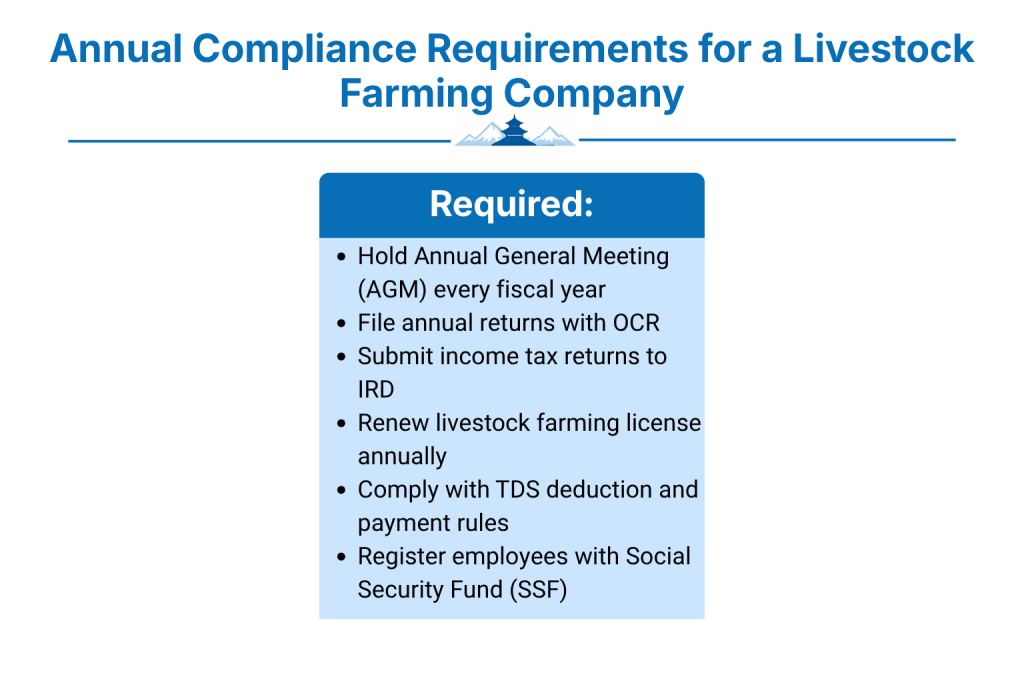
A registered livestock farming company in Nepal must meet annual compliance obligations:
- Annual General Meeting (AGM): Hold an AGM within 6 months of the end of each fiscal year as required under Companies Act, 2063.
- Annual Return Filing: File annual returns with the OCR after each AGM, including financial statements audited by a certified auditor.
- Tax Return Filing: File income tax returns with the IRD within 3 months after the end of the fiscal year (Ashad end).
- Renewal of Livestock License: The DLS livestock farming license must be renewed annually.
- TDS Compliance: Deduct and deposit Tax Deducted at Source (TDS) on applicable payments.
- Labor Compliance: Register employees with the Social Security Fund (SSF) as required under the Social Security Act, 2074 (2017).
Can Foreign Nationals Register a Livestock Farming Company in Nepal?
Foreign nationals and foreign companies can invest in Nepal’s livestock farming sector under the Foreign Investment and Technology Transfer Act (FITTA), 2075 (2019). However, livestock farming falls under the negative list for foreign direct investment (FDI) in Nepal. The Industrial Policy, 2067 and FITTA Schedule restrict 100% foreign ownership in primary agriculture and livestock farming.
Foreign investors must obtain prior approval from the Department of Industry or the Investment Board Nepal (IBN) for qualifying investments. Joint ventures with Nepali partners are a common approach for foreign participation in Nepal’s livestock sector.
Conclusion
Registering a livestock farming company in Nepal is a structured legal process governed by the Companies Act, 2063, the Animal Health and Livestock Services Act, 2055, and various other applicable laws. Entrepreneurs who formally register their livestock businesses gain access to legal protection, government subsidies, agricultural loans, insurance programs, and market credibility.
The process involves registration at the OCR, obtaining a PAN from the IRD, and securing a livestock operation license from the Department of Livestock Services. Staying compliant with annual filing obligations at OCR and IRD ensures the company maintains its legal standing and continues to benefit from all available government incentives in Nepal’s growing livestock sector.
FAQs
1. How long does it take to register a livestock farming company in Nepal?
The OCR typically processes company registration within 7 to 15 working days after receiving complete documents. The DLS livestock license may take an additional 15 to 30 days depending on farm inspection schedules.
2. Is a separate license required for poultry farming registration in Nepal?
Yes. Poultry farming requires a specific livestock farming license from the Department of Livestock Services. Additional approvals may be required from local municipality offices depending on the farm’s location and scale.
3. What is the minimum capital required to register a livestock farming company in Nepal?
There is no statutory minimum paid-up capital requirement for a private limited livestock farming company under the Companies Act, 2063. However, a reasonable capital base improves access to bank financing and government subsidies.
4. Can a single person register a livestock farming company in Nepal?
Yes. Under the Companies Act, 2063 as amended, a single shareholder can incorporate a private limited company (single-member company) in Nepal, making solo livestock farming ventures legally possible.
5. What tax benefits do registered livestock farming companies receive in Nepal?
Agro-based industries including livestock farming receive income tax holidays of up to 10 years under the Industrial Enterprises Act, 2076 and Income Tax Act, 2058, depending on the industry category and geographical location.
6. Where can I verify the registration of a livestock farming company in Nepal?
You can verify company registration details at the Office of Company Registrar’s official website at https://ocr.gov.np using the company’s registration number or name.