

Land is one of the most important assets for any business, industry, or infrastructure project in Nepal. Whether a foreign investor wants to set up a factory, build a hotel, or establish an industrial unit, understanding how land is acquired, used, and compensated under Nepalese law is essential. This article explains the legal framework surrounding land acquisition in Nepal, including the Land Acquisition Act, 2034 (1977), the Land Use Act, 2076 (2019), and related laws that affect foreign investment, company registration, and industrial development.
CompanyNP works with foreign nationals and companies who wish to register a business in Nepal. Since land matters often intersect with company formation, industrial licensing, and investment approval, this guide is written to help investors, landowners, and business owners understand their rights and obligations under Nepalese land law. This article is for general information purposes and should not be treated as a substitute for professional legal advice.
Understanding the Land Acquisition Act 2076 and Its Legal Framework
Land acquisition in Nepal is governed by a combination of laws that have developed over several decades. The principal law dealing with compulsory acquisition of private land for public purposes is the Land Acquisition Act, 2034 (1977), which has been amended several times to reflect changing government needs. Alongside this, the Land Use Act, 2076 (2019) was introduced to regulate how land across Nepal is classified, zoned, and used, including agricultural, residential, commercial, and industrial categories. Together, these laws form the backbone of what is commonly referred to as Nepal’s land acquisition and land use system.
For foreign investors, these laws matter because industrial projects, infrastructure development, and large commercial ventures often require land that may be privately owned, government owned, or subject to acquisition procedures. Understanding this framework helps investors plan their projects with realistic timelines and legal certainty.
What Is the Purpose of the Land Acquisition Act in Nepal?
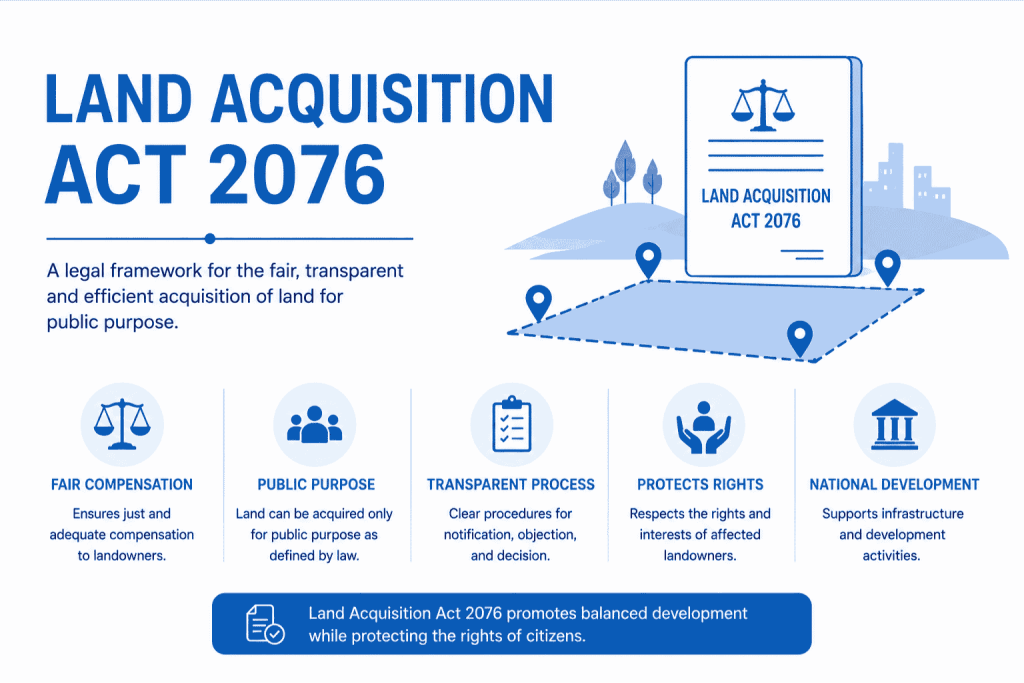
The main purpose of the Land Acquisition Act is to allow the Government of Nepal to acquire private land when it is required for a public purpose, such as roads, hydropower projects, government offices, or approved industrial zones. The law balances the state’s need for land with the constitutional right of citizens to own property and receive fair compensation when that property is taken.
Key objectives of the Act include:
- Allowing the government to acquire land only for defined public purposes
- Ensuring landowners receive timely notice before acquisition
- Establishing a fair and transparent compensation process
- Providing a legal mechanism for landowners to raise objections
Which Laws Govern Land Acquisition and Land Use in Nepal?
Several laws and regulatory bodies work together to govern land matters in Nepal. The table below summarises the key laws relevant to land acquisition and land use.
| Law or Regulation | Year (BS/AD) | Main Purpose |
|---|---|---|
| Land Acquisition Act | 2034 (1977) | Governs compulsory acquisition of private land for public purposes |
| Land Acquisition Rules | 2026 (1969) | Provides procedural details for acquisition and compensation |
| Land Use Act | 2076 (2019) | Regulates land classification and zoning across Nepal |
| Companies Act | 2063 (2006) | Governs company registration and corporate operations |
| Foreign Investment and Technology Transfer Act (FITTA) | 2075 (2019) | Regulates foreign investment approval, including industrial land use |
| Income Tax Act | 2058 (2002) | Governs taxation on income, including gains from land transactions |
The Nepal Law Commission publishes the official text of these laws on its official website, which serves as the authoritative source for anyone seeking to verify legal provisions.
Who Has the Legal Authority to Acquire Land?
Under the Land Acquisition Act, the Government of Nepal, through the concerned Chief District Officer, has the authority to initiate and carry out land acquisition proceedings. The process typically begins when a government agency or an approved project requires land for a public purpose and submits a formal request through the appropriate ministry.
The Chief District Officer plays a central role in:
- Issuing preliminary notices to affected landowners
- Coordinating with the compensation fixation committee
- Overseeing the handover of possession once compensation is settled
What Is the Step-by-Step Process for Land Acquisition?
The land acquisition process in Nepal follows a defined legal procedure. Below is a general outline of the steps involved, though actual timelines may vary depending on project size and location.
Step 1: Preliminary Notice
The concerned government office identifies the land required for a public purpose and issues a preliminary notice to the landowners, informing them that their land may be acquired.
Step 2: Survey and Assessment
Officials conduct a survey of the land to determine its exact area, boundaries, and existing structures or crops present on the property.
Step 3: Compensation Determination
A compensation fixation committee is formed to assess the fair market value of the land and any structures or assets on it, in accordance with the Land Acquisition Act.
Step 4: Final Notice and Possession
Once compensation is finalized and paid, a final notice is issued, and the government takes formal possession of the land for the intended public purpose.
Step 5: Grievance Resolution
If a landowner is dissatisfied with the compensation amount or the process, they may raise objections through the legal channels provided under the Act.
How Is Compensation Determined for Acquired Land?
Compensation is one of the most important aspects of land acquisition, as it directly affects the rights of landowners. The Land Acquisition Act requires that compensation reflect the fair market value of the land at the time of acquisition, along with the value of any structures, trees, or crops affected.
The table below outlines common factors considered during compensation determination.
| Factor Considered | Description |
|---|---|
| Market value of land | Current prevailing price of similar land in the area |
| Value of structures | Compensation for buildings, walls, or fixed installations |
| Standing crops and trees | Value of agricultural produce or trees affected by acquisition |
| Loss of livelihood | Additional consideration for landowners dependent on the land for income |
| Location and accessibility | Land near roads or urban centers may carry higher valuation. |
The compensation fixation committee, formed under the Act, is responsible for calculating these amounts fairly and transparently before land possession is transferred.
What Rights Do Landowners Have During Acquisition?
Landowners in Nepal are not without protection during the acquisition process. The law provides several rights designed to ensure fairness, including:
- The right to receive advance notice before acquisition begins
- The right to present objections regarding the necessity of acquisition
- The right to a fair compensation assessment
- The right to appeal decisions related to compensation amounts
These protections are important for both local citizens and foreign investors who may hold or lease land connected to their business operations in Nepal.
How Does the Land Acquisition Act 2076 Affect Foreign Investors and Companies?
Foreign investors setting up companies in Nepal often require land for factories, offices, warehouses, or other commercial activities. While foreign nationals generally cannot directly own land in Nepal under existing land ownership restrictions, companies incorporated in Nepal, including those with foreign investment approved under FITTA, may acquire land use rights through lease arrangements or industrial land allocation programs facilitated by government authorities.
This is particularly relevant when:
- A foreign-invested company requires industrial land in a designated industrial zone
- A project involves land that is subject to government acquisition for public infrastructure connected to the business
- A company needs a land use certificate to confirm the permitted use of a plot for industrial or commercial activity
Understanding these procedures helps investors avoid delays during the company registration and industrial licensing process.
What Is the Role of Government Bodies Like the Department of Industry and Nepal Rastra Bank?
Several government institutions play a supporting role when land acquisition intersects with foreign investment and business registration.
- The Department of Industry, Investment and Promotion is responsible for approving industrial projects and coordinating with local authorities regarding industrial land requirements. More information is available on the official website at doind.gov.np.
- Nepal Rastra Bank regulates the inflow and outflow of foreign currency related to investment, including funds used for land lease payments or industrial development, in accordance with its foreign investment guidelines. Details can be found at nrb.org.np.
- The Nepal Law Commission maintains the official text of the Land Acquisition Act, Land Use Act, Companies Act, and other relevant laws at lawcommission.gov.np.
These institutions work together to ensure that foreign investment activities, including those involving land, comply with Nepalese law.
Can Foreign Companies Use Acquired Land for Industrial or Business Purposes?
Land acquired by the government for public purposes is generally intended for infrastructure or public projects rather than direct private industrial use. However, government-established industrial zones and estates, developed partly through acquisition processes, are made available to registered companies, including those with foreign investment, on a leasehold basis. Companies interested in such land must apply through the appropriate industrial promotion authority and comply with land use classification requirements under the Land Use Act, 2076.
What Legal Remedies Exist Against Unfair Land Acquisition?
If a landowner believes that the acquisition process was conducted unfairly or that compensation was inadequate, the Land Acquisition Act provides a mechanism to raise objections before the concerned authority. In cases where disputes remain unresolved, affected parties may seek further legal remedy through Nepal’s court system, in accordance with general principles of administrative and property law.
How Does This Framework Relate to Company Registration and Foreign Investment in Nepal?
Land matters often arise during the company registration process, particularly for manufacturing or industrial businesses. Investors must ensure that:
- The land intended for business use has a valid land use certificate
- Any lease or acquisition-related land is properly documented before applying for an industrial license
- Company registration under the Companies Act, 2063, and investment approval under FITTA, 2075 are completed in coordination with land-related compliance
Since these processes involve multiple government offices, professional guidance can help streamline compliance and avoid unnecessary delays.
How Does CompanyNP Assist Foreign Investors With Land and Company Registration Matters?
CompanyNP assists foreign investors and companies with company registration, foreign investment approval, and related regulatory compliance in Nepal. While CompanyNP does not process land acquisition cases directly, the firm helps clients understand how land use, industrial licensing, and business registration requirements interact under Nepalese law, ensuring that investors are well informed before committing resources to a project.
Frequently Asked Questions
Is the Land Acquisition Act still in force in Nepal?
Yes, the Land Acquisition Act, 2034 (1977), as amended, remains the principal law governing compulsory acquisition of land for public purposes in Nepal, alongside the Land Use Act, 2076, which regulates land classification and zoning nationwide.
Can foreigners own land in Nepal directly?
Generally, foreign individuals cannot directly own land in Nepal. However, companies incorporated in Nepal with approved foreign investment may lease land or obtain industrial land allocation for approved business activities, subject to government regulations.
Who decides the compensation amount during land acquisition?
A compensation fixation committee, formed under the Land Acquisition Act, determines compensation based on market value, structures, crops, and other relevant factors, ensuring landowners receive fair value for acquired property.
Which government office issues land acquisition notices?
The Chief District Officer, acting on behalf of the concerned government agency, issues preliminary and final notices to landowners during the land acquisition process, as prescribed under the Land Acquisition Act and its rules.
Does FITTA cover land-related matters for foreign investors?
FITTA primarily regulates foreign investment. The Land Acquisition Act and Land Use Act govern land use and acquisition matters separately, although both frameworks may apply to industrial projects.
Where can I find the official text of Nepal’s land laws?
The official text of the Land Acquisition Act, Land Use Act, and other related legislation is published by the Nepal Law Commission on its official website, which serves as the authoritative legal reference for citizens and investors alike.