


Highlights of Companies Act 2063 Nepal’s; Companies Act 2063 (2006 AD) is the primary legislation that governs the formation, registration, operation, management, and dissolution of companies in Nepal. The Act was enacted by the Parliament of Nepal and came into force to replace the earlier Companies Act 2053 (1997 AD). The Office of the Company Registrar (OCR) administers this Act. This law defines the legal framework within which both private and public companies operate in the country.
Understanding the key provisions of the Companies Act 2063 is essential for entrepreneurs, investors, directors, shareholders, and legal professionals dealing with corporate matters in Nepal.
What Is the Companies Act 2063 of Nepal?
The Companies Act 2063 is a comprehensive statutory framework that regulates the entire lifecycle of a company in Nepal from its incorporation to its winding up. The Act was passed by the Legislature-Parliament and published in the Nepal Gazette. It consists of multiple chapters and sections that cover company registration, share capital, shareholder rights, board of directors, general meetings, accounts, audit, mergers, and dissolution.
The Act applies to:
- Private Limited Companies
- Public Limited Companies
- Not-for-Profit Companies
- Foreign Companies operating in Nepal
The Office of the Company Registrar, operating under the Ministry of Industry, Commerce and Supplies, is the central authority for company registration and compliance in Nepal. You can access OCR’s official portal at www.ocr.gov.np.
What Are the Types of Companies Under Companies Act 2063?
Under Section 3 of the Companies Act 2063, companies in Nepal are classified based on liability and public participation.
Classification of Companies
| Type of Company | Minimum Shareholders | Minimum Paid-Up Capital | Share Transferability |
|---|---|---|---|
| Private Limited Company | 1 (minimum) | As prescribed | Restricted |
| Public Limited Company | 7 (minimum) | As prescribed | Freely transferable |
| Not-for-Profit Company | 5 (minimum) | No profit distribution | Restricted |
| Foreign Company | As per parent country | As prescribed by law | As per agreement |
A Private Limited Company (Pvt. Ltd.) cannot have more than 101 shareholders and cannot invite the public to subscribe to its shares. A Public Limited Company (Ltd.) can have an unlimited number of shareholders and can issue shares to the general public through the capital market.
What Are the Key Highlights of Companies Act 2063?
1. Company Incorporation and Registration
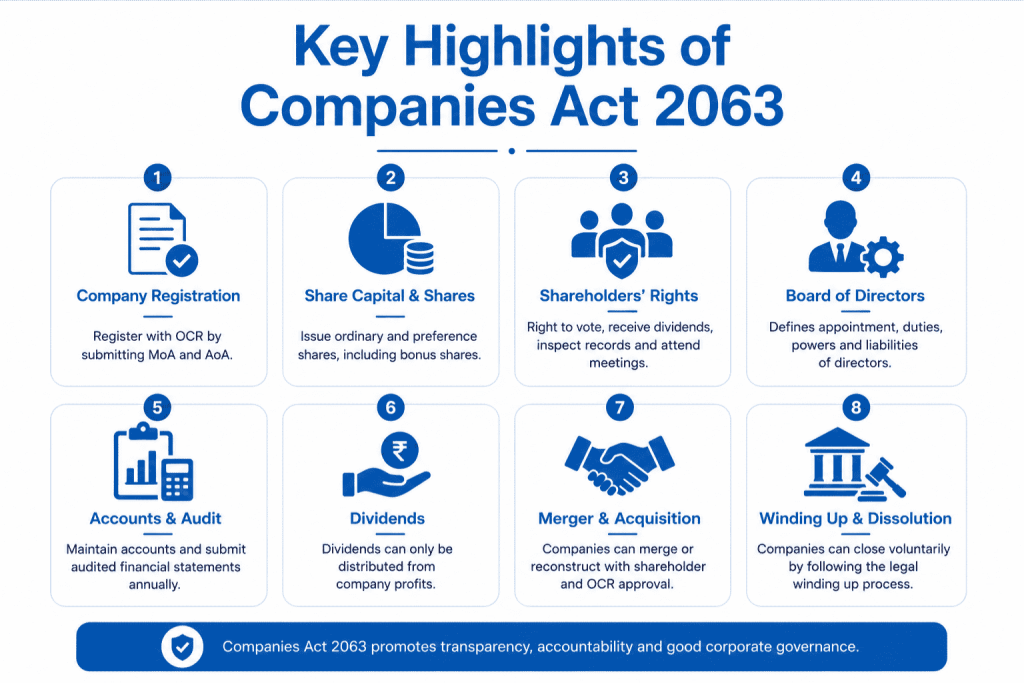
Section 4 to Section 14 of the Companies Act 2063 deal with the incorporation and registration of companies. A company is required to submit the Memorandum of Association (MoA) and Articles of Association (AoA) to the OCR.
Documents required for company registration include:
- Application form in prescribed format
- Memorandum of Association (MoA)
- Articles of Association (AoA)
- Citizenship certificates of all promoters/shareholders
- Passport-size photographs of promoters
- Proof of registered office address
- Tax Permanent Account Number (PAN) of shareholders
- Resolution passed by promoters
- No Objection Certificate (if required by sector)
The OCR must register the company within 15 days of receiving a complete application. Upon registration, a Certificate of Incorporation is issued, which serves as conclusive proof of the company’s legal existence.
2. Share Capital and Shares
Chapter 4 (Sections 22 to 50) of the Companies Act 2063 governs share capital, types of shares, issuance, and transfer of shares.
Key provisions include:
- Companies can issue ordinary shares and preference shares
- Preference shares can be cumulative or non-cumulative
- A company must not issue shares at a discount unless permitted by law
- Share certificates must be issued within 35 days of allotment
- Transfer of shares in private limited companies requires approval from the board of directors
- Public companies can list shares on the Nepal Stock Exchange (NEPSE)
Under Section 29, a company may issue bonus shares from its retained earnings or share premium account. This provision has been widely used by listed companies in Nepal to reward shareholders.
3. Shareholders’ Rights and Meetings
Chapter 6 and Chapter 7 of the Companies Act 2063 lay out the rights of shareholders and the rules for conducting general meetings.
Shareholders have the following rights:
- Right to attend and vote in general meetings
- Right to inspect company documents
- Right to receive dividends when declared
- Right to transfer shares as per the AoA
- Right to receive the company’s annual report and audited financial statements
Types of meetings under the Act:
- Annual General Meeting (AGM): Must be held within 6 months from the end of the fiscal year
- Special General Meeting (SGM): Called when required by directors or shareholders holding at least 5% of total paid-up capital
- Board of Directors Meeting: Must be held at least once every 3 months
Under Section 76, a minimum quorum is required to conduct a valid AGM. For private companies, quorum is at least 2 members or 50% of total shareholders, whichever is less.
4. Board of Directors
Chapter 8 (Sections 86 to 118) of the Companies Act 2063 regulates the appointment, duties, liabilities, and removal of directors.
Key provisions for Board of Directors:
- A private limited company must have at least 1 director
- A public limited company must have at least 3 directors and not more than 11 directors (unless otherwise prescribed)
- Directors must not be bankrupt, convicted of criminal offenses, or declared mentally incapacitated
- The term of a director in a public company is 4 years
- Directors must disclose conflict of interest under Section 93
- Independent directors must be appointed in public companies as per regulatory guidelines
- The company secretary plays a key compliance role in listed companies
Under Section 102, directors are liable for any loss caused to the company due to their negligence, fraud, or breach of duty.
5. Accounts and Audit
Chapter 10 of the Companies Act 2063 deals with books of accounts, financial statements, and audit requirements.
- Every company must maintain proper books of accounts at its registered office
- Annual financial statements must include balance sheet, profit and loss account, and cash flow statement
- Accounts must be audited by a licensed auditor registered with the Institute of Chartered Accountants of Nepal (ICAN)
- Audited financial statements must be submitted to the OCR within 6 months of the end of the fiscal year
- Public companies must publish financial statements in a national newspaper
Failure to maintain proper accounts or submit audited financials within the prescribed timeline attracts penalties under Section 159 of the Companies Act 2063.
6. Dividends
Under Section 52 to Section 59 of the Companies Act 2063:
- Dividends can only be declared from profits and not from capital
- Interim dividends may be declared by the board
- Dividends must be distributed within 45 days of declaration
- Unclaimed dividends must be held in a separate account
- Bonus shares can be issued in lieu of cash dividends
7. Merger, Acquisition, and Reconstruction
Chapter 14 (Sections 177 to 185) of the Companies Act 2063 provides provisions for mergers, acquisitions, and reconstruction of companies.
- Two or more companies can merge with the approval of shareholders by a special resolution
- The merged company must file the merger scheme with the OCR
- All assets, liabilities, and obligations of the merging company transfer to the surviving company
- Shareholders of the merged company receive shares in the surviving company as per the agreed ratio
8. Winding Up and Dissolution
Chapter 15 (Sections 186 to 198) deals with the voluntary winding up of companies.
A company can be wound up voluntarily when:
- The company has completed the purpose for which it was incorporated
- The company is unable to pay its debts
- Shareholders pass a special resolution for winding up
Process for voluntary winding up:
- Pass a special resolution at the general meeting
- Appoint a liquidator
- File application with the OCR
- Publish a notice in national newspaper
- Settle all outstanding liabilities
- Distribute remaining assets among shareholders
- File final accounts with the OCR
- Obtain a Certificate of Dissolution
Key Compliance Requirements Table
| Compliance Requirement | Deadline | Authority |
|---|---|---|
| Annual General Meeting (AGM) | Within 6 months of fiscal year end | OCR / SEBON |
| Submission of Annual Financial Statements | Within 6 months of fiscal year end | OCR |
| Board Meeting | At least once every 3 months | Company |
| Share Certificate Issuance | Within 35 days of allotment | Company |
| Dividend Distribution | Within 45 days of declaration | Company |
| Company Registration | 15 days after complete application | OCR |
Penalties Under Companies Act 2063
Chapter 16 (Sections 155 to 175) prescribes penalties for violations of the Act.
- Failure to hold AGM: Fine up to NPR 25,000 and NPR 1,000 per day for continued default
- Failure to file annual returns: Fine up to NPR 50,000
- False statements in documents: Imprisonment up to 3 years and/or fine
- Directors convicted of fraud: Disqualification from holding directorship for 5 years
- Non-maintenance of accounts: Fine up to NPR 25,000
What Are the Recent Amendments to Companies Act 2063?

The Companies Act 2063 has been amended multiple times to align with the changing business environment:
- Companies (First Amendment) Act 2074 (2017 AD) introduced provisions for single-member companies, allowing one person to form a private limited company
- Provisions for electronic filings and digital submissions to OCR were added
- Requirements for independent directors in listed public companies were strengthened
- Corporate governance guidelines were reinforced for banks and financial institutions regulated by Nepal Rastra Bank
Conclusion
The Companies Act 2063 is the cornerstone of Nepal’s corporate legal framework. It covers all aspects of company law from registration and share capital to director duties, annual compliance, and dissolution. Every company operating in Nepal must comply with the provisions of this Act to maintain its legal standing.
Entrepreneurs, investors, and directors must familiarize themselves with its key provisions, timelines, and penalties to ensure full compliance. For official filings and registrations, visit the Office of the Company Registrar or consult a licensed legal professional in Nepal.
FAQs
1. What is the Companies Act 2063 of Nepal?
The Companies Act 2063 is the primary law governing company formation, management, and dissolution in Nepal. It was enacted in 2006 AD and is administered by the Office of the Company Registrar under the Ministry of Industry, Commerce and Supplies.
2. How many shareholders are required to form a private limited company under Companies Act 2063?
Under the Companies Act 2063 as amended, a private limited company can be formed by a minimum of 1 shareholder (single-member company) and can have a maximum of 101 shareholders as per Section 3.
3. What is the time limit to hold an AGM under Companies Act 2063?
Under Section 76 of the Companies Act 2063, every company must hold its Annual General Meeting within 6 months from the end of its fiscal year. Failure to hold the AGM attracts financial penalties.
4. Can a foreign company register under the Companies Act 2063?
Yes. A foreign company can register a branch office or liaison office in Nepal under Chapter 16 of the Companies Act 2063. They must file incorporation documents and obtain approval from the OCR and relevant regulatory authorities.
5. What is the role of the Office of the Company Registrar in Nepal?
The OCR is the regulatory authority for company registration, compliance monitoring, and dissolution. It maintains a public register of all companies in Nepal and administers the Companies Act 2063. Its official website is www.ocr.gov.np.
6. What are the penalties for failing to submit annual financial statements under Companies Act 2063?
Under Section 159 of the Companies Act 2063, a company that fails to submit audited annual financial statements within the prescribed deadline is liable to pay a fine up to NPR 50,000 along with additional daily penalties for continued default.