


he Environmental Impact Assessment (EIA) approval process in Nepal is a mandatory legal requirement for specific development projects before construction or operation begins. The EIA process in Nepal evaluates the potential environmental, social, and ecological consequences of a proposed project. Any developer, investor, or government agency planning a large-scale project in Nepal must complete the EIA process under Nepali law.
This article explains the entire EIA approval process in Nepal, the legal framework, required documents, timelines, and responsible authorities.
What is Environmental Impact Assessment (EIA) in Nepal?
Environmental Impact Assessment (EIA) in Nepal is a systematic process that identifies, predicts, and evaluates the potential environmental impacts of a proposed project or activity. In Nepal, EIA is a pre-approval requirement for projects that may cause significant environmental damage.
The EIA process in Nepal ensures that decision-makers, project proponents, and the public receive complete environmental information before a project is approved. It covers land use, air quality, water resources, biodiversity, cultural heritage, and socio-economic conditions.
Nepal uses two levels of environmental studies:
- Initial Environmental Examination (IEE): For projects with moderate environmental impact
- Environmental Impact Assessment (EIA): For projects with significant environmental impact
Both IEE and EIA are mandatory legal instruments under Nepali environmental law.
What is the Legal Framework for EIA in Nepal?

The EIA approval process in Nepal operates under the following laws and regulations:
- Environment Protection Act, 2076 (2019): The primary legislation governing environmental protection and EIA in Nepal. This Act repealed the Environment Protection Act, 1997.
- Environment Protection Rules, 2077 (2020): These Rules prescribe detailed procedures, timelines, and thresholds for IEE and EIA requirements.
- National Environmental Impact Assessment Guidelines, 1993: These guidelines provide technical standards for EIA preparation.
- Sectoral Environmental Guidelines: Separate guidelines exist for hydropower, roads, tourism, industry, mining, and other sectors.
The Ministry of Forests and Environment (MoFE) is the apex authority responsible for environmental policy and EIA approval at the national level. For projects within provinces, the Province Ministry of Industry, Tourism, Forests and Environment handles approvals.
More information is available at the Ministry of Forests and Environment Nepal official website.
Which Projects Require EIA in Nepal?
Not all projects require a full EIA. Nepal classifies projects based on their scale and potential impact. The Environment Protection Rules, 2077 define specific thresholds for IEE and EIA requirements.
Projects Typically Requiring EIA in Nepal
| Project Type | EIA Threshold |
|---|---|
| Hydropower Projects | Above 50 MW capacity |
| Irrigation Projects | Command area above 10,000 hectares |
| Road Construction | Above 25 km in forested or sensitive areas |
| Industrial Zones | Area above 50 hectares |
| Tourism Development | Hotels above 100 rooms in sensitive zones |
| Mining Projects | Above defined extraction limits |
| Transmission Lines | Above 132 kV voltage and specific length |
| Urban Development Projects | Above defined area thresholds |
Projects below these thresholds may still require an IEE rather than a full EIA. Projects in protected areas, national parks, buffer zones, or ecologically sensitive regions are subject to stricter environmental scrutiny regardless of size.
Who Prepares the EIA Report in Nepal?
The project proponent (the developer, company, or government agency proposing the project) is responsible for commissioning and submitting the EIA report. However, the actual preparation of the EIA document must be done by a licensed Environmental Consultant registered with the Department of Environment (DoE) or relevant government body in Nepal.
The EIA team typically includes:
- Environmental scientists
- Social scientists
- Biodiversity experts
- Hydrologists and water resource specialists
- Socio-economic analysts
- Local community consultation representatives
The project proponent cannot prepare the EIA report independently. Nepal law requires the engagement of qualified professionals with demonstrated expertise in environmental assessment.
What is the Step-by-Step EIA Approval Process in Nepal?
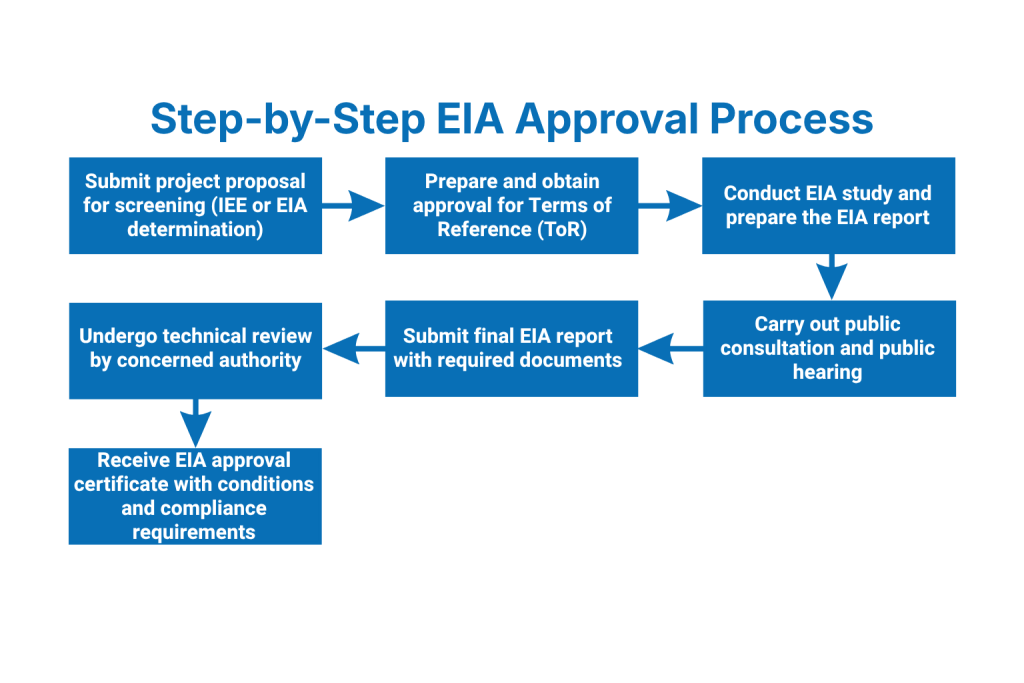
The EIA approval process in Nepal follows a structured sequence of steps as prescribed under the Environment Protection Act, 2076 and Environment Protection Rules, 2077.
Step 1: Project Screening
The project proponent submits a project proposal to the concerned ministry or department. The authority determines whether the project requires an IEE or full EIA based on the type, scale, and location of the project.
Step 2: Scoping
The proponent submits a Terms of Reference (ToR) document to the concerned authority. The ToR defines the scope, boundaries, and key issues to be studied in the EIA. The authority reviews and approves the ToR before the study begins.
Step 3: EIA Study and Report Preparation
A licensed environmental consultant conducts the field study, baseline data collection, impact prediction, and mitigation planning. The consultant prepares the full EIA Report as per the approved ToR and national EIA guidelines.
Key components of an EIA report include:
- Project description and alternatives considered
- Baseline environmental status (air, water, land, biodiversity)
- Identification and prediction of significant impacts
- Environmental Management Plan (EMP)
- Public consultation report
- Monitoring and evaluation plan
- Summary in Nepali language
Step 4: Public Consultation and Disclosure
Nepal law requires mandatory public disclosure of the EIA report. The project proponent must:
- Publish a notice in a national newspaper inviting public comments
- Display the EIA report at the local government office, Ward office, and project site
- Conduct a public hearing at the project-affected area
- Submit written objections and responses to the authority
Public consultation is a legal requirement under the Environment Protection Act, 2076. The affected communities, local governments, civil society organizations, and any individual can submit written feedback during the disclosure period.
Step 5: EIA Report Submission
After incorporating public comments, the proponent submits the final EIA report to the concerned authority:
- Ministry of Forests and Environment (MoFE): For projects of national significance
- Province Ministry: For projects falling under provincial jurisdiction
- Department of Environment (DoE): For coordination and technical review
Required documents for EIA submission include:
- Completed EIA report (printed and digital copies)
- Approved Terms of Reference
- Public hearing minutes and attendance records
- Written responses to public comments
- No Objection Certificates (NOCs) from relevant agencies
- Land ownership or lease documents
- Project feasibility study report
- Company registration certificate
- Tax clearance certificate
- Letter of authorization from project proponent
Step 6: Technical Review
The concerned authority assigns a Technical Review Committee to evaluate the EIA report. The committee reviews:
- Scientific accuracy of impact predictions
- Adequacy of proposed mitigation measures
- Quality and completeness of public consultation
- Compliance with sectoral standards and legal requirements
- Environmental Management Plan (EMP) feasibility
The review committee may request additional information, field visits, or revisions to the EIA report.
Step 7: EIA Approval Decision
After satisfactory review, the concerned authority issues the EIA Approval Certificate. The approval may include:
- Conditions and restrictions attached to project implementation
- Requirements for environmental monitoring and reporting
- Mandatory EMP implementation and budget allocation
- Requirements for periodic environmental audits
If the EIA report is rejected, the authority provides written reasons and the proponent may revise and resubmit.
What are the Timelines for EIA Approval in Nepal?
| EIA Process Stage | Prescribed Timeline |
|---|---|
| ToR Review and Approval | 30 days from submission |
| EIA Study Period | 6 to 18 months (project-specific) |
| Public Disclosure Period | Minimum 30 days |
| Technical Review of EIA Report | 60 days from submission |
| EIA Approval Decision | 30 days after review completion |
These timelines are prescribed under the Environment Protection Rules, 2077. Delays may occur if the report requires significant revisions or if public objections raise complex issues.
What Happens After EIA Approval in Nepal?
After receiving EIA approval, the project proponent must:
- Implement the Environmental Management Plan (EMP) throughout the project lifecycle
- Submit periodic environmental monitoring reports to the concerned authority
- Conduct environmental audits at intervals prescribed in the approval conditions
- Inform the authority of any significant changes to the project design
- Maintain an Environmental Management Unit within the project organization
The Department of Environment and sectoral ministries conduct compliance monitoring of approved EIA projects. Failure to comply with EIA approval conditions can result in:
- Suspension of project activities
- Financial penalties under the Environment Protection Act, 2076
- Revocation of project licenses
- Criminal prosecution for serious violations
What is the Difference Between IEE and EIA in Nepal?

Initial Environmental Examination (IEE) applies to projects with moderate environmental impact. IEE requires a less detailed study compared to EIA. The IEE report is reviewed and approved by the concerned sectoral ministry.
Environmental Impact Assessment (EIA) applies to projects with significant, large-scale, or irreversible environmental impacts. EIA requires detailed baseline studies, rigorous impact assessment, and mandatory public disclosure and hearing.
Both IEE and EIA are legal requirements under the Environment Protection Act, 2076 and the Environment Protection Rules, 2077.
Conclusion
The Environmental Impact Assessment (EIA) approval process in Nepal is a well-defined legal requirement under the Environment Protection Act, 2076 and Environment Protection Rules, 2077. The process involves project screening, scoping, detailed environmental study, public consultation, technical review, and formal approval by the Ministry of Forests and Environment or the relevant provincial authority. Project proponents must strictly follow each step, engage licensed consultants, and implement the Environmental Management Plan after receiving EIA approval. The EIA system in Nepal serves to protect the environment while enabling responsible and sustainable development across all sectors.
FAQs
1. What law governs the EIA process in Nepal?
The Environment Protection Act, 2076 (2019) and Environment Protection Rules, 2077 (2020) govern the EIA approval process in Nepal. The Ministry of Forests and Environment is the nodal authority.
2. Which authority approves EIA in Nepal?
The Ministry of Forests and Environment (MoFE) approves EIA for national-level projects. Province Ministries handle provincial projects. The Department of Environment provides technical coordination and review support.
3. How long does EIA approval take in Nepal?
The EIA process in Nepal typically takes 12 to 24 months depending on project complexity. The Environment Protection Rules, 2077 prescribe specific timelines for each stage of the process.
4. Is public hearing mandatory for EIA in Nepal?
Yes. Public hearing is a mandatory legal requirement under the Environment Protection Act, 2076. The project proponent must publish notice, disclose the report for 30 days, and conduct a formal public hearing at the project site.
5. Can a project start before EIA approval in Nepal?
No. Starting a project that requires EIA before receiving EIA approval is illegal under Nepal law. Violators face financial penalties, project suspension, and possible criminal prosecution under the Environment Protection Act, 2076.
6. Who can prepare an EIA report in Nepal?
Only licensed environmental consultants registered with the concerned government authority can prepare EIA reports in Nepal. The project proponent must hire qualified professionals with expertise in environmental and social assessment.
For official EIA guidelines and related notifications, visit Ministry of Forests and Environment Nepal and Department of Environment Nepal.