

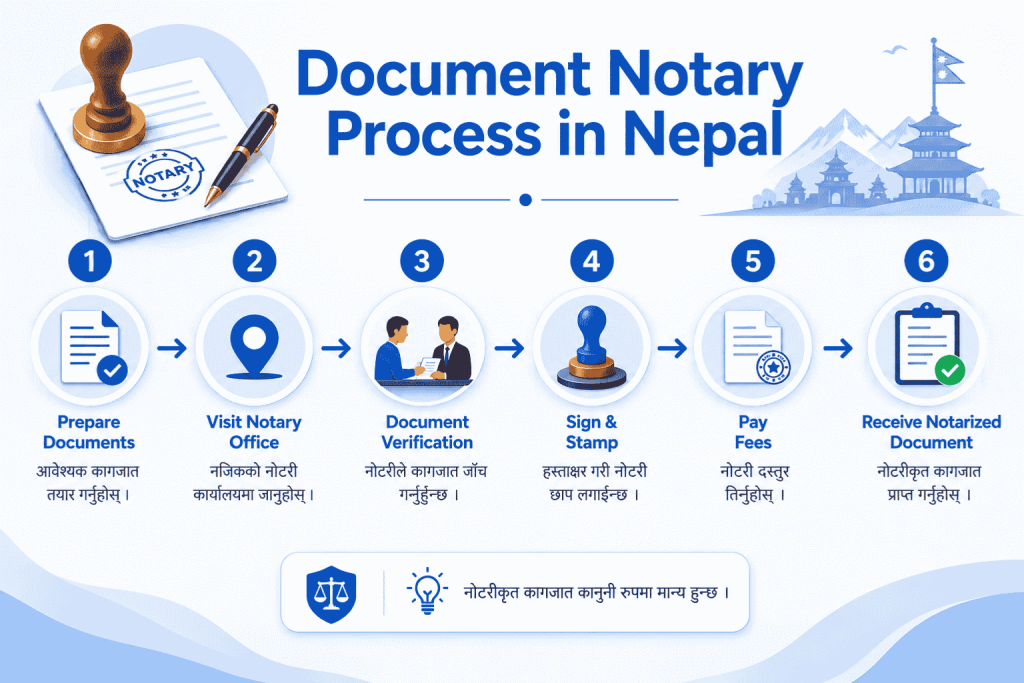
The document notary process in Nepal is a formal legal procedure that authenticates the genuineness of documents, signatures, and facts for use in legal, official, and international matters. Whether you are processing documents for foreign employment, overseas education, business agreements, or immigration purposes, understanding the document notary process in Nepal is essential. Nepal’s notary system operates under specific legal frameworks and designated authorities that verify and certify documents as authentic.
What Is a Notary Public in Nepal?
A Notary Public in Nepal is a licensed legal officer authorized to certify, attest, and authenticate documents for legal purposes. A notary public in Nepal holds official authority to witness signatures, certify copies of original documents, administer oaths, and authenticate legal instruments.
In Nepal, the Notary Public Act, 2063 (2006) governs the appointment, duties, and functions of notary publics. The Act defines who qualifies as a notary public and what types of documents a notary can certify. This law was introduced to formalize document authentication services that were previously handled informally or through courts alone.
The Ministry of Law, Justice and Parliamentary Affairs of Nepal oversees the regulation of notary publics. A list of registered notary publics is maintained by the government to ensure accountability and legal compliance.
Why Is Document Notarization Needed in Nepal?
Document notarization in Nepal serves several specific legal and official purposes. The following situations require notarization of documents:
- Foreign employment documents – Job contracts, power of attorney, and consent letters require notarization before submission to the Department of Foreign Employment.
- Property transactions – Sale deeds, mortgage documents, and lease agreements require notarized signatures.
- Educational documents – Certificates and transcripts sent abroad for higher education need notarization.
- Business agreements – Partnership deeds, memoranda of understanding, and contracts use notarized documents.
- Immigration and visa applications – Foreign embassies and consulates require notarized documents.
- Court proceedings – Affidavits and declarations used in legal cases need notarization.
- Adoption and family matters – Legal documents for adoption, divorce, and guardianship require notarized verification.
Legal Framework Governing Document Notary in Nepal
The primary law governing the notary process in Nepal is:
Notary Public Act, 2063 (2006) This Act outlines:
- The eligibility criteria to become a notary public
- The scope and limitations of notarization authority
- The legal validity of notarized documents
- Penalties for fraudulent notarization
Notary Public Regulations, 2065 (2008) These regulations supplement the Act and provide procedural guidelines for notary services in Nepal.
Additionally, the Authentication and Legalization process involves the Ministry of Foreign Affairs of Nepal for documents intended for use in foreign countries. This process is often referred to as apostille or legalization in the international context.
You can access the Ministry of Foreign Affairs Nepal at: https://mofa.gov.np
Who Can Perform Document Notarization in Nepal?
In Nepal, the following authorities can perform document notarization:
| Authority | Type of Documents | Applicable Law |
|---|---|---|
| Licensed Notary Public | General documents, affidavits, contracts | Notary Public Act, 2063 |
| District Court | Legal affidavits, sworn statements | Muluki Civil Procedure Code |
| Ministry of Foreign Affairs | Documents for foreign use, legalization | Foreign Affairs procedures (consular legalization system) |
| District Administration Office | Citizenship-related documents | Nepal Citizenship Act |
| Nepal Bar Association Members | Legal documents | Nepal Bar Council Act |
A registered notary public in Nepal must be a licensed advocate with a minimum of five years of legal practice experience. The Ministry of Law, Justice and Parliamentary Affairs issues notary licenses after a formal application and verification process.
Step-by-Step Document Notary Process in Nepal
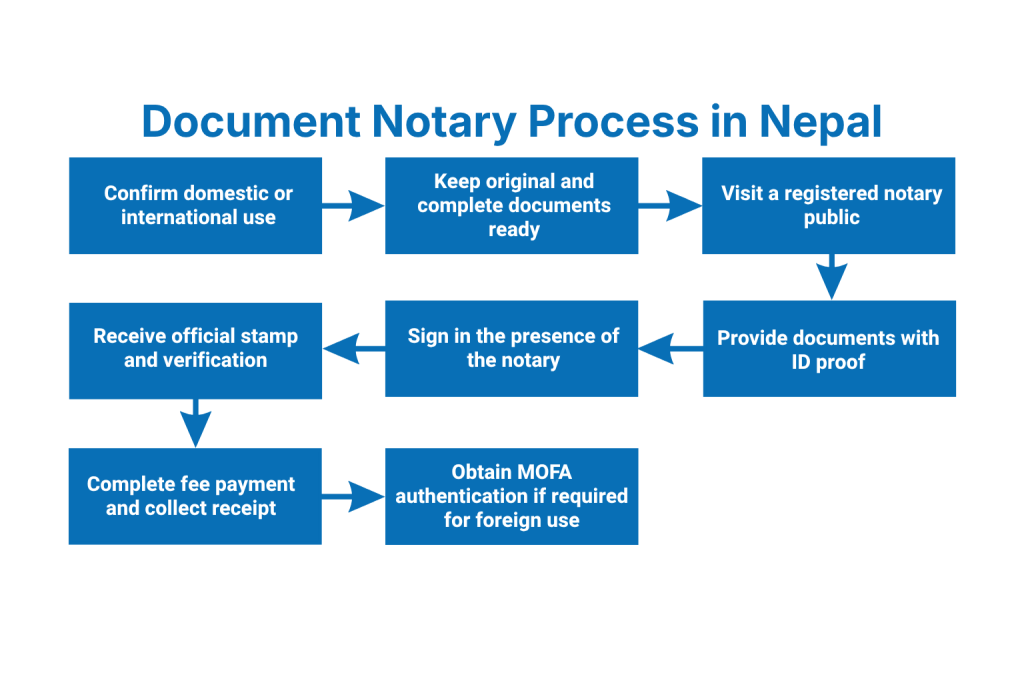
The document notarization process in Nepal involves the following steps:
Step 1: Identify the Type of Document
- Determine whether the document is for domestic use or international use.
- For international use, additional legalization from the Ministry of Foreign Affairs is required.
Step 2: Prepare Original Documents
- Collect the original document that requires notarization.
- Ensure the document is complete and error-free before presenting it to the notary.
Step 3: Locate a Licensed Notary Public
- Visit the Ministry of Law, Justice and Parliamentary Affairs website or local bar association to find a registered notary public in your district.
- You may also approach the District Court for notarization services.
Step 4: Submit Documents to the Notary
- Present original documents along with your identification proof such as citizenship certificate or passport.
- The notary will examine the document’s authenticity and completeness.
Step 5: Sign in the Presence of the Notary
- The concerned person must sign the document in the physical presence of the notary public.
- The notary will witness the signature and verify the identity of the signatory.
Step 6: Notary Seal and Certificate
- The notary public will affix an official seal and signature on the document.
- A notary certificate or endorsement is attached confirming the authenticity of the document.
Step 7: Pay Notary Fees
- Notary fees in Nepal are regulated and depend on the type of document and service provided.
- Obtain a receipt for payment.
Step 8: Additional Legalization (If Required)
- For documents to be used in foreign countries, proceed to the Ministry of Foreign Affairs for further authentication and legalization.
- This step is mandatory for documents submitted to foreign embassies or overseas institutions.
Documents Required for Notarization in Nepal
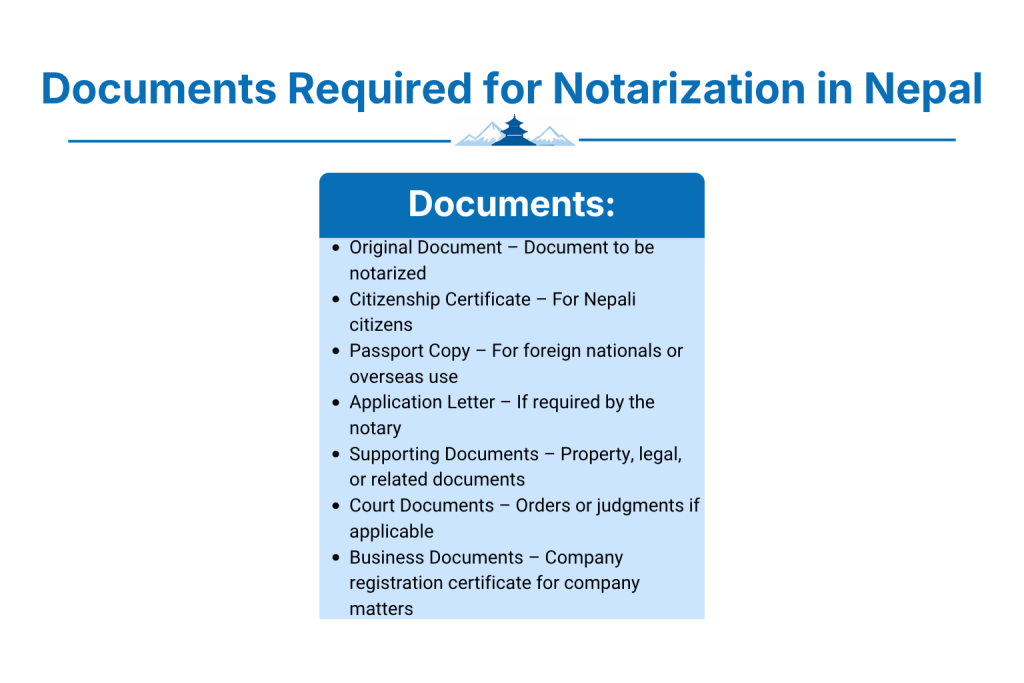
The documents required during the notary process in Nepal typically include:
- Original document to be notarized
- Citizenship certificate of the applicant (for Nepali citizens)
- Passport copy (for foreign nationals or documents intended for overseas use)
- Application letter addressed to the notary public (in some cases)
- Supporting documents as relevant (e.g., property ownership certificates for property documents)
- Court order or legal judgment copy (if applicable)
- Company registration certificate (for business documents)
Document Notary Fees in Nepal
Notary fees in Nepal are fixed by the government under the Notary Public Regulations, 2065. The fees vary based on the nature of the document and service type.
| Document Type | Approximate Fee (NPR) |
|---|---|
| Affidavit Notarization | NPR 200 – NPR 500 |
| Power of Attorney | NPR 500 – NPR 1,000 |
| Copy Certification | NPR 100 – NPR 300 per page |
| Contract/Agreement Notarization | NPR 500 – NPR 2,000 |
| Birth/Marriage Certificate | NPR 200 – NPR 500 |
| Commercial Documents | NPR 1,000 – NPR 5,000 |
| Ministry of Foreign Affairs Legalization | NPR 500 – NPR 1,500 |
Fees may vary slightly depending on the notary and location. Always request an official receipt.
Notarization vs. Legalization vs. Apostille in Nepal
Many people confuse these three terms when dealing with the document notary process in Nepal. Here is a clear distinction:
Notarization – The process by which a licensed notary public in Nepal certifies the authenticity of a document, signature, or copy. This is the first step.
Legalization – After notarization, the document goes to the Ministry of Foreign Affairs of Nepal for further authentication. This is required when documents need to be used in foreign countries. The Ministry of Foreign Affairs adds its seal and signature to validate the notary’s certification.
Apostille – Nepal is not a member of the Hague Apostille Convention. Therefore, Nepal does not issue apostille certificates. Instead, Nepal uses the legalization process through the Ministry of Foreign Affairs. Countries that require an apostille from Nepal must accept the legalization certificate issued by the Ministry of Foreign Affairs.
This distinction is important for Nepali citizens working abroad, students applying for foreign universities, and individuals pursuing immigration or visa processes.
Common Documents That Require Notarization in Nepal
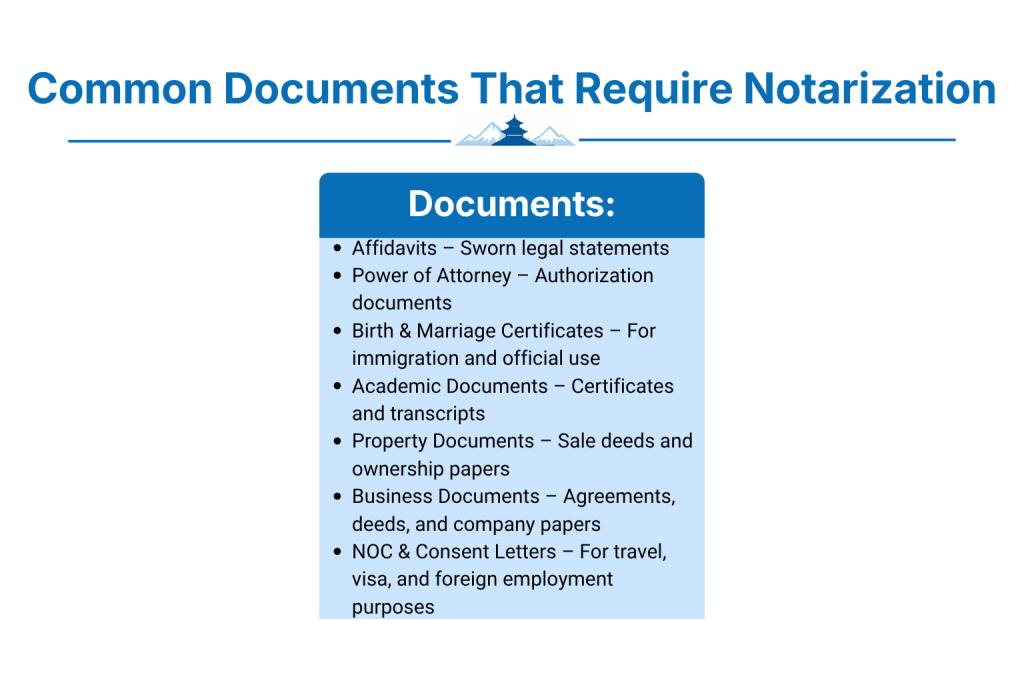
The following documents commonly go through the notarization process in Nepal:
- Affidavits – Sworn written statements used in legal and official matters
- Power of Attorney – Authorization documents that allow one person to act on behalf of another
- Birth Certificates – For foreign education, marriage, or immigration applications
- Marriage Certificates – Required for spousal visa or family reunion applications
- Academic Certificates and Transcripts – For foreign universities and employment abroad
- Property Documents – Sale deeds, land ownership certificates
- Business Documents – Partnership deeds, company documents, contracts
- No Objection Certificates (NOC) – For foreign employment and visa purposes
- Consent Letters – Parental consent letters for minors traveling abroad
Notarization for Foreign Employment in Nepal
Notarization for foreign employment in Nepal is a specific requirement set by the Department of Foreign Employment (DoFE). Workers going abroad for employment must notarize several documents including:
- Employment contract
- Medical fitness certificate
- Insurance documents
- Consent letters from family members
The Foreign Employment Act, 2064 (2007) mandates that all documents submitted for foreign employment processing be verified and authenticated. This protects workers from fraudulent recruitment and ensures document validity.
Visit the Department of Foreign Employment at: https://dofe.gov.np
How to Verify a Notarized Document in Nepal
Verifying a notarized document in Nepal involves:
- Checking the official seal and signature of the licensed notary public
- Cross-checking the notary’s registration number with the Ministry of Law, Justice and Parliamentary Affairs
- For Ministry of Foreign Affairs legalized documents, the stamp and registration number can be verified at the Ministry directly
- Courts and government offices in Nepal can independently verify notarized documents through official records
Conclusion
The document notary process in Nepal is a structured legal procedure governed by the Notary Public Act, 2063 and the Notary Public Regulations, 2065. Understanding who performs notarization, what documents are required, the applicable fees, and the additional legalization steps is essential for anyone dealing with legal, official, or international document submissions. For documents intended for foreign countries, the Ministry of Foreign Affairs legalization step is mandatory since Nepal does not follow the apostille system. Always use registered and licensed notary publics in Nepal to ensure the legal validity and acceptance of your documents.
FAQs
1. What is the document notary process in Nepal?
The document notary process in Nepal is the official procedure where a licensed notary public certifies, witnesses, and authenticates documents under the Notary Public Act, 2063 for legal and official use domestically and internationally.
2. Who is authorized to notarize documents in Nepal?
In Nepal, only licensed notary publics registered under the Ministry of Law, Justice and Parliamentary Affairs can notarize documents. District Courts and specific government offices also perform similar authentication functions.
3. Is apostille available in Nepal?
No. Nepal is not a signatory to the Hague Apostille Convention. Instead, Nepal uses the legalization process through the Ministry of Foreign Affairs to authenticate documents for international use.
4. How much does notarization cost in Nepal?
Notary fees in Nepal range from NPR 100 to NPR 5,000 depending on the document type. Fees are regulated by Notary Public Regulations, 2065 and an official receipt must always be provided.
5. Can a notarized document from Nepal be used abroad?
Yes, but only after additional legalization from the Ministry of Foreign Affairs of Nepal. Foreign embassies and institutions require the Ministry’s authentication stamp along with the notary certification.
6. How long does the document notarization process take in Nepal?
Notarization by a licensed notary public in Nepal typically takes one to two working days. Ministry of Foreign Affairs legalization may take an additional two to five working days depending on the document type and workload.