

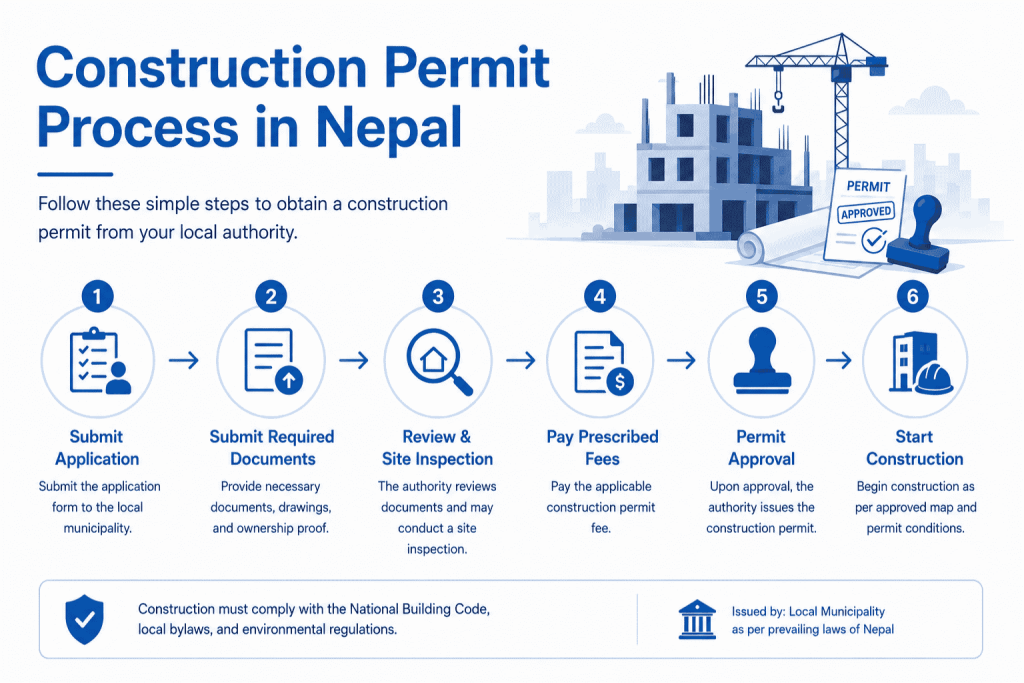
A construction permit process in Nepal is a legal authorization issued by the concerned local government body that allows an individual or organization to begin construction, renovation, or demolition of a building or structure. Without a valid construction permit, any building activity is considered illegal under Nepal’s existing laws and regulations.
The Government of Nepal has made the construction permit process mandatory to ensure that all buildings meet safety standards, follow zoning regulations, and comply with the National Building Code of Nepal. The permit system protects both the builder and the public by ensuring that structures are safe, properly designed, and located in approved zones.
Whether you are building a private residential house, a commercial building, or an industrial structure, you must obtain a construction permit before starting any work. This applies to urban municipalities, sub-metropolitan cities, metropolitan cities, and rural municipalities across Nepal.
Legal Framework Governing Construction Permits in Nepal
The construction permit process in Nepal is governed by several laws and regulations:
- Building Act, 1998 (2055 BS) – This is the primary legislation that governs building construction and permits in Nepal.
- Local Government Operation Act, 2017 (2074 BS) – This act grants authority to local governments (Municipalities and Rural Municipalities) to issue construction permits.
- National Building Code of Nepal (NBC) – A set of technical standards that all buildings must comply with during design and construction.
- Town Development Act, 1988 (2045 BS) – Governs urban planning and land use regulations.
- Land Use Act, 2019 (2076 BS) – Regulates the use of land across different zones in Nepal.
- Kathmandu Valley Development Authority (KVDA) Regulations – Specific to buildings constructed within the Kathmandu Valley.
The Department of Urban Development and Building Construction (DUDBC) under the Ministry of Urban Development is the central authority responsible for formulating building codes and construction standards in Nepal.
Who Needs a Construction Permit in Nepal?
Any person, company, or organization planning to carry out the following activities must obtain a construction permit:
- New building construction – Residential, commercial, or institutional buildings
- Building renovation or extension – Adding floors, rooms, or changing the structure
- Demolition of an existing building
- Change of building use – For example, converting a residential building into a commercial space
- Construction near public infrastructure – Roads, rivers, electricity lines, or heritage zones
Even small structures in some municipalities require a permit. It is the responsibility of the property owner to check with the local ward office or municipality before starting any construction activity.
Types of Construction Permits in Nepal
Nepal’s municipalities issue different types of construction permits based on the nature and scale of the project:
| Type of Permit | Description |
|---|---|
| Residential Building Permit | For houses and private residential structures |
| Commercial Building Permit | For shops, offices, hotels, and business centers |
| Industrial Building Permit | For factories and manufacturing facilities |
| Renovation/Extension Permit | For modifying or extending existing structures |
| Demolition Permit | For tearing down existing buildings |
| Heritage Zone Permit | For construction in protected or heritage areas |
| Government/Institutional Permit | For public buildings like schools, hospitals |
Documents Required for Construction Permit in Nepal
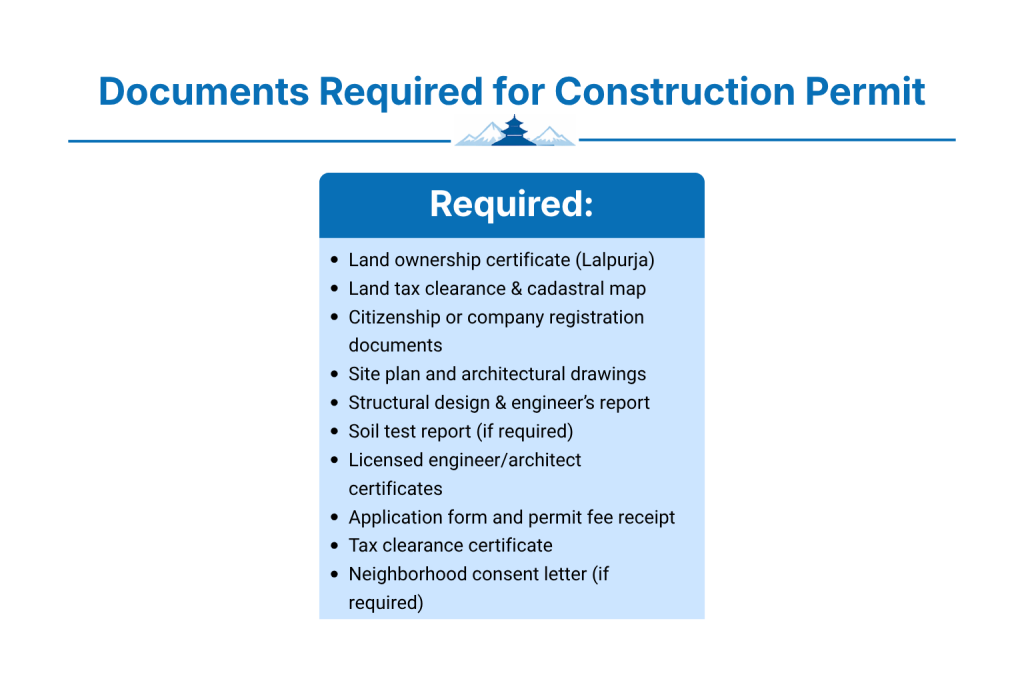
The documents required for a building permit application in Nepal vary slightly based on the municipality. However, the following are generally required across all local governments:
Land Ownership Documents:
- Land ownership certificate (Lalpurja)
- Land revenue clearance certificate (Malpot Tireko Praman)
- Cadastral map (Tiro-Naksha)
Applicant Identity Documents:
- Citizenship certificate of the applicant
- If the applicant is an organization – registration certificate and PAN certificate
Building Design Documents:
- Site plan showing the location of the proposed building
- Architectural drawings (floor plans, elevations, sections)
- Structural design drawings
- Structural calculation report signed by a licensed structural engineer
- Soil test report (for buildings above a certain height)
- Building design compliance certificate with National Building Code
Professional Certifications:
- Certificate of a licensed architect or civil engineer
- Engineer or architect’s council registration certificate (Nepal Engineering Council or Council of Architecture)
Other Documents:
- Application form (available at the ward office or municipality)
- Tax clearance certificate
- Neighborhood consent letter (in some municipalities)
- Building permit fee receipt
You can check the updated document requirements on the Kathmandu Metropolitan City official website or your respective municipality’s portal.
Step-by-Step Construction Permit Process in Nepal
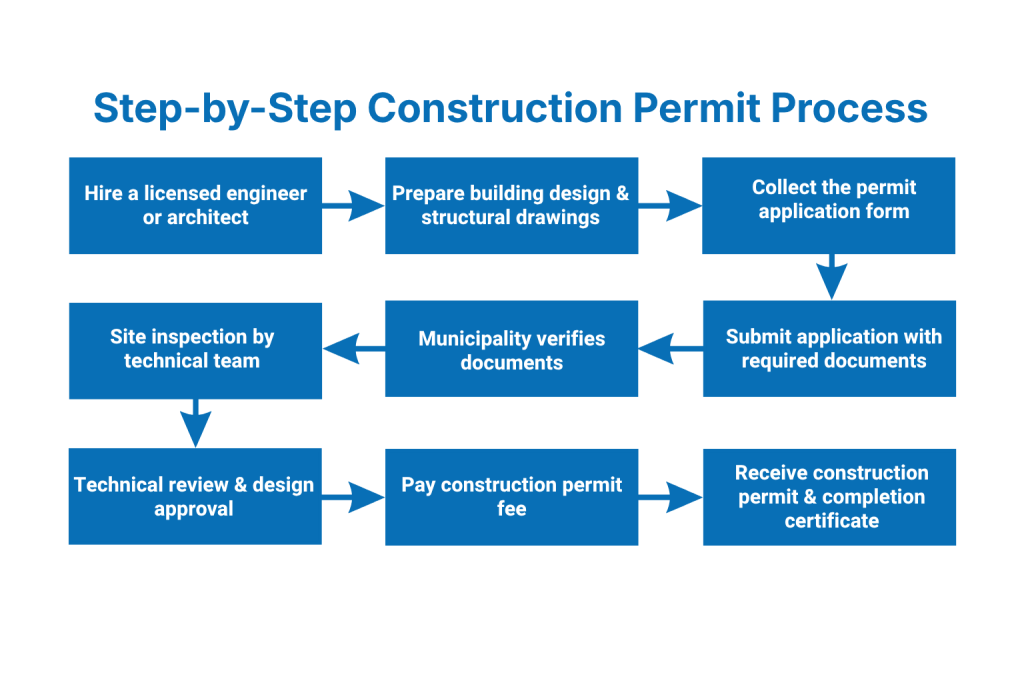
The building permit application process in Nepal follows a structured procedure. Below is the general process applicable across most municipalities:
Step 1: Consult a Licensed Engineer or Architect
Before anything else, hire a licensed civil engineer or architect registered with the Nepal Engineering Council (NEC) or Council of Architecture. They will prepare the building design in compliance with the National Building Code of Nepal.
Step 2: Prepare Building Design and Structural Drawings
Your engineer or architect will prepare architectural drawings, structural drawings, and structural calculations. All designs must comply with NBC standards, seismic zone requirements, and local zoning bylaws.
Step 3: Collect Application Form from Ward Office or Municipality
Visit your local ward office or municipality office to collect the construction permit application form. Some municipalities also provide online application forms through their digital portals.
Step 4: Submit Application with All Required Documents
Submit the completed application form along with all required documents to the designated desk at the municipality or ward office. Ensure that all documents are complete and properly signed by the licensed professional.
Step 5: Initial Document Verification
The municipality’s technical staff will verify the submitted documents. If any documents are missing or incorrect, you will be asked to resubmit.
Step 6: Site Inspection by Municipality Technical Team
After document verification, the municipality sends a technical team to inspect the proposed construction site. They verify the land boundaries, setback distances, and site conditions.
Step 7: Technical Review and Approval
The municipality’s technical department reviews the building design for compliance with the National Building Code, zoning regulations, and setback requirements. If everything is in order, they approve the design.
Step 8: Pay Construction Permit Fee
After approval, you are required to pay the construction permit fee at the municipality or designated bank. The fee is calculated based on the floor area, type of building, and location.
Step 9: Receive Construction Permit
After payment, the municipality issues the official construction permit. This document allows you to begin construction. Keep this permit at the construction site at all times.
Step 10: Completion Certificate (After Construction)
Once construction is complete, apply for a building completion certificate from the municipality. A final inspection is conducted, and if the building matches the approved plans, the completion certificate is issued.
Construction Permit Fees in Nepal
The building permit fee in Nepal is not uniform across all municipalities. Each local government has the authority to set its own fee structure under the Local Government Operation Act, 2017.
| Building Type | Approximate Fee Basis |
|---|---|
| Residential (up to 3 stories) | Per square meter of floor area |
| Residential (4+ stories) | Higher rate per square meter |
| Commercial Buildings | Higher rate than residential |
| Industrial Buildings | Based on floor area and category |
| Renovation/Extension | Percentage of new construction area |
For Kathmandu Metropolitan City, the fee varies from NPR 30 to NPR 150 per square meter depending on the building type and location. Rural municipalities generally charge lower fees. Always confirm the latest fee with your specific municipality.
Timeline for Getting a Construction Permit in Nepal
The processing time for a building permit application in Nepal typically ranges from 15 to 45 working days depending on the municipality and the complexity of the project. The following affects the timeline:
- Completeness of submitted documents
- Complexity of the building design
- Availability of technical staff at the municipality
- Location (urban municipalities are often faster due to more staff)
Under the Local Government Operation Act, 2017, municipalities are obligated to process permit applications within a reasonable time. Delays can be reported to the concerned municipal authority.
Common Reasons for Construction Permit Rejection in Nepal
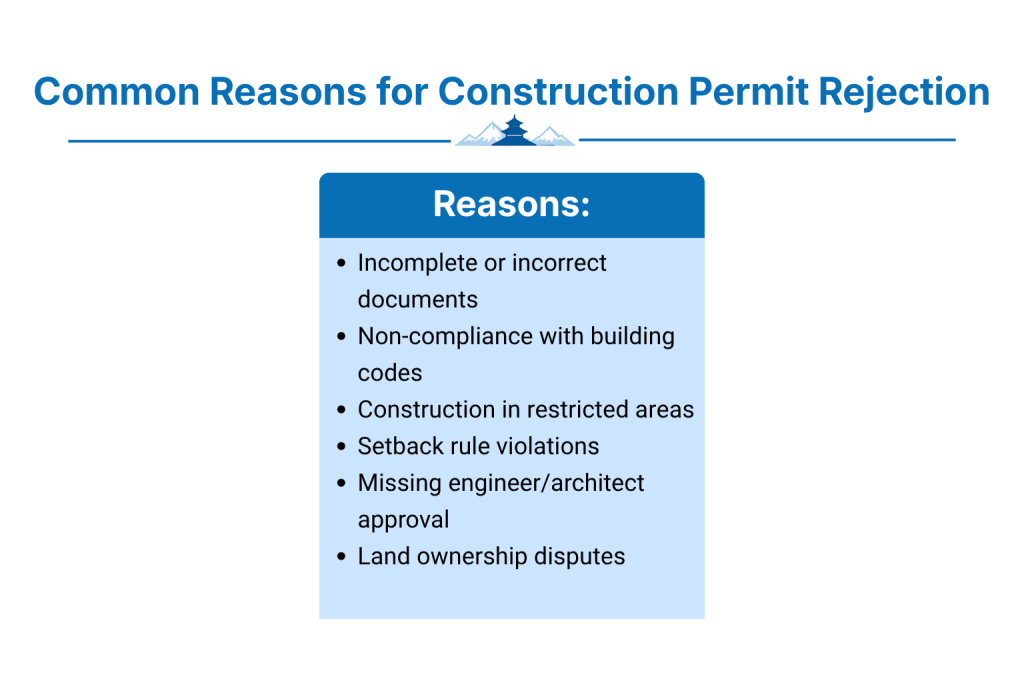
Applications for building permits are commonly rejected due to the following reasons:
- Incomplete or incorrect documents
- Building design that does not comply with the National Building Code
- Land located in a restricted zone (floodplain, heritage zone, road setback area)
- Setback violations – building too close to road, river, or neighbor’s property
- Missing engineer or architect certification
- Land ownership disputes or unclear title
Construction Permit Renewal in Nepal
A construction permit in Nepal is generally valid for a period specified by the municipality, often 2 to 5 years. If construction is not completed within that period, the permit holder must apply for renewal before the permit expires.
For renewal:
- Submit a renewal application to the ward office or municipality
- Pay the applicable renewal fee
- Provide progress report of the construction
- Ensure the building under construction still complies with approved plans
Conclusion
The construction permit process in Nepal is a structured, legally mandated procedure that all property owners and developers must follow before beginning any building activity. Governed by the Building Act, 1998, the National Building Code, and the Local Government Operation Act, 2017, this process ensures that all structures in Nepal are safe, properly designed, and built in compliance with zoning and land use regulations.
Understanding the documents required, the steps involved, and the fees applicable helps you complete the permit process efficiently without legal complications. Always work with licensed professionals and consult your local municipality for the most accurate and updated information.
FAQs
1. What is a construction permit in Nepal?
A construction permit in Nepal is a legal document issued by the local municipality or ward office that authorizes an individual or organization to begin constructing, renovating, or demolishing a building in compliance with the National Building Code and local zoning laws.
2. Which government body issues construction permits in Nepal?
Construction permits in Nepal are issued by local government bodies such as metropolitan cities, sub-metropolitan cities, municipalities, and rural municipalities. The Department of Urban Development and Building Construction (DUDBC) sets the technical standards.
3. How long does it take to get a building permit in Nepal?
The building permit process in Nepal generally takes 15 to 45 working days depending on the municipality, completeness of documents, and complexity of the building design submitted for approval.
4. What happens if I construct a building without a permit in Nepal?
Constructing a building without a permit in Nepal is illegal under the Building Act, 1998. The municipality can issue a stop-work order, impose fines, or even order demolition of the unauthorized structure.
5. Is it mandatory to hire a licensed engineer for a construction permit in Nepal?
Yes. All building designs submitted for a construction permit must be prepared and certified by a licensed civil engineer or architect registered with the Nepal Engineering Council or the Council of Architecture.
6. Can I apply for a construction permit online in Nepal?
Some municipalities in Nepal, including Kathmandu Metropolitan City, have started offering online permit application systems. However, physical document submission is still required in many municipalities across Nepal.