


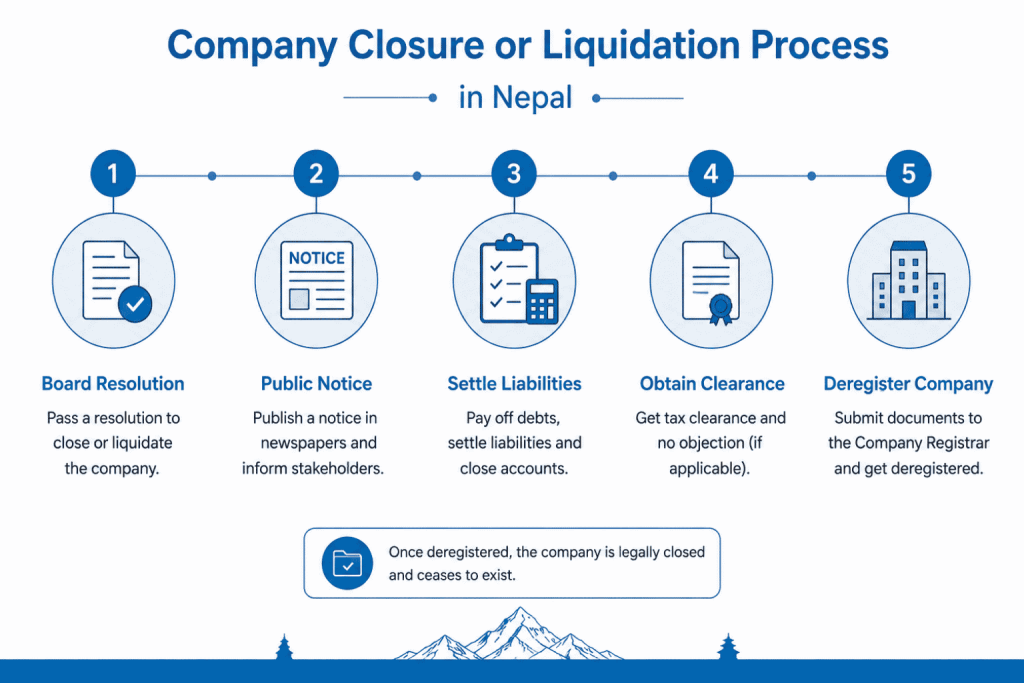
What is Company Closure or Liquidation in Nepal?
Company closure or liquidation process in Nepal refers to the formal legal process of winding up a registered company, settling its liabilities, distributing remaining assets to shareholders, and ultimately removing it from the official company register maintained by the Office of the Company Registrar (OCR). This process marks the end of a company’s legal existence in Nepal.
The liquidation process in Nepal is primarily governed by the Companies Act, 2063 (2006) and the Insolvency Act, 2063 (2006). Both laws provide distinct procedures depending on whether a company is voluntarily closing down or being forced into liquidation due to financial insolvency. Any company registered under the Companies Act, 2063 must follow the prescribed legal procedures before it can be legally dissolved.
Company dissolution in Nepal cannot happen informally. A company that simply stops operating without following the proper closure procedure remains legally active in the eyes of the law, continues to have tax obligations, and may face penalties from the Inland Revenue Department (IRD) and the Office of the Company Registrar.
What Laws Govern Company Liquidation in Nepal?
The legal framework for company closure and liquidation in Nepal rests on several key statutes.
Primary Laws:
- Companies Act, 2063 (2006) – Chapter 17 specifically deals with the winding up of companies registered in Nepal.
- Insolvency Act, 2063 (2006) – Governs court-supervised insolvency proceedings and the appointment of insolvency administrators.
- Income Tax Act, 2058 (2002) – Regulates tax clearance requirements during company dissolution.
- Labor Act, 2074 (2017) – Governs settlement of employee dues and gratuity during company closure.
The Office of the Company Registrar (OCR) operates under the Ministry of Industry, Commerce and Supplies and oversees company registration, renewal, and dissolution in Nepal. You can visit the official OCR portal at www.ocr.gov.np for updated guidelines and forms.
What Are the Types of Company Liquidation in Nepal?
Under the Companies Act, 2063 and the Insolvency Act, 2063, there are two primary types of company liquidation in Nepal.
1. Voluntary Liquidation (Members’ Voluntary Winding Up)
Voluntary liquidation occurs when the shareholders or members of a company themselves decide to wind up the company. This type of closure is common when:
- The company has achieved its purpose and is no longer needed.
- The promoters wish to exit the business.
- The company is solvent and can pay all its debts.
Under Section 132 of the Companies Act, 2063, a company may pass a special resolution in a general meeting to voluntarily wind up its affairs.
2. Compulsory Liquidation (Court-Ordered Winding Up)
Compulsory liquidation takes place through a court order. Under Section 136 of the Companies Act, 2063, a company may be wound up by the court if:
- The company is unable to pay its debts.
- The company has not commenced operations within one year of incorporation.
- The number of shareholders falls below the legally required minimum.
- The court determines it is just and equitable to wind up the company.
- The company has acted against the national interest or violated the law.
Under the Insolvency Act, 2063, creditors, shareholders, or the company itself may file a petition in the Debt Recovery Tribunal or the appropriate court to initiate insolvency proceedings.
What is the Step-by-Step Process for Voluntary Company Closure in Nepal?

The following steps outline the standard procedure for voluntary company closure in Nepal:
Step 1: Board of Directors Resolution
- The Board of Directors passes a resolution recommending the closure of the company and calling a special general meeting.
Step 2: Special General Meeting and Shareholder Resolution
- Shareholders pass a special resolution with at least a 75% majority to approve the winding up.
- The resolution must be published in a national daily newspaper as required under the Companies Act, 2063.
Step 3: Appointment of a Liquidator
- The company appoints a liquidator who is responsible for managing the winding-up process.
- The liquidator takes control of company assets, settles liabilities, and distributes remaining assets.
Step 4: Notification to OCR
- The company notifies the Office of the Company Registrar about the resolution to wind up within 15 days of passing the resolution.
Step 5: Tax Clearance from IRD
- The company must obtain a tax clearance certificate from the Inland Revenue Department (IRD).
- All pending tax returns, VAT filings, and TDS payments must be completed.
Step 6: Settlement of Liabilities
- The liquidator settles all outstanding debts including creditor payments, employee dues (gratuity, provident fund), and other obligations as per the Labor Act, 2074.
Step 7: Asset Distribution
- After settling all debts, the remaining assets are distributed among shareholders in proportion to their shareholding.
Step 8: Final Report and Application for Dissolution
- The liquidator prepares a final liquidation report and submits it to the OCR along with a formal application for dissolution.
Step 9: Removal from Company Register
- The OCR reviews all submitted documents and, upon satisfaction, removes the company’s name from the official company register. The company ceases to legally exist from this date.
What Documents Are Required for Company Closure in Nepal?

The following documents are required to be submitted to the Office of the Company Registrar for company dissolution in Nepal:
- Certified copy of the special resolution passed by shareholders to wind up the company
- Minutes of the Board of Directors meeting approving closure
- Appointment letter of the liquidator
- Newspaper publication notice of the winding-up resolution
- Tax clearance certificate from the Inland Revenue Department (IRD)
- Audited financial statements up to the date of closure
- Final liquidation report prepared by the liquidator
- Settlement proof of employee dues (gratuity, provident fund contributions)
- PAN cancellation certificate from the IRD
- VAT deregistration certificate (if applicable)
- Company registration certificate (original)
- Citizenship copies and documents of directors and shareholders
- No-objection letters from relevant regulatory authorities (if a regulated entity)
- Affidavit declaring the company is free from pending litigations
What Are the Roles and Responsibilities of a Liquidator in Nepal?
The liquidator plays a central role in the company closure process in Nepal. Under the Companies Act, 2063 and the Insolvency Act, 2063, a liquidator is legally appointed to oversee the winding-up process.
Key responsibilities of a liquidator include:
- Taking custody and control of all company assets
- Identifying and notifying all creditors
- Verifying and settling legitimate creditor claims
- Realizing and converting assets to cash
- Maintaining accurate records of all transactions during winding up
- Filing periodic reports with the OCR and the court (if court-supervised)
- Distributing remaining assets to shareholders after debt settlement
- Submitting the final dissolution report to the OCR
A liquidator must be a qualified professional, typically a Chartered Accountant or a legal professional recognized under Nepali law. In court-ordered liquidation under the Insolvency Act, 2063, the court appoints an insolvency administrator who performs similar functions.
Timeline and Fees for Company Closure in Nepal
The duration and cost of company dissolution in Nepal vary depending on the complexity of the company’s affairs, the number of pending liabilities, and the efficiency of regulatory approvals.
| Stage | Approximate Time | Responsible Authority |
|---|---|---|
| Board and Shareholder Resolution | 1–2 weeks | Company Board & Shareholders |
| Newspaper Publication | 1 week | National Daily Newspaper |
| Tax Clearance (IRD) | 2–6 months | Inland Revenue Department |
| PAN Cancellation | 1–4 weeks | IRD |
| Liquidation and Asset Settlement | 1–6 months | Liquidator |
| OCR Dissolution Approval | 4–8 weeks | Office of Company Registrar |
| Total Estimated Duration | 6 months to 2 years | Various Authorities |
Fees: The OCR charges a prescribed fee for processing the dissolution application. Tax-related penalties and arrears may significantly increase the total cost of closure. Professional fees for liquidators and auditors are additional expenses.
Consequences of Not Properly Closing a Company in Nepal
Failing to follow the proper legal process for company closure in Nepal carries serious consequences.
| Consequence | Applicable Law |
|---|---|
| Continued tax filing obligations | Income Tax Act, 2058 |
| Accumulation of penalty and interest | Income Tax Act, 2058 |
| Blacklisting of directors from forming new companies | Companies Act, 2063 |
| OCR may strike off the company with penalties | Companies Act, 2063 |
| Continued liability for outstanding debts | Companies Act, 2063 |
| Criminal liability in cases of fraud | Insolvency Act, 2063 |
Under Section 154 of the Companies Act, 2063, the OCR has the authority to strike off companies that have been inactive but may still hold directors personally liable for unresolved dues and liabilities.
What is the Difference Between Company Closure and Insolvency in Nepal?

Company closure and insolvency are related but distinct processes in Nepal.
Voluntary company closure applies when a company is solvent and can pay all its debts. The shareholders decide to close the company, and the process is largely administrative.
Insolvency proceedings under the Insolvency Act, 2063 apply when a company cannot pay its debts as they fall due. In such cases, creditors or the company itself may approach the Debt Recovery Tribunal or a competent court. The court appoints an insolvency administrator who takes over the management and closure of the company.
The key distinction is that insolvency is a court-supervised process initiated due to financial distress, while voluntary closure is a company-initiated administrative process applicable to solvent companies.
Conclusion
Company closure or liquidation in Nepal is a structured legal process governed by the Companies Act, 2063 and the Insolvency Act, 2063. Whether voluntary or court-ordered, the process requires proper shareholder resolutions, appointment of a liquidator, settlement of all liabilities, tax clearance from the IRD, and formal application to the Office of the Company Registrar. Companies must strictly follow each procedural step to avoid legal penalties, director blacklisting, and continued tax liabilities. For official forms and updated guidelines, visit www.ocr.gov.np and www.ird.gov.np.
FAQs
1. Can a company in Nepal be closed without tax clearance?
No. Tax clearance from the Inland Revenue Department (IRD) is mandatory before a company can be dissolved in Nepal. The OCR will not process a dissolution application without a valid tax clearance certificate and PAN cancellation.
2. Who can file for compulsory liquidation of a company in Nepal?
Under Section 136 of the Companies Act, 2063 and the Insolvency Act, 2063, creditors, shareholders, the company itself, or the government can file a petition in the appropriate court for compulsory liquidation of a company in Nepal.
3. How long does company dissolution take in Nepal?
The entire company dissolution process in Nepal generally takes between 6 months to 2 years, depending on the complexity of tax clearances, outstanding liabilities, and regulatory approvals from the Office of the Company Registrar.
4. What happens to employees when a company is liquidated in Nepal?
Under the Labor Act, 2074, all employees must receive their full and final settlement, including gratuity, provident fund contributions, and any pending salaries before the company can be formally dissolved in Nepal.
5. Can a dissolved company be revived in Nepal?
Under certain circumstances, a company that has been struck off the register may apply for restoration to the OCR within a specified period. The Companies Act, 2063 contains provisions allowing courts to order restoration if the dissolution was improper or unjust.
6. Is it mandatory to publish a notice in a newspaper for company liquidation in Nepal?
Yes. Under the Companies Act, 2063, a notice of the winding-up resolution must be published in a national daily newspaper to inform creditors and other stakeholders. Failure to publish may invalidate subsequent steps in the dissolution process.