

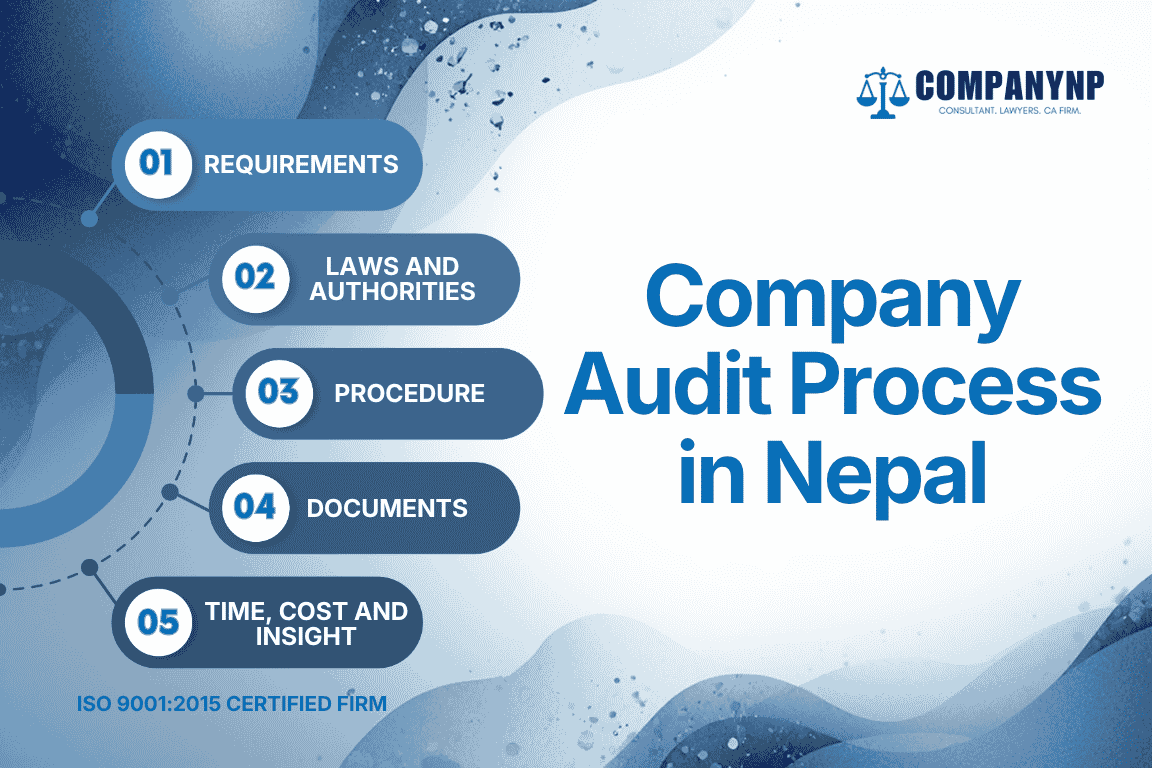

Every registered company in Nepal must conduct a company audit as per the legal framework established under Nepali law. The company audit process in Nepal ensures financial transparency, regulatory compliance, and accountability to shareholders, creditors, and government authorities. Whether you operate a private limited company, public limited company, or a foreign company branch in Nepal, understanding the audit process is essential for legal compliance.
This article explains the company audit process in Nepal, the applicable laws, required documents, types of audits, and step-by-step procedures that every business must follow.
What Is a Company Audit in Nepal?
A company audit in Nepal is a formal, independent examination of a company’s financial records, accounts, and statements to verify accuracy, legality, and compliance with applicable accounting standards and tax laws. The audit confirms whether the financial statements prepared by the company truly represent the financial position and performance of the company.
In Nepal, the Companies Act, 2063 (2006) and the Income Tax Act, 2058 (2002) are the primary legal instruments that mandate company audits. Additionally, the Nepal Standards on Auditing (NSA) issued by the Institute of Chartered Accountants of Nepal (ICAN) govern the audit practices.
The audit report produced after the audit process is submitted to the Office of the Company Registrar (OCR), the Inland Revenue Department (IRD), and shareholders during the Annual General Meeting (AGM).
Why Is a Company Audit Mandatory in Nepal?
Legal Requirement Under the Companies Act 2063
Section 111 of the Companies Act, 2063 mandates that every company registered in Nepal must appoint an auditor and conduct an annual audit of its accounts. Failure to comply with this requirement can lead to penalties, suspension of company registration, or legal action against the company directors.
Tax Compliance Under the Income Tax Act 2058
The Income Tax Act, 2058 requires companies to file audited financial statements with the Inland Revenue Department (IRD) along with their income tax returns. The audit ensures that income, expenses, deductions, and tax liabilities are correctly computed and reported.
Shareholder Protection
The audit process protects the interests of shareholders by providing an independent opinion on whether the financial statements present a true and fair view of the company’s financial health.
Types of Company Audits in Nepal

Nepal recognizes several types of company audits depending on the purpose and the requirement:
| Type of Audit | Purpose | Authority Involved |
|---|---|---|
| Statutory Audit | Annual legal compliance audit | ICAN Registered Auditor |
| Tax Audit | Verification of tax compliance | Inland Revenue Department (IRD) |
| Internal Audit | Internal control and efficiency review | Internal Auditor |
| Special Audit | Specific investigations or fraud detection | OCR / Government |
| Government Audit | Audit of government-owned companies | Office of the Auditor General |
1. Statutory Audit
A statutory audit is the most common type of company audit in Nepal. It is conducted annually by an ICAN-registered Chartered Accountant (CA) or audit firm. The auditor examines all financial records including balance sheets, profit and loss statements, cash flow statements, and notes to accounts.
2. Tax Audit
Under the Income Tax Act, 2058, companies with annual transactions exceeding a specified threshold must submit audited financial statements with their tax returns. The IRD may also conduct its own tax audit to verify the accuracy of tax payments.
3. Internal Audit
Large companies and public companies in Nepal often maintain an internal audit department that continuously monitors internal controls, operational efficiency, and risk management. Although not always mandatory, it is recommended under corporate governance best practices.
4. Special Audit
The Office of the Company Registrar or a court can order a special audit of a company if there are allegations of fraud, mismanagement, or financial irregularities under Section 117 of the Companies Act, 2063.
Who Can Conduct a Company Audit in Nepal?
Under Section 112 of the Companies Act, 2063, only a Chartered Accountant (CA) licensed by the Institute of Chartered Accountants of Nepal (ICAN) can conduct the statutory audit of a company. The auditor must be independent and must not hold any financial interest in the company being audited.
Disqualification of Auditors
The following persons cannot act as company auditors in Nepal:
- A director or employee of the company
- A person who holds shares in the company
- A close relative of the director or promoter
- A person who has a financial interest or loan relationship with the company
The appointment of an auditor is made at the Annual General Meeting (AGM) of the company, and the auditor’s remuneration is also fixed at the AGM.
Documents Required for Company Audit in Nepal
The company must provide the following documents and records to the appointed auditor:
- Financial Statements: Balance sheet, profit and loss account, cash flow statement, and statement of changes in equity
- Books of Accounts: General ledger, subsidiary ledgers, cash book, and bank book
- Bank Statements: All bank account statements for the fiscal year
- Sales and Purchase Records: Invoices, receipts, purchase orders, and delivery notes
- Tax Documents: VAT returns, TDS returns, advance tax payment receipts
- Payroll Records: Salary sheets, PF/CIT contribution records
- Fixed Asset Register: Details of all fixed assets including depreciation calculations
- Loan and Liability Documents: Loan agreements, outstanding liabilities list
- Board Resolutions and Minutes: Minutes of Board meetings and AGM
- Memorandum and Articles of Association (MoA/AoA)
- Company Registration Certificate
- PAN Certificate
- Previous Year’s Audit Report
- Inventory Records: Stock registers and physical count records
Step-by-Step Company Audit Process in Nepal

The company audit process in Nepal follows a structured and systematic approach. Below is the step-by-step procedure:
Step 1: Appointment of Auditor
The company appoints a qualified ICAN-registered Chartered Accountant at the AGM. The auditor is given a formal appointment letter specifying the scope, timeline, and remuneration.
Step 2: Engagement Letter
The auditor issues an Engagement Letter to the company management clearly stating the scope of work, responsibilities of both parties, audit timeline, and fee structure.
Step 3: Audit Planning
The auditor prepares an Audit Plan that identifies key risk areas, determines materiality levels, and designs audit procedures. The plan includes assessment of the company’s internal control systems.
Step 4: Preliminary Review
The auditor conducts a preliminary review of the accounting records, previous audit reports, internal control documents, and management letters to understand the business environment.
Step 5: Field Work and Examination
This is the core stage of the audit process. The auditor:
- Examines all books of accounts
- Verifies bank reconciliations
- Reviews vouchers and supporting documents
- Confirms balances with debtors and creditors
- Physically verifies fixed assets and inventory
- Tests internal controls and accounting procedures
- Reviews compliance with tax laws and labor laws
Step 6: Audit Working Papers
The auditor prepares detailed audit working papers documenting all findings, evidence collected, test results, and conclusions reached during the audit.
Step 7: Audit Queries and Management Response
The auditor raises audit queries to the management regarding discrepancies, missing documents, or accounting irregularities. The management provides explanations and supporting documents in response.
Step 8: Finalization of Financial Statements
After completing the audit examination, the auditor finalizes the financial statements in coordination with the company’s accounts department. Any necessary adjustments are made before finalization.
Step 9: Audit Report Preparation
The auditor prepares the Audit Report in accordance with Nepal Standards on Auditing (NSA). The report includes:
- Auditor’s Opinion: Unqualified, Qualified, Adverse, or Disclaimer of opinion
- Basis of Opinion
- Key Audit Matters
- Management’s Responsibility
- Auditor’s Responsibility
- Other Reporting Requirements under Companies Act 2063
Step 10: Submission of Audit Report
The finalized audit report and audited financial statements are submitted to:
- The Board of Directors of the company
- Shareholders at the Annual General Meeting (AGM)
- Office of the Company Registrar (OCR) along with the annual return
- Inland Revenue Department (IRD) with the income tax return
Audit Deadline and Filing Requirements in Nepal
| Requirement | Deadline | Authority |
|---|---|---|
| Completion of Annual Audit | Within 6 months of fiscal year end | ICAN / Companies Act |
| Filing Annual Return with OCR | Within 3 months of AGM | Office of Company Registrar |
| Income Tax Return with Audit Report | By Poush end (mid-January) | Inland Revenue Department |
| AGM to approve audit report | Within 6 months of fiscal year end | Companies Act, 2063 |
Nepal’s fiscal year runs from Shrawan 1 to Ashadh 31 (approximately mid-July to mid-July). Therefore, companies must complete their audit by Poush end of the following year for tax filing purposes.
Penalties for Non-Compliance With Audit Requirements

Non-compliance with the audit requirements under the Companies Act, 2063 and the Income Tax Act, 2058 can result in serious consequences:
- Financial Penalties: The OCR can impose fines on companies that fail to submit audited accounts on time
- Directors’ Liability: Directors can be held personally liable for non-compliance under Section 166 of the Companies Act, 2063
- Tax Penalties: The IRD can impose penalties and interest for late filing of audited tax returns
- Suspension of Company Registration: Persistent non-compliance can lead to the company being struck off the register
- Criminal Liability: In cases of fraudulent financial reporting, criminal proceedings can be initiated under applicable laws
Role of ICAN in the Audit Process
The Institute of Chartered Accountants of Nepal (ICAN) is the apex professional body regulating the accounting and auditing profession in Nepal. ICAN issues Nepal Standards on Auditing (NSA), which are based on International Standards on Auditing (ISA) issued by IAASB. All auditors conducting company audits in Nepal must comply with NSA and ICAN’s Code of Ethics.
ICAN also conducts quality reviews of audit firms to ensure the quality of audit services delivered to companies across Nepal. Visit the official ICAN website at www.ican.org.np for auditor registration and standards.
For company registration and annual return filing, visit the Office of the Company Registrar at www.ocr.gov.np. For tax-related audit submissions, visit the Inland Revenue Department at www.ird.gov.np.
Conclusion
The company audit process in Nepal is a legally mandated procedure governed by the Companies Act, 2063, Income Tax Act, 2058, and Nepal Standards on Auditing issued by ICAN. Every company must appoint a qualified Chartered Accountant, complete the annual audit, and submit audited financial statements to the OCR and IRD within the prescribed deadlines. Proper compliance with the audit process protects shareholders, ensures tax compliance, and maintains the legal standing of the company in Nepal.
FAQs
1. Is a company audit mandatory for all companies in Nepal?
Yes. Under Section 111 of the Companies Act, 2063, every registered company in Nepal must conduct an annual statutory audit by an ICAN-registered Chartered Accountant. No exemption exists for private limited companies.
2. Who appoints the auditor of a company in Nepal?
The auditor is appointed by shareholders at the Annual General Meeting (AGM) of the company. The Board of Directors can appoint the first auditor before the first AGM under Section 112 of the Companies Act, 2063.
3. What is the audit deadline for companies in Nepal?
Companies must complete their audit and file their income tax returns with the IRD by the end of Poush (mid-January). The annual return must be filed with the OCR within 3 months after the AGM.
4. Can a company employee conduct the statutory audit in Nepal?
No. A company employee, director, or relative of the promoter cannot act as a statutory auditor. Only an independent ICAN-registered Chartered Accountant or audit firm can conduct the company audit in Nepal.
5. What happens if a company does not conduct an audit in Nepal?
Non-compliance leads to financial penalties from the OCR and IRD, potential suspension of company registration, personal liability for directors, and tax penalties including interest under the Income Tax Act, 2058.
6. What type of audit opinion can an auditor give in Nepal?
An auditor in Nepal can issue four types of opinions: Unqualified (clean) opinion, Qualified opinion, Adverse opinion, or Disclaimer of opinion, depending on the findings during the audit process under Nepal Standards on Auditing.