


What Is Adoption in Nepal?
Adoption process in Nepal is a legal process through which a person or a couple formally takes a child as their own, granting the child all legal rights equivalent to a biological child. The adopted child receives the same inheritance rights, name, and parental care as any biological offspring. Nepal recognizes both domestic adoption and intercountry adoption (international adoption), each governed by separate legal procedures and requirements.
The adoption process in Nepal is primarily regulated under the Children’s Act, 2075 (2018) and the National Civil Code, 2074 (2017). The Ministry of Women, Children and Senior Citizens (MoWCSC) and the Department of Women and Children (DWC) are the primary government bodies overseeing child adoption in Nepal.
What Is the Legal Framework Governing Adoption in Nepal?
Nepal has a structured legal framework for adoption. The key laws and regulations include:
- Children’s Act, 2075 (2018): This is the primary law governing child rights and adoption procedures in Nepal. It defines eligibility, procedures, and safeguards for both domestic and intercountry adoptions.
- National Civil Code, 2074 (2017): Covers personal law matters including family relations and inheritance rights of adopted children.
- Child Rights Convention (CRC): Nepal is a signatory and follows international standards for child protection.
- Hague Convention on Intercountry Adoption: Nepal is not yet a full signatory but follows similar principles for international adoptions.
The Ministry of Women, Children and Senior Citizens and Department of Women and Children are responsible for processing adoption applications and granting approval.
Who Is Eligible to Adopt a Child in Nepal?
For Domestic Adoption (Nepali Citizens)
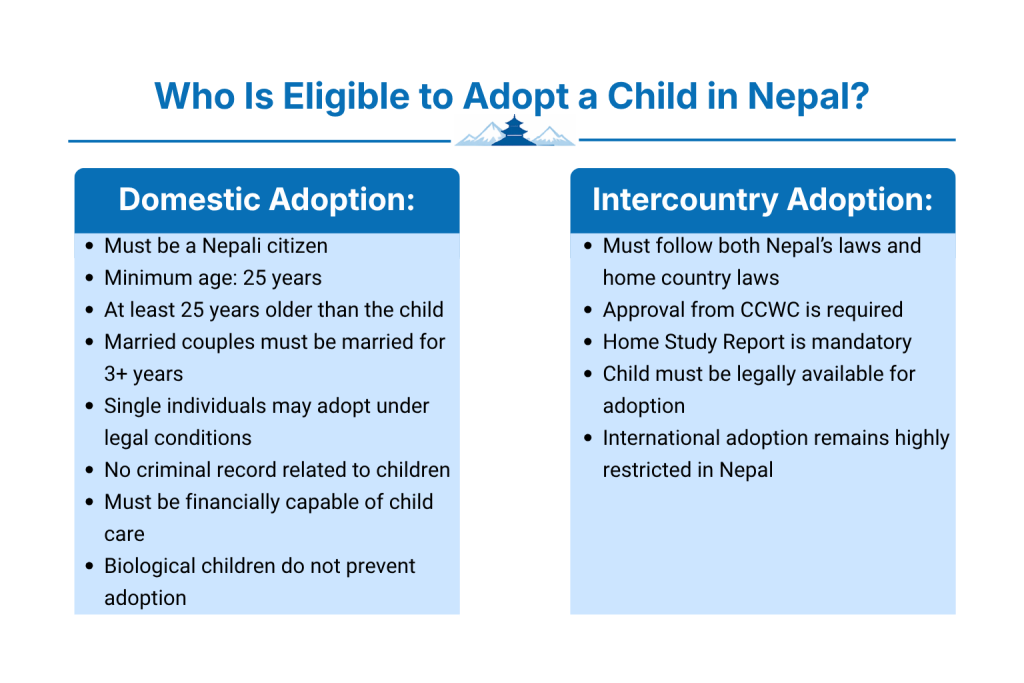
Under the Children’s Act, 2075, the following eligibility criteria apply for domestic adoption in Nepal:
- The adoptive parent(s) must be Nepali citizens.
- The adoptive parent must be at least 25 years old.
- The age difference between the adoptive parent and the child must be at least 25 years.
- Married couples must have been married for at least 3 years before applying.
- Single individuals (male or female) can adopt under specific conditions permitted by law.
- The applicant must not have a criminal record involving offenses against children.
- The applicant must be financially stable and capable of providing proper care.
- Couples with biological children are still permitted to adopt.
For Intercountry Adoption (Foreign Nationals)
Nepal has significantly restricted intercountry adoption over the years due to child trafficking concerns and irregularities. As of 2024, Nepal’s international adoption process remains largely suspended pending reform. However, for cases where intercountry adoption is permitted:
- Foreign applicants must comply with both Nepal’s adoption laws and the laws of their home country.
- Approval from the Central Child Welfare Committee (CCWC) is mandatory.
- A Home Study Report from the applicant’s home country is required.
- The child must be confirmed as legally available for adoption and registered with the government.
What Are the Documents Required for Adoption in Nepal?
For Domestic Adoption in Nepal
The following documents are required when applying for child adoption in Nepal:
- Citizenship Certificate of the applicant(s)
- Marriage Certificate (for married couples)
- Medical Certificate confirming good physical and mental health
- Police Clearance Certificate (no criminal record)
- Financial Statement or Income Proof (tax clearance or bank statement)
- Property Ownership Documents or proof of stable residence
- Character Certificate from the local ward office
- Passport-sized photographs of the applicant(s)
- Written consent of the biological parents or legal guardian (if applicable)
- Birth Certificate of the child to be adopted
- Proof of the child’s legal availability for adoption (orphan certificate or abandonment documentation)
- Application form from the Department of Women and Children
For Intercountry Adoption (Additional Documents)
- Home Study Report from a licensed social worker in the applicant’s home country
- Approval from the home country’s adoption authority
- Valid Passport and Visa documentation
- Proof of residence in the home country
What Is the Step-by-Step Adoption Process in Nepal?

Domestic Adoption Process in Nepal
- Obtain Application Form: Collect the official adoption application form from the Department of Women and Children (DWC) or download it from the DWC official website.
- Prepare All Required Documents: Gather all the documents listed above, ensuring they are notarized and up to date.
- Submit Application: Submit the completed application form along with all supporting documents to the DWC or the respective District Child Welfare Board (DCWB).
- Document Verification: The DWC verifies all submitted documents. Officials may conduct background checks and verify the applicant’s financial and social stability.
- Home Study/Social Investigation: A social worker or welfare officer conducts a home study investigation to assess the applicant’s living conditions, family environment, and suitability as a parent.
- Child Matching: Once approved, the DWC matches the applicant with a child who is legally available for adoption.
- Pre-Adoption Foster Care: The applicant may be required to take the child on a foster care basis for a specific period before the final adoption order is issued.
- Court Application: The applicant files a petition before the District Court in the district where the child resides for a legal adoption order.
- Court Hearing and Approval: The District Court reviews the application, verifies that the adoption is in the best interest of the child, and issues the adoption decree.
- Adoption Registration: The adoption decree is registered at the local Ward Office and the child’s name is updated in the official civil records.
- Issuance of Adoption Certificate: The final Adoption Certificate is issued to the adoptive parents.
How Long Does the Adoption Process Take in Nepal?
The timeline for completing the adoption process in Nepal varies depending on document completeness, the availability of eligible children, and court schedules.
| Stage | Estimated Duration |
|---|---|
| Document preparation and submission | 2 – 4 weeks |
| Document verification by DWC | 4 – 8 weeks |
| Home study and social investigation | 2 – 6 weeks |
| Child matching | 1 – 6 months |
| Pre-adoption foster care period | 3 – 6 months |
| Court hearing and adoption decree | 1 – 3 months |
| Adoption registration and certification | 2 – 4 weeks |
| Total Estimated Time | 6 months – 1.5 years |
What Are the Rights of an Adopted Child in Nepal?
Under the National Civil Code, 2074 and the Children’s Act, 2075, an adopted child in Nepal holds the following rights:
- Equal inheritance rights as a biological child of the adoptive parents.
- The right to use the surname of the adoptive parents.
- The right to Nepali citizenship if the adoptive parents are Nepali citizens.
- Education, health, and protection rights as guaranteed by the Children’s Act.
- The right to know about their adoption at an appropriate age, as per child rights standards.
- Social security benefits applicable to children under the adoptive family.
Once the adoption is legally finalized, all legal ties with the biological parents are severed unless the court decides otherwise based on the child’s best interests.
What Is Intercountry Adoption in Nepal?
Intercountry adoption, also known as international adoption in Nepal, refers to the process by which a foreign national legally adopts a Nepali child and takes the child to live in another country. Nepal has historically been a source country for intercountry adoption.
However, due to serious concerns about child trafficking, fraud, and irregularities in the adoption process, Nepal imposed strict restrictions and a moratorium on intercountry adoptions starting around 2010. The government has since been working to reform its adoption system to align with international standards.
Current Status of International Adoption in Nepal
| Aspect | Current Status |
|---|---|
| Intercountry adoption status | Largely suspended/restricted |
| Governing authority | Ministry of Women, Children and Senior Citizens |
| Hague Convention status | Not yet fully ratified |
| Domestic adoption priority | Yes – domestic adoption is prioritized |
| Reform process | Ongoing as of 2024 |
Foreign nationals seeking to adopt from Nepal are advised to check current official advisories from both the Nepal Ministry of Women, Children and Senior Citizens and their home country’s adoption authority before proceeding.
What Is the Role of the Central Child Welfare Committee in Adoption?

The Central Child Welfare Committee (CCWC), operating under the Ministry of Women, Children and Senior Citizens, plays a central role in Nepal’s adoption process. Its responsibilities include:
- Reviewing and approving adoption applications, particularly for intercountry adoption.
- Maintaining a registry of children legally available for adoption.
- Ensuring that the adoption process strictly follows the best interest of the child principle.
- Monitoring licensed child care homes and orphanages.
- Coordinating with District Child Welfare Boards for local adoption processes.
The CCWC also works in coordination with the Department of Women and Children to ensure compliance with both national and international child protection standards.
What Happens to the Biological Parents’ Rights After Adoption?
Under Nepal’s adoption law, once a child is legally adopted through the District Court process, the biological parents permanently surrender all legal rights to the child. This includes:
- Loss of guardianship and custody rights.
- No inheritance claim by biological parents from the adopted child.
- No claim to the child’s property acquired through adoption.
However, biological parents may voluntarily provide written consent for adoption. In cases where a child is an orphan or abandoned, the state acts as the legal guardian until adoption is finalized.
FAQs
1. Can a single person adopt a child in Nepal?
Yes, a single person can legally adopt a child in Nepal under the Children’s Act, 2075, provided they meet the age, financial stability, and social suitability criteria set by the Department of Women and Children.
2. What is the minimum age requirement to adopt a child in Nepal?
The adoptive parent must be at least 25 years old, and there must be a minimum 25-year age gap between the adoptive parent and the child being adopted, as per Nepal’s Children’s Act, 2075.
3. Can foreigners adopt Nepali children?
Intercountry adoption from Nepal is currently largely suspended due to child protection concerns. Foreign nationals must check current government policies through the Ministry of Women, Children and Senior Citizens before applying.
4. How long does it take to complete adoption in Nepal?
The entire domestic adoption process typically takes between 6 months to 1.5 years, depending on documentation, court schedules, child matching, and the completion of the pre-adoption foster care period.
5. Is court approval mandatory for adoption in Nepal?
Yes, a District Court adoption decree is legally mandatory for all adoptions in Nepal. Without a court order, the adoption has no legal standing under the National Civil Code, 2074.
6. What documents does the child need for adoption in Nepal?
The child must have a birth certificate, proof of abandonment or orphan status, and documentation confirming their legal availability for adoption as verified by the Department of Women and Children.
Conclusion
The adoption process in Nepal follows a structured legal framework under the Children’s Act, 2075 and the National Civil Code, 2074. Domestic adoption is accessible to eligible Nepali citizens, while intercountry adoption remains restricted. All applicants must work through the Department of Women and Children and obtain a District Court adoption decree to complete the legal process. The central priority throughout Nepal’s adoption system remains the best interest of the child.
For official guidance, visit the Ministry of Women, Children and Senior Citizens or the Department of Women and Children.