

epal has become an attractive destination for software development, business process outsourcing, data services, and digital product companies. Its legal framework permits foreign investors to own information technology companies, subject to compliance with the Companies Act, 2063 (2006), the Foreign Investment and Technology Transfer Act, 2075 (2019) (FITTA), the Industrial Enterprises Act, 2076 (2020), the Income Tax Act, 2058 (2002), and the directives and bylaws issued by Nepal Rastra Bank (NRB).
This guide, prepared by CompanyNP, explains IT company registration in Nepal in question form, so that each legal requirement can be understood in sequence. All statements below are based on prevailing Nepali legislation and the published procedures of the Office of the Company Registrar (OCR), the Department of Industry (DOI), the Inland Revenue Department (IRD), and Nepal Rastra Bank.
Which Laws and Authorities Govern IT Company Registration in Nepal?
An information technology company in Nepal is regulated by several statutes at the same time. A company is a corporate person created under company law, an industry recognised under industrial law, a taxpayer under tax law, and, where foreign capital is involved, an approved foreign investment under FITTA and NRB rules.
What are the principal statutes and regulators?
| Subject | Governing law | Authority |
|---|---|---|
| Incorporation of the company | Companies Act, 2063 (2006) | Office of the Company Registrar (ocr.gov.np) |
| Foreign investment approval | FITTA, 2075 (2019) and Foreign Investment and Technology Transfer Rules, 2078 | Department of Industry (doind.gov.np) or Investment Board Nepal |
| Industry registration and classification | Industrial Enterprises Act, 2076 (2020) | Department of Industry |
| Inward remittance and repatriation | Foreign Exchange (Regulation) Act, 2019 and NRB bylaws | Nepal Rastra Bank (nrb.org.np) |
| PAN, VAT and income tax | Income Tax Act, 2058; Value Added Tax Act, 2052 | Inland Revenue Department (ird.gov.np) |
| Employment and social security | Labour Act, 2074; Social Security Act, 2074 | Department of Labour; Social Security Fund |
The Nepal Law Commission publishes the consolidated texts of these laws at lawcommission.gov.np, which serves as the authoritative source for statutory language.
Why is the IT sector treated favourably?
Information technology and technology-based service industries are listed as recognised industries under the Industrial Enterprises Act, 2076. They are not included in Schedule 1 (the negative list) of FITTA, which excludes sectors such as retail trade with limited turnover, personal service businesses, and certain small-scale activities. Consequently, software development, data processing, cloud services, IT-enabled services, digital marketing platforms, and outsourcing centres are generally open to foreign direct investment in Nepal.
Who Can Register an IT Company, and What Ownership Limits Apply?
Can a foreigner own 100 percent of an IT company in Nepal?
Yes. FITTA, 2075 does not impose a general ceiling on foreign equity in the information technology sector. A single foreign individual or foreign body corporate may hold the entire issued share capital of a Nepali private limited company engaged in IT services, provided:
- The proposed objectives do not fall within Schedule 1 of FITTA.
- Approval of the Department of Industry (or Investment Board Nepal, depending on size) is obtained before investment.
- The investment is brought into Nepal through banking channels in convertible foreign currency, with NRB recording or approval as required.
An important exception concerns consultancy services. Under FITTA, foreign investment in management consultancy, engineering consultancy, legal, accounting, auditing, and similar consultancy services is capped at 51 percent. Therefore, if the proposed company’s objectives state “IT consultancy” rather than IT services or software development, the ownership ceiling may apply. Correct drafting of the memorandum of association is a substantive legal issue, not a formality.
What is the minimum foreign investment amount?
Section 9 of FITTA empowers the Government of Nepal to prescribe a minimum threshold for foreign investment by notification in the Nepal Gazette. The general threshold has historically been fixed at NPR 20,000,000 (two crore) per foreign investor. However, the Government has, by Gazette notification, exempted specified information technology based industries from the minimum threshold in order to promote the digital economy.
Investors should confirm the prevailing threshold figure with the Department of Industry before filing, as the executive notification sets this threshold and it has been revised multiple times. CompanyNP verifies the current notification for every application.
Which authority approves the investment?
- Investment up to NPR 6 billion: Department of Industry, under FITTA and the Foreign Investment (Automatic Route) Procedure where applicable.
- Investment above NPR 6 billion: Investment Board Nepal, under the Public Private Partnership and Investment Act, 2075.
Certain qualifying investments may be processed through the automatic route on the Government’s online investment system, which shortens the approval timeline for eligible IT projects.
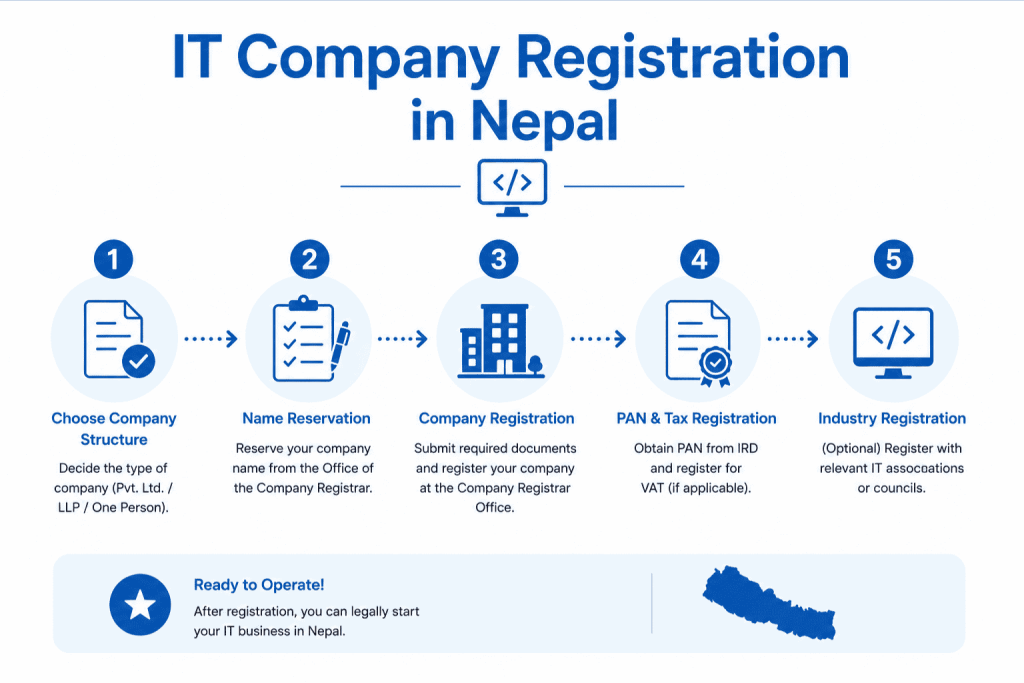
What is the step-by-step process for registering an IT company in Nepal?
The following sequence reflects the procedures published by the Department of Industry and the Office of the Company Registrar. Local investors may omit Steps 2 and 7.
Step 1: Determine the company structure and objectives
Most IT businesses are registered as a private limited company under Section 3 of the Companies Act, 2063, because liability is limited and shares are transferable. A private company may have one to 101 shareholders. At this stage, the promoters must settle:
- Authorised, issued and paid-up capital.
- Shareholding ratio between foreign and Nepali shareholders, if any.
- Objectives should be drafted to reflect software development, IT-enabled services, or outsourcing, rather than being restricted to consultancy.
- Registered office address in Nepal.
Step 2: Obtain foreign investment approval from the Department of Industry
A foreign investor must obtain approval before remitting funds. The application to the Department of Industry generally includes:
- Application in the prescribed format with the proposed project report or business plan.
- A board resolution from the investing company or a written commitment from an individual investor.
- Certificate of incorporation, charter documents and audited financial statements of the corporate investor.
- Passport copy and biodata of the individual investor or authorised representative.
- Financial credibility certificate issued by the investor’s bank.
- Joint venture agreement, where there is more than one shareholder.
- Power of attorney appointing a local representative.
The Department issues a foreign investment approval letter specifying the approved amount, sector and conditions.
Step 3: Reserve the company name at the Office of the Company Registrar.
The name is reserved online through the OCR system. The proposed name must be unique from existing companies, must not infringe a registered trademark, and must align with public morality and the law under Section 6 of the Companies Act.
Step 4: File incorporation documents and obtain the certificate of incorporation.
The application under Section 4 of the Companies Act is submitted with:
- Memorandum of association and articles of association, signed by all promoters.
- Consensus agreement, if the shareholders execute one.
- Copies of citizenship certificates of Nepali promoters or passports of foreign promoters.
- The Department of Industry approval letter, in the case of foreign investment.
- Evidence of payment of the registration fee, which is calculated on authorized capital.
The registrar then issues the certificate of incorporation, and the company acquires separate legal personality from the date of registration.
Step 5: Register the industry with the Department of Industry.
After incorporation, the company registers the IT industry itself under the Industrial Enterprises Act, 2076, receiving an industry registration certificate that records the classification (micro, cottage, small, medium, or large), fixed capital, and employment. This certificate is generally required for capital injection, visa recommendation, and later repatriation.
Step 6: Obtain PAN and, where applicable, VAT registration.
Registration with the Inland Revenue Department is mandatory. Every company must obtain a permanent account number. Value Added Tax registration is required where the company crosses the prevailing small-vendor turnover threshold under the Value Added Tax Act, 2052, or where it engages in transactions for which registration is compulsory. Exported IT services are generally treated as zero-rated supplies, which makes voluntary VAT registration commercially useful for exporters claiming input credit.
Step 7: Obtain Nepal Rastra Bank recording and inject the capital
Under Section 19 of FITTA and the NRB Foreign Investment and Foreign Loan Management Bylaws: Foreign currency may be brought in only after the investment is recorded with Nepal Rastra Bank. The company then:
- Opens a bank account with a licensed commercial bank in Nepal.
- Receives the share capital from the investor’s own account abroad through banking channels.
- Obtains a credit advice and foreign investment certificate from the bank.
- Files the share lodgement report with the Department of Industry and updates the shareholder register at the Office of the Company Registrar.
Capital must be injected within the timeframe stated in the approval letter and the Foreign Investment and Technology Transfer Rules, 2078.
Step 8: Complete local registrations and employment compliance.
- Registration with the ward office or municipality of the registered office, as required by the local government.
- Enrolment of the employer and employees in the Social Security Fund under the Social Security Act, 2074.
- Preparation of employment contracts, remuneration records, and a labor register consistent with the Labour Act, 2074.
- Registration with the Department of Information Technology or a licence from the Nepal Telecommunications Authority, where the activity involves internet service provision, telecommunication services or specified government-facing digital services.
Step 9: Apply for business or residential visas
Under Section 32 of FITTA, a foreign investor, the authorised representative and dependent family members may obtain a business visa on the recommendation of the approving authority. Under Section 33, a foreign investor who makes a lump-sum investment of at least one million United States dollars may obtain a residential visa, subject to the prescribed conditions.
Indicative timeline for a foreign-owned IT company
| Stage | Responsible authority | Indicative working days |
|---|---|---|
| Foreign investment approval | Department of Industry | 7 to 20 |
| Name reservation | Office of the Company Registrar | 1 to 3 |
| Incorporation | Office of the Company Registrar | 3 to 7 |
| Industry registration | Department of Industry | 3 to 7 |
| PAN and VAT | Inland Revenue Department | 1 to 3 |
| NRB recording and capital injection | Nepal Rastra Bank and the bank | 7 to 15 |
Timelines depend on the completeness of the documents and are only indicative.
What Are the Tax, Capital, and Reporting Obligations After Registration?
How is an IT company taxed in Nepal?
Under the Income Tax Act, 2058, a resident company is ordinarily taxed at 25 percent of taxable income, subject to concessions granted by Section 11 of the Act and by the annual Finance Act. Notable features relevant to IT companies include:
- A rebate on income tax for industries established inside an information technology park designated by the government, as provided in Section 11 of the Income Tax Act.
- Export-related concessions on income derived from the export of services from sources in Nepal.
- Withholding tax obligations on salaries, service payments, rent, and dividends.
- Advance tax instalments in Poush, Chaitra, and Asar, and the filing of the annual income tax return within three months of the end of the income year, extendable as permitted.
Dividends distributed to shareholders are subject to final withholding tax at the rate prescribed by the Finance Act. Current rates and thresholds should always be confirmed on ird.gov.np.
How can profits and capital be repatriated?
Section 20 of FITTA permits a foreign investor to repatriate dividends, sale proceeds of shares, proceeds of liquidation, royalties, and approved fees in convertible foreign currency, with the approval of Nepal Rastra Bank. In practice, the bank and NRB require:
- The Department of Industry’s approval and the industry registration certificate.
- Evidence of the original inward remittance and share lodgement.
- Audited financial statements and the board or general meeting resolution declaring dividends.
- A tax clearance certificate confirming that all tax liabilities have been settled.
What ongoing corporate compliance is required?
- Annual general meeting and annual return filing with the Office of the Company Registrar under the Companies Act, 2063.
- Statutory audit by a licensed auditor appointed by the general meeting.
- Updating the Registrar on changes in directors, capital, registered office, or objectives within the prescribed period.
- Annual progress reporting to the Department of Industry.
- Maintenance of shareholder registers, minute books, and share certificates at the registered office.
Non-compliance may attract fines under the Companies Act, interest and penalties under the Income Tax Act, and, in serious cases, restrictions on repatriation.
How Does CompanyNP Support IT Company Registration in Nepal?
CompanyNP acts as an end-to-end adviser for foreign and Nepali promoters establishing technology businesses. Our engagement typically covers structuring advice on ownership caps and objectives, preparation of the Department of Industry application, drafting of the memorandum and articles of association and joint venture agreements, incorporation at the Office of the Company Registrar, PAN and VAT registration, coordination with the commercial bank and Nepal Rastra Bank for capital injection, share lodgement reporting, visa recommendation support, and continuing tax, audit, and annual filing compliance.
Because thresholds, fees, and concessions are periodically revised by the Finance Act and by Gazette notification, every file is checked against the prevailing rules before submission.
Frequently Asked Questions
Is a local Nepali shareholder mandatory for an IT company?
No. FITTA permits 100 percent foreign ownership in the information technology sector, so a Nepali partner is optional. A local partner becomes necessary only where the objectives fall within consultancy services, which are capped at 51 percent foreign equity.
Can a foreign investor register an IT company without visiting Nepal?
Yes. A foreign investor may appoint a local representative through a notarized and, where required, consularized power of attorney. The representative may sign applications, open procedures, and follow up with authorities, although bank account operation may still require personal verification.
How much paid-up capital is required for a local IT company?
The Companies Act, 2063, prescribes no statutory minimum paid-up capital for a private limited company with purely Nepali ownership. Capital should nevertheless be realistic for operations. Foreign-invested companies must satisfy the minimum threshold prescribed by the Gazette notification under FITTA.
Are software export earnings subject to value-added tax in Nepal?
Services exported from Nepal are generally treated as zero-rated under the Value Added Tax Act, 2052. The exporter charges no VAT but may claim input tax credit, provided banking evidence of foreign currency receipt and prescribed documentation are properly maintained and retained.
What happens if capital is not injected within the approved period?
The Department of Industry may require an extension request with justification, and an unexplained delay can result in the cancellation of the foreign investment approval. Nepal Rastra Bank may also decline to record remittances that do not match the approval terms.
Does an IT company need any separate license beyond registration?
Ordinary software development and outsourcing require no separate license. Internet service provision, telecommunication services, payment-related systems, and certain data services require additional authorization from the Nepal Telecommunications Authority, Nepal Rastra Bank, or the Department of Information Technology.