

Consultancy services form one of the fastest-growing segments of Nepal’s service economy. Management advisory firms, engineering consultancies, IT consultancies, accounting and audit-support firms, human resource advisory houses, and education consultancies all operate under a common legal framework built upon the Companies Act, 2063 (2006), the Industrial Enterprises Act, 2076 (2020), the Foreign Investment and Technology Transfer Act, 2075 (2019) (FITTA), the Income Tax Act, 2058 (2002), the Value Added Tax Act, 2052 (1996), and directives issued by Nepal Rastra Bank (NRB).
This guide, prepared by CompanyNP, answers the questions most frequently raised by promoters regarding consultancy company registration in Nepal, with reference only to statutory provisions and official government sources.
What Is a Consultancy Company Under Nepali Law?
A consultancy company is a company incorporated under the Companies Act, 2063, whose stated objectives in the Memorandum of Association relate to the supply of professional advice, expertise, or technical services rather than the manufacture or trade of goods. Under the Industrial Enterprises Act, 2076, such an undertaking is classified as a service industry.
Which laws govern consultancy company registration in Nepal?
The following instruments apply directly:
- Companies Act, 2063 (2006) — incorporation, share capital, directors, statutory records, and annual filings with the Office of the Company Registrar (OCR).
- Industrial Enterprises Act, 2076 (2020) — registration of the service industry with the Department of Industry (DOI) or the concerned Provincial Ministry.
- Foreign Investment and Technology Transfer Act, 2075 (2019) and the Foreign Investment and Technology Transfer Rules, 2077 (2021) — foreign equity approval, technology transfer agreements, and repatriation rights.
- Income Tax Act, 2058 (2002) — permanent account number (PAN), corporate income tax, withholding tax, and return filing.
- Value Added Tax Act, 2052 (1996) and Rules — compulsory VAT registration for specified professional and consultancy services.
- Nepal Rastra Bank Foreign Investment and Foreign Loan Management Bylaws, 2078 — inward remittance recording and repatriation approval.
What consultancy activities are commonly registered?
- Management and business consultancy
- Engineering, architectural, and survey consultancy
- Information technology and software consultancy
- Financial, accounting, and tax advisory support services
- Human resource, recruitment, and training advisory
- Environmental, energy, and agricultural consultancy
- Media, marketing, and market research services
Which consultancy activities require sectoral licences?
Registration with the OCR alone is not always sufficient. For example, educational consultancy relating to foreign study requires permission from the Ministry of Education, Science and Technology under the Education Act and its Rules. Foreign employment (manpower) services require a licence from the Department of Foreign Employment under the Foreign Employment Act, 2064. Audit practice requires a certificate of practice from the Institute of Chartered Accountants of Nepal under the Nepal Chartered Accountants Act, 2053. Engineering consultancies must engage professionals registered with the Nepal Engineering Council.
Who Is Permitted to Register a Consultancy Company in Nepal?
Both Nepali citizens and foreign investors may promote a consultancy company, but the conditions differ materially.
Can a foreign national own a consultancy company in Nepal?
Yes, subject to a statutory ceiling. Schedule 1 of FITTA, 2075 (the negative list) restricts foreign investment in consultancy services such as management, accounting, engineering, and legal services where foreign investment would exceed fifty-one percent. Consequently:
- Foreign equity in a consultancy company is generally permitted up to fifty-one percent.
- The remaining forty-nine percent or more must be held by Nepali persons or Nepali-owned entities.
- Language training, music training, and computer training services are placed wholly within the negative list and are not open to foreign investment.
- Information technology services, software development, and business process outsourcing are treated separately from restricted consultancy and are generally open to full foreign ownership, subject to DOI determination of the objective clause.
Promoters are advised to obtain a written classification of their proposed objectives from the Department of Industry before finalising the Memorandum of Association.
What is the minimum foreign investment threshold?
Pursuant to Section 9 of FITTA and the notice published in the Nepal Gazette by the Ministry of Industry, Commerce and Supplies, the minimum foreign investment per foreign investor is NPR 20,000,000 (twenty million). The Government of Nepal has, by subsequent Gazette notification, exempted specified information technology-based services from this threshold. The threshold applies per foreign investor, not per company.
Which company structures are available?
| Structure | Governing Provision | Shareholders | Suitability for Consultancy |
|---|---|---|---|
| Private limited company | Companies Act, 2063, Sections 3–5 | 1 to 101 | Most common vehicle for domestic and foreign-invested consultancies |
| Public limited company | Companies Act, 2063, Section 3 | Minimum 7 | Used where public share issuance is intended; minimum paid-up capital NPR 10,000,000 |
| Branch office | Companies Act, 2063, Section 154 | Not applicable | Permitted where a foreign company has secured a contract or licence in Nepal |
| Liaison office | Companies Act, 2063, Section 154 | Not applicable | Non-income-generating representative presence only |
| Sole proprietorship / partnership firm | Private Firm Registration Act, 2014; Partnership Act, 2020 | 1 or more | Available to Nepali citizens only; not open to foreign investment |
How Is a Consultancy Company Registered in Nepal?
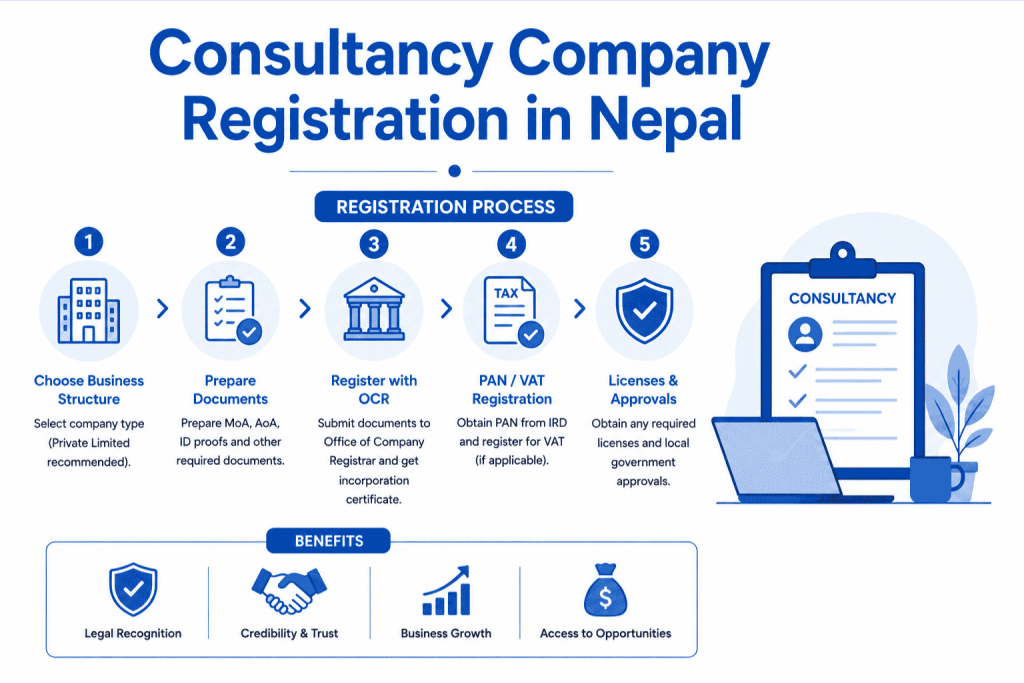
The process differs depending on whether foreign equity is involved. The sequence below reflects the procedure published by the Office of the Company Registrar and the Department of Industry.
Step 1 (Foreign investment approval, where applicable)
Where foreign equity is proposed, an application is filed with the Department of Industry through its online foreign investment system, accompanied by the project report, joint venture agreement, financial credibility certificate, incorporation documents of the foreign investor, board resolution, and passport copies. Approval is granted by the DOI for investments up to NPR 6,000,000,000; larger projects fall under the Investment Board Nepal.
Step 2 (Company name reservation)
The proposed name is reserved through the OCR online portal. Names identical or deceptively similar to existing companies, or contrary to public decency, are rejected under Section 6 of the Companies Act, 2063.
Step 3 (Preparation of constitutional documents)
The Memorandum of Association and Articles of Association are drafted in Nepali, stating the objectives, authorised capital, issued capital, paid-up capital, and shareholding structure. Where foreign investment is involved, the joint venture agreement is also prepared.
Step 4 (Incorporation at the Office of the Company Registrar)
The application under Section 4 of the Companies Act is filed with the required documents and the prescribed registration fee. The OCR issues the Certificate of Incorporation and the company number.
Step 5 (Permanent Account Number registration)
The company registers with the concerned Inland Revenue Office and obtains a PAN under the Income Tax Act, 2058. VAT registration is completed at the same stage where applicable.
Step 6 (Local level business registration)
The company registers with the relevant Metropolitan City, Municipality, or Rural Municipality ward office and pays the applicable business tax under the Local Government Operation Act, 2074.
Step 7 (Industry registration with the Department of Industry)
Service industries are registered under the Industrial Enterprises Act, 2076, with the DOI or the Provincial Ministry of Industry, according to the level of the industry.
Step 8 (Nepal Rastra Bank record of investment)
The foreign investor remits the approved capital through banking channels. NRB records the inward foreign direct investment under the Foreign Investment and Foreign Loan Management Bylaws, 2078. This record is a precondition for lawful repatriation of dividends, sale proceeds, and royalties.
Step 9 (Share allotment and post-registration filings)
Shares are allotted, the share register is maintained, the share lot statement is filed with the OCR, and a corporate bank account is operated in the company’s name.
How long does the process take?
A wholly Nepali-owned consultancy company is ordinarily registered within five to ten working days. A foreign-invested consultancy company typically requires four to ten weeks, depending on the completeness of the DOI application and the timing of the remittance and NRB recording.
What Are the Capital, Fee, and Taxation Requirements?
Is there a minimum paid-up capital for a consultancy company?
The Companies Act, 2063 does not prescribe a minimum paid-up capital for private companies. In practice, the OCR accepts an authorised and paid-up capital of NPR 100,000 or above for domestic consultancies. For foreign-invested companies, the capital must be consistent with the amount approved by the Department of Industry and must satisfy the statutory minimum foreign investment threshold.
What registration fees apply?
Registration fees payable to the OCR are calculated on authorised capital in accordance with the Schedule to the Companies Act:
| Authorised Capital (NPR) | Registration Fee (NPR) |
|---|---|
| Up to 100,000 | 1,000 |
| 100,001 – 500,000 | 4,500 |
| 500,001 – 2,500,000 | 9,500 |
| 2,500,001 – 10,000,000 | 16,000 |
| 10,000,001 – 20,000,000 | 19,000 |
| 20,000,001 – 30,000,000 | 22,000 |
| 30,000,001 – 50,000,000 | 28,000 |
| 50,000,001 – 100,000,000 | 43,000 |
| Above 100,000,000 | 43,000 plus 30 for each additional 100,000 |
Applicants should verify current rates on the official OCR website before payment.
What taxes apply to consultancy companies?
- Corporate income tax: twenty-five percent of taxable income under Schedule 1 of the Income Tax Act, 2058.
- Dividend tax: five percent final withholding on distributed dividends, including dividends repatriated to foreign investors.
- Value Added Tax: thirteen percent. Under the Value Added Tax Rules, specified professional services, including management, legal, accounting, audit, and engineering consultancy provided within designated urban areas, must register for VAT irrespective of the turnover threshold.
- Withholding tax: fifteen percent on service fees paid to non-VAT-registered service providers and one and a half percent on payments under contracts, pursuant to Section 89 of the Income Tax Act.
- Advance tax instalments are payable in Poush, Chaitra, and Ashadh.
What annual compliance obligations continue after registration?
- Annual General Meeting and filing of the annual return with the OCR within thirty days of the meeting, under Sections 76 and 80 of the Companies Act.
- Audited financial statements prepared by a licensed auditor.
- Income tax return filed with the Inland Revenue Department within three months of the close of the fiscal year, extendable on application.
- Monthly or four-monthly VAT returns, and monthly TDS returns.
- Annual reporting of foreign investment status to the Department of Industry and Nepal Rastra Bank.
What Additional Rights and Restrictions Apply to Foreign-Invested Consultancies?
Can profits be repatriated abroad?
Yes. Section 20 of FITTA guarantees repatriation of dividends, proceeds from the sale of shares, royalties under technology transfer agreements, and approved lease rentals, provided the investment is recorded with Nepal Rastra Bank and all tax liabilities are cleared. Repatriation is approved by NRB upon submission of audited accounts, tax clearance certificates, and board resolutions.
What visa facilities are available to foreign investors?
Under Sections 30 and 31 of FITTA, a foreign investor, an authorised representative, and dependent family members are entitled to a business visa for the period the investment is retained. A foreign investor making a lump-sum investment of at least NPR 100,000,000 is entitled to a residential visa.
What are the principal legal risks?
- Registering objectives that fall within the negative list, leading to rejection or later cancellation.
- Injecting capital before NRB recording, which jeopardises repatriation.
- Failure to obtain sectoral licences for regulated consultancy activities.
- Non-filing of annual returns, attracting fines under Section 81 of the Companies Act.
Frequently Asked Questions
Can a single foreign investor register a consultancy company alone in Nepal?
No. Because FITTA restricts foreign investment exceeding fifty-one percent in consultancy services, at least forty-nine percent Nepali shareholding is required. Full foreign ownership may be possible where objectives are classified as information technology services.
Is physical presence in Nepal required during registration?
Physical presence is not mandatory. Foreign promoters may appoint an authorised representative through a notarised and consularised power of attorney, which is accepted by the Office of the Company Registrar and the Department of Industry.
What documents must foreign investors submit for approval?
Passport copies, certificate of incorporation, board resolution, audited financials or bank credibility certificate, project report, joint venture agreement, and biodata. Corporate documents executed abroad must be notarised and authenticated through the concerned diplomatic mission.
Does a consultancy company need VAT registration immediately?
Generally yes. The Value Added Tax Rules require compulsory registration for specified professional and consultancy services within designated urban areas, regardless of annual turnover, so registration is normally completed alongside PAN registration.
Can shares later be transferred to another foreign investor?
Yes. Share transfer involving foreign investors requires prior approval from the Department of Industry, tax clearance from the Inland Revenue Department on capital gains, and subsequent amendment filings with the Office of the Company Registrar.
What happens if the company remains inactive after registration?
Inactive companies continue to accrue statutory filing obligations and penalties. A company may apply for dormant status or voluntary liquidation under the Companies Act, following clearance of tax liabilities and settlement of all outstanding fines.
Official References
- Office of the Company Registrar: https://www.ocr.gov.np
- Department of Industry: https://www.doind.gov.np
- Inland Revenue Department: https://ird.gov.np
- Nepal Rastra Bank: https://www.nrb.org.np
CompanyNP assists domestic promoters and foreign investors with name reservation, drafting of the Memorandum and Articles of Association, Department of Industry approval, company incorporation, PAN and VAT registration, Nepal Rastra Bank recording, and continuing annual compliance.