

Nepal has always kept a close watch on how money moves in and out of the country. One of the oldest laws that controls this movement is the Act Restricting Investment Abroad, 2021 (1964). This law was made to stop Nepali citizens, firms, and companies from sending their money outside Nepal for investment purposes without permission from the government. Even today, this Act plays an important role in how Nepal Rastra Bank, the Department of Industry, and other government bodies regulate outward capital flow.
At CompanyNP, we help foreign nationals and businesses register companies in Nepal and understand the legal environment they are entering. While our main work involves inward foreign investment, many of our clients also ask about outward investment rules once their Nepali company starts making profit. This article explains the Act Restricting Investment Abroad 1964 in simple language, based on official Nepali laws such as the Companies Act, the Foreign Investment and Technology Transfer Act (FITTA), the Income Tax Act, and Nepal Rastra Bank regulations.
What Is the Act Restricting Investment Abroad 1964?
The Act Restricting Investment Abroad, 2021 (1964) is a Nepali law that limits the ability of Nepali citizens, companies, and other entities to invest money outside the country. It was passed at a time when Nepal had very limited foreign currency reserves and needed to protect its economy from capital flight.
Background and Purpose of the Act
Nepal introduced this law shortly after opening its economy to international trade in the mid-twentieth century. At that time, the government was concerned that citizens with access to foreign currency might send funds abroad instead of investing them inside Nepal. The Act was designed to:
- Stop unauthorized outward remittance of capital
- Protect Nepal’s limited foreign exchange reserves
- Keep domestic savings and profits within the national economy
- Support Nepal Rastra Bank’s control over foreign currency
Legal Status of the Act Today
The Act Restricting Investment Abroad 1964 remains in force in Nepal, although it has been read alongside newer laws such as the Foreign Exchange (Regulation) Act, 2019 (1962) and the Foreign Investment and Technology Transfer Act, 2075 (2019). This means that outward investment is still generally restricted, but certain exceptions have been created over time through amendments and Nepal Rastra Bank directives, especially for the information technology sector.
Relation With Foreign Exchange Regulation Act 2019
The Foreign Exchange (Regulation) Act, 2019 (1962) works together with the Act Restricting Investment Abroad. While the 1964 Act restricts the act of investing abroad, the Foreign Exchange Regulation Act controls how foreign currency can be held, transferred, or converted. Nepal Rastra Bank is the authority responsible for enforcing both laws through its Foreign Exchange Management Department. You can review official notices on this subject through the Nepal Rastra Bank website.
Why Does Nepal Restrict Outward Investment by Its Citizens and Companies?
Understanding the reasoning behind this restriction helps foreign investors and Nepali entrepreneurs plan their business activities properly.
Foreign Exchange Reserve Protection
Nepal’s foreign exchange reserves are limited compared to larger economies. If citizens and companies were freely allowed to send money abroad for investment, it could put pressure on the country’s foreign currency holdings, which are needed for essential imports such as fuel, medicine, and machinery.
Balance of Payments Considerations
The balance of payments records all money coming into and going out of Nepal. Restricting outward investment helps the government manage this balance and avoid situations where more money leaves the country than enters it. This is a common practice in many developing economies, not just Nepal.
Role of Nepal Rastra Bank in Currency Control
Nepal Rastra Bank, established under the Nepal Rastra Bank Act, 2058 (2002), is the central authority responsible for managing the country’s monetary policy and foreign exchange system. It issues directives, circulars, and approval mechanisms that determine when and how outward investment may be permitted under exceptional circumstances.
What Are the Key Legal Provisions Under the Act?
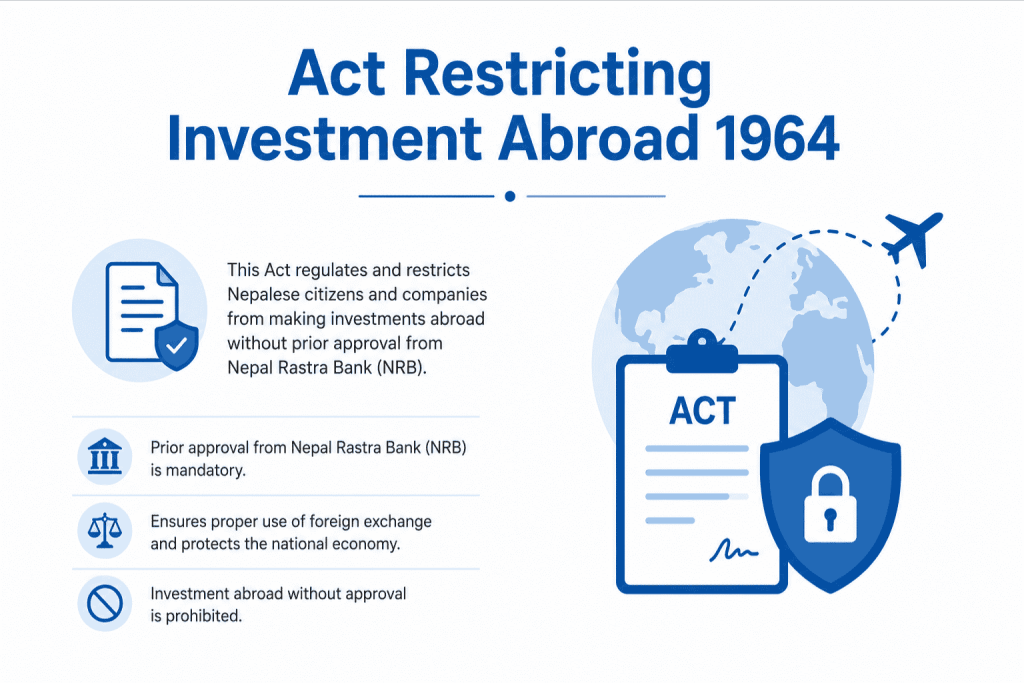
The Act Restricting Investment Abroad generally prohibits any Nepali citizen, firm, company, or other body from investing money, property, or assets outside Nepal without prior approval from the Government of Nepal or Nepal Rastra Bank, as applicable.
Prohibition on Investment Abroad Without Approval
Under the Act, no person or entity may:
- Purchase shares or securities of a foreign company
- Establish a branch office or subsidiary outside Nepal
- Transfer capital abroad for business purposes
- Acquire property or assets in a foreign country for investment
without following the approval process set out by the concerned government authority.
Exceptions Introduced Through FITTA and NRB Directives
Over the years, Nepal has recognized that some outward investment can benefit the national economy, especially in sectors like information technology and services. The Foreign Investment and Technology Transfer Act, 2075 (2019) and subsequent Nepal Rastra Bank directives have opened limited pathways for certain companies to invest abroad under strict conditions and monetary limits.
Outward Investment by Information Technology Companies
Nepal Rastra Bank has issued directives allowing Nepali information technology and software companies to invest abroad in specific situations, such as opening a branch office or subsidiary to expand their service market. These approvals are subject to conditions, including verification of the source of funds, a cap on the investment amount, and reporting obligations to Nepal Rastra Bank.
Table 1: Key Legal Framework Governing Outward Investment in Nepal
| Law or Regulation | Year Enacted | Main Purpose |
|---|---|---|
| Act Restricting Investment Abroad | 2021 (1964) | Restricts outward investment without government approval |
| Foreign Exchange (Regulation) Act | 2019 (1962) | Controls foreign currency transactions |
| Foreign Investment and Technology Transfer Act (FITTA) | 2075 (2019) | Regulates inward and limited outward investment |
| Companies Act | 2063 (2006) | Governs company formation and operation in Nepal |
| Income Tax Act | 2058 (2002) | Taxes income earned domestically and abroad |
| Nepal Rastra Bank Act | 2058 (2002) | Establishes the central bank’s regulatory powers |
How Can a Person or Company Apply for Approval to Invest Abroad?
Since outward investment is restricted by default, any person or company wishing to invest abroad must apply for permission through the proper legal channel. This process generally involves both Nepal Rastra Bank and, in some cases, the Department of Industry.
Application Process Through Nepal Rastra Bank
The general process for seeking approval to invest abroad follows a structured procedure. Below is a simplified overview of the steps typically involved.
Step 1: Preliminary Assessment
The applicant, whether an individual or a registered company, must first confirm whether their proposed outward investment falls under any permitted category, such as the information technology sector exception recognized by Nepal Rastra Bank directives.
Step 2: Preparation of Application and Supporting Documents
The applicant prepares an application addressed to Nepal Rastra Bank, along with company registration documents, tax clearance certificates, and a clear business justification for the outward investment.
Step 3: Submission to Nepal Rastra Bank
The application is submitted to the Foreign Exchange Management Department of Nepal Rastra Bank for review and verification of compliance with the Act Restricting Investment Abroad and related regulations.
Step 4: Review and Approval
Nepal Rastra Bank reviews the source of funds, the purpose of investment, and compliance with monetary limits before granting or denying approval.
Step 5: Post-Approval Reporting
Once approved, the investor must report the outward investment activity periodically to Nepal Rastra Bank, including details of returns, dividends, or repatriated profits.
Documents Required for Outward Investment Approval
Applicants are generally expected to submit the following documents:
- Company registration certificate issued under the Companies Act 2063
- Permanent Account Number and tax clearance certificate under the Income Tax Act 2058
- Board resolution approving the outward investment, if applicable
- Detailed business plan or justification for the investment
- Proof of the source of investment funds
For companies already registered with the Department of Industry under FITTA, additional coordination with the Department of Industry may be required, particularly when the outward investment relates to a foreign investment-linked business activity.
What Are the Penalties for Violating the Act Restricting Investment Abroad?
Failing to follow the approval process under this Act can lead to serious legal consequences. Because this law works closely with foreign exchange control mechanisms, violations are treated seriously by Nepali authorities.
Legal Consequences Under the Act
Unauthorized outward investment made without following the prescribed approval process may result in:
- Confiscation of the invested amount or its equivalent value
- Fines as prescribed under the Act and related foreign exchange regulations
- Legal action initiated by Nepal Rastra Bank or the concerned government authority
Connection With Companies Act 2063 and Income Tax Act 2058
If a company registered under the Companies Act 2063 is found to have made unauthorized outward investments, it may also face consequences under company law, including scrutiny of its financial statements and possible penalties for non-disclosure. Similarly, under the Income Tax Act 2058, any undeclared foreign income or improperly reported outward investment can lead to additional tax liabilities and penalties.
Enforcement by Government Authorities
Enforcement of the Act Restricting Investment Abroad is primarily carried out by Nepal Rastra Bank through its foreign exchange monitoring mechanisms. The Department of Industry and the Office of the Company Registrar may also become involved when the violation relates to a company’s registration status or its compliance obligations. For official legal texts and updates, readers may refer to the Nepal Law Commission website, which publishes the current and amended versions of Nepali laws.
Frequently Asked Questions
What is the Act Restricting Investment Abroad 1964?
It is a Nepali law from 2021 (1964) that stops citizens and companies from investing money outside Nepal without prior approval from the government or Nepal Rastra Bank, mainly to protect foreign exchange reserves.
Can Nepali companies invest abroad under current law?
Generally, no, unless they receive specific approval. Certain exceptions exist for information technology companies under Nepal Rastra Bank directives and the Foreign Investment and Technology Transfer Act 2075.
Which authority approves outward investment in Nepal?
Nepal Rastra Bank, through its Foreign Exchange Management Department, is the primary authority responsible for reviewing and approving outward investment applications under this Act.
What happens if someone invests abroad without approval?
The investment may be confiscated, the person or company may face fines, and further legal action can be taken under the Act, the Foreign Exchange Regulation Act, and related tax laws.
Does this Act affect foreign investors registering companies in Nepal?
This Act mainly restricts Nepali entities from sending money abroad. Foreign investors bringing money into Nepal are governed separately under FITTA and Department of Industry procedures.
Where can I read the official text of this law?
The official text and amendments are available through the Nepal Law Commission website, which maintains updated versions of all Nepali legislation, including the Act Restricting Investment Abroad 1964.