

Nepal has emerged as an increasingly attractive destination for foreign investors seeking to establish a business presence in South Asia. The strategic location between India and China, coupled with a growing economy and liberalized foreign investment policies, makes Nepal a viable option for multinational corporations. One of the most common structures foreign companies adopt is a subsidiary company.
This article covers the complete subsidiary company registration process in Nepal, including legal requirements, documents, procedures, and applicable laws.
What Is a Subsidiary Company in Nepal?
A subsidiary company is a company in which a foreign parent company holds a majority stake typically more than 50% of shares. In Nepal, a subsidiary company is treated as a separate legal entity from its parent company. The subsidiary operates under Nepali law and is subject to all applicable regulations governing companies incorporated in Nepal.
Under the Companies Act, 2006 (2063 B.S.), a subsidiary company is defined as a company where another company the holding company controls the composition of its Board of Directors or holds more than half of its equity share capital. This makes the subsidiary legally distinct yet financially connected to the parent entity.
Legal Framework Governing Subsidiary Company Registration in Nepal
The registration and operation of subsidiary companies in Nepal fall under multiple legal instruments:
- Companies Act, 2006 (2063 B.S.) — Governs the incorporation, management, and dissolution of companies in Nepal.
- Foreign Investment and Technology Transfer Act (FITTA), 2019 (2075 B.S.) — Regulates foreign direct investment and technology transfer.
- Industrial Enterprises Act, 2020 (2076 B.S.) — Governs industrial operations and investment categories.
- Nepal Rastra Bank (NRB) Directives — Governs foreign currency transactions and repatriation of profits.
- Income Tax Act, 2002 (2058 B.S.) — Governs taxation of companies including subsidiaries.
The Office of the Company Registrar (OCR) is the primary authority responsible for company registration in Nepal. The OCR operates under the Ministry of Industry, Commerce and Supplies.
🔗 Office of the Company Registrar – Official Website 🔗 Department of Industry Nepal
Types of Company Structure Available for Foreign Investors in Nepal
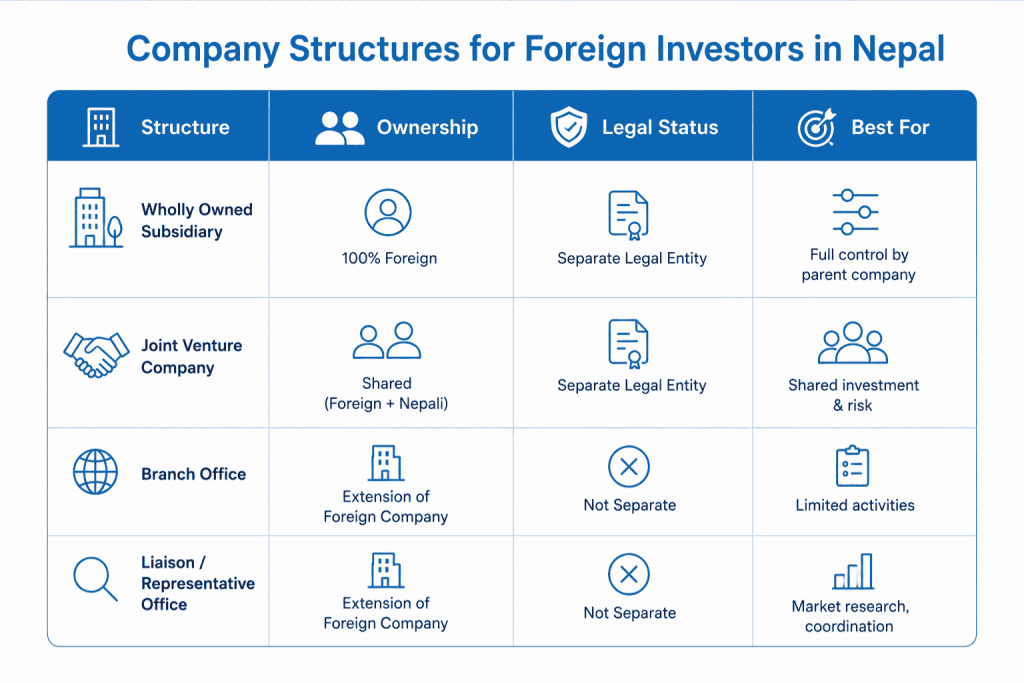
Foreign investors can choose from the following structures when setting up operations in Nepal:
| Structure | Ownership | Legal Status | Best For |
|---|---|---|---|
| Wholly Owned Subsidiary | 100% Foreign | Separate Legal Entity | Full control by parent company |
| Joint Venture Company | Shared (Foreign + Nepali) | Separate Legal Entity | Shared investment & risk |
| Branch Office | Extension of Foreign Company | Not Separate | Limited activities |
| Liaison/Representative Office | Extension of Foreign Company | Not Separate | Market research, coordination |
A wholly owned subsidiary or a joint venture registered as a private limited company is the most preferred structure for foreign companies doing business in Nepal.
Minimum Capital Requirement for Subsidiary Company in Nepal
Under FITTA 2019, foreign investors establishing a subsidiary company in Nepal must meet the minimum foreign investment threshold. As per the current regulation:
- The minimum foreign investment for a foreign-owned company is NPR 20 million (approximately USD 150,000).
- For industries in special categories or those listed in the Negative List, different rules apply.
- Certain sectors like small cottage industries, travel agencies, and mass media remain restricted or prohibited for foreign investment.
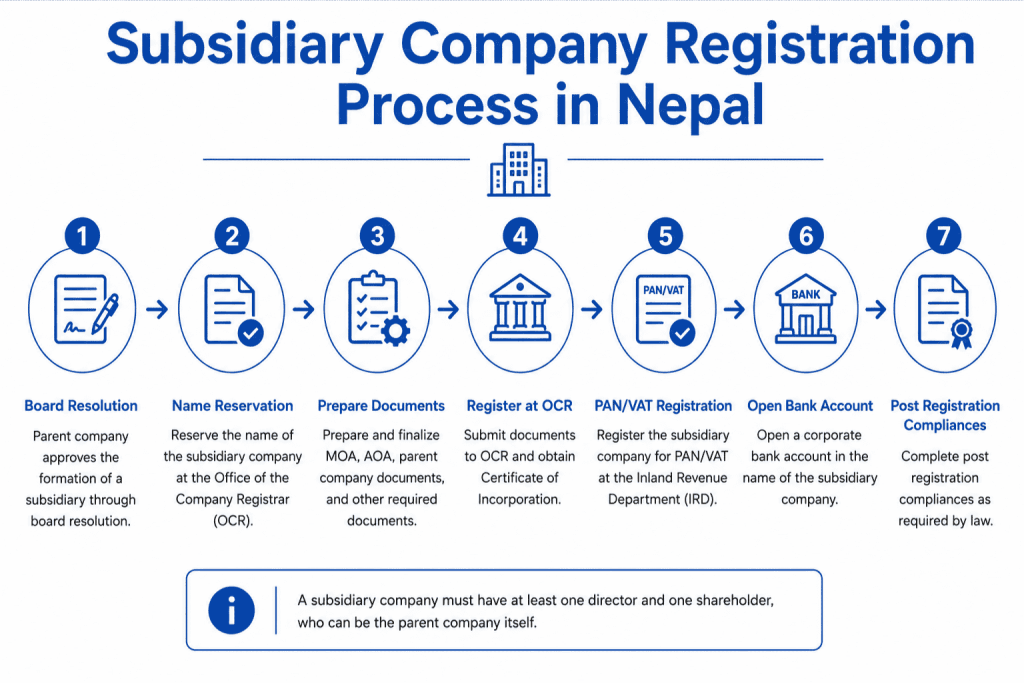
Step-by-Step Process to Register a Subsidiary Company in Nepal
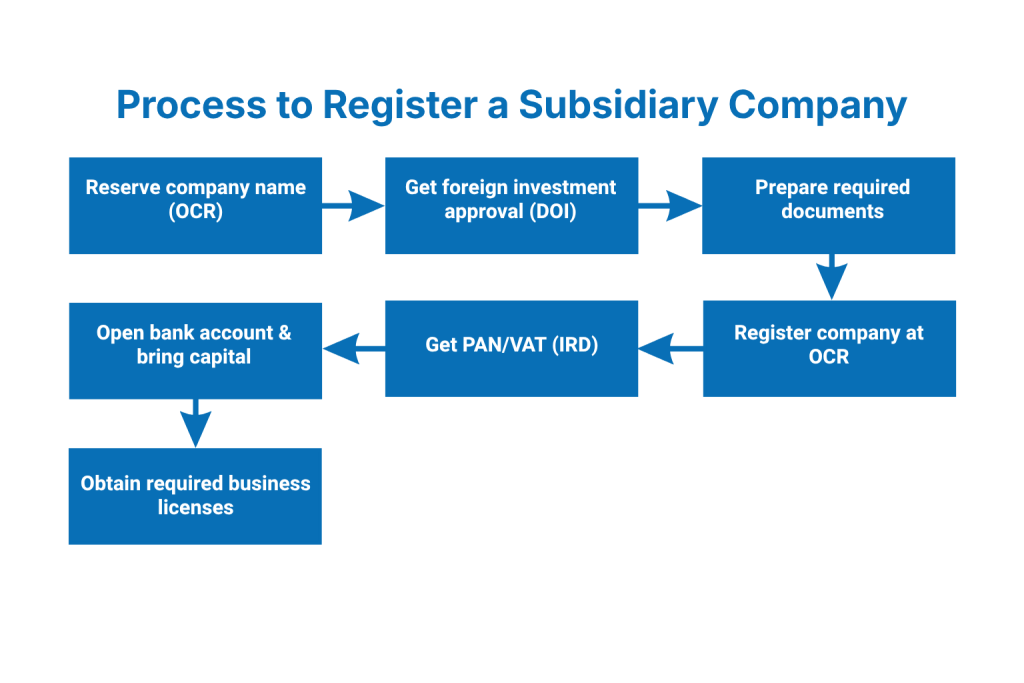
The subsidiary company registration process involves multiple government agencies. Below is a structured breakdown of the process:
Step 1: Name Reservation at the Office of the Company Registrar (OCR)
- Visit the OCR portal at https://www.ocr.gov.np
- Submit an application for the proposed company name
- The OCR checks for name uniqueness and approves or suggests alternatives
- Reserved names are valid for 35 days
Step 2: Obtain Foreign Investment Approval from the Department of Industry (DOI)
- Submit an application for foreign investment approval to the Department of Industry
- This step is mandatory under FITTA 2019, Section 5
- Include details of the proposed business activities, investment amount, and ownership structure
- DOI issues a Foreign Investment Approval Certificate
Step 3: Prepare the Required Documents
The following documents must be prepared for submission:
From the Foreign Parent Company:
- Certificate of Incorporation of the parent company (notarized and apostilled)
- Memorandum and Articles of Association of the parent company
- Board Resolution authorizing subsidiary formation in Nepal
- Latest audited financial statements of the parent company
- Passport copies of authorized signatories and directors
- Power of Attorney (notarized and apostilled)
For the Subsidiary Company in Nepal:
- Memorandum of Association (MoA) drafted as per OCR format
- Articles of Association (AoA)
- Proposed company name reservation certificate
- Details of shareholders and directors
- Registered office address proof in Nepal
- Citizenship certificates of Nepali directors (if applicable)
Step 4: Company Incorporation at the OCR
- Submit the complete application package to the OCR
- Pay the applicable registration fee based on authorized capital
- The OCR reviews the submitted documents
- Upon approval, the OCR issues the Certificate of Incorporation
- This process typically takes 7 to 15 working days
Step 5: Register with the Inland Revenue Department (IRD)
- Obtain a Permanent Account Number (PAN) from the Inland Revenue Department
- Register for Value Added Tax (VAT) if annual turnover exceeds NPR 5 million
- Register at: https://www.ird.gov.np
Step 6: Open a Corporate Bank Account
- Open a corporate bank account in Nepal with a licensed commercial bank
- Remit the initial foreign investment through banking channels as required by Nepal Rastra Bank directives
- NRB must be notified of foreign currency inflows per NRB Foreign Exchange Management Guidelines
Step 7: Obtain Sector-Specific Licenses and Permits
Depending on the nature of business, additional licenses may be required:
- Industrial Registration Certificate from DOI
- Tourism License from Nepal Tourism Board (for travel/hospitality sectors)
- Telecom License from NTA (for telecom sector)
- Environment Impact Assessment (EIA) approval for large projects
Registration Fee Structure at the OCR
The OCR charges registration fees based on the authorized capital of the company.
| Authorized Capital (NPR) | Registration Fee (NPR) |
|---|---|
| Up to 1,00,000 | 1,000 |
| 1,00,001 to 5,00,000 | 4,500 |
| 5,00,001 to 25,00,000 | 9,500 |
| 25,00,001 to 1,00,00,000 | 16,000 |
| 1,00,00,001 to 2,00,00,000 | 21,000 |
| Above 2,00,00,000 | Additional as per OCR schedule |
Fees are subject to revision by the OCR. Always verify the latest fee schedule at www.ocr.gov.np.
Foreign Investment Restrictions and Negative List in Nepal
Under FITTA 2019 and the Industrial Enterprises Act 2020, Nepal maintains a Negative List of industries where foreign investment is either restricted or prohibited. Key restricted sectors include:
- Cottage and small-scale industries (reserved for Nepali citizens)
- Arms and ammunition manufacturing
- Real estate business (buying and selling of land)
- Retail trade (below a certain investment threshold)
- Poultry farming, fishery, and bee-keeping (at small scale)
- Printing and publication of newspapers in Nepali language
Foreign investors must verify that their proposed business activity does not fall within the restricted or negative list before initiating the registration process.
Annual Compliance Requirements for Subsidiary Companies in Nepal
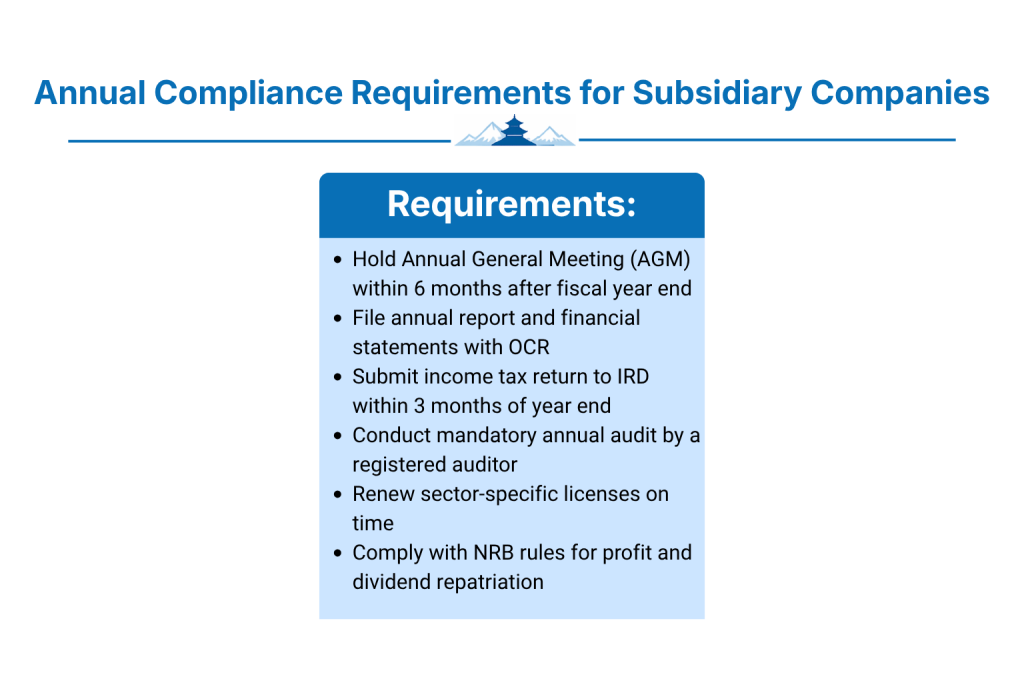
Once registered, a subsidiary company in Nepal must fulfill ongoing legal obligations:
- Annual General Meeting (AGM): Must be held within 6 months of the end of each fiscal year as per the Companies Act 2006.
- Annual Report Filing: Financial statements and annual reports must be filed with the OCR.
- Tax Return Filing: Income tax returns must be filed with the Inland Revenue Department within 3 months of the fiscal year end.
- Audit Requirement: All companies registered in Nepal are required to have their accounts audited by a registered auditor.
- Renewal of Licenses: Sector-specific licenses must be renewed periodically.
- Repatriation Compliance: Profits and dividends must be repatriated through approved banking channels per NRB directives.
Role of Nepal Rastra Bank in Subsidiary Company Operations
The Nepal Rastra Bank (NRB) plays a significant role in monitoring foreign investment transactions. Under the Foreign Exchange (Regulation) Act, 1962 (2019 B.S.) and subsequent NRB directives:
- All foreign currency received as investment must be reported to NRB.
- Repatriation of profits, dividends, and capital requires NRB approval.
- Loan transactions between parent company and subsidiary (inter-company loans) are subject to NRB regulations.
🔗 Nepal Rastra Bank – Official Website
Time Required for Subsidiary Company Registration in Nepal
The full process from start to finish typically requires:
- Name reservation: 1–3 working days
- Foreign Investment Approval (DOI): 7–15 working days
- OCR Company Incorporation: 7–15 working days
- PAN/VAT Registration: 3–5 working days
- Bank Account Opening: 5–10 working days
- Total Estimated Time: Approximately 30–45 working days (subject to document completeness)
Conclusion
The subsidiary company registration process in Nepal involves multiple regulatory steps across several government agencies including the OCR, DOI, IRD, and NRB. The legal framework under the Companies Act 2006, FITTA 2019, and the Industrial Enterprises Act 2020 provides a structured pathway for foreign companies to establish subsidiaries in Nepal. With proper documentation, compliance with capital requirements, and adherence to the sector-specific regulations, foreign parent companies can successfully incorporate and operate subsidiary companies in Nepal.
FAQs
1. Can a foreign company own 100% shares in a Nepali subsidiary?
Yes. Under FITTA 2019, a foreign company can own 100% shares in a Nepali subsidiary company, provided the business activity is not listed in the negative list and the minimum investment threshold of NPR 20 million is met.
2. What is the minimum paid-up capital to register a subsidiary company in Nepal?
The minimum foreign investment required under FITTA 2019 is NPR 20 million. The minimum paid-up capital for company registration under the Companies Act 2006 may differ based on company type and sector.
3. Is a local Nepali director required to register a subsidiary company?
No. There is no mandatory requirement for a local Nepali director. However, having a local representative simplifies operations, banking, and regulatory interactions in Nepal.
4. Where do I register a subsidiary company in Nepal?
The Office of the Company Registrar (OCR) is the primary authority for company registration in Nepal. Foreign investment approval must also be obtained from the Department of Industry (DOI) before OCR registration.
5. How long does it take to complete subsidiary company registration in Nepal?
The complete process typically takes between 30 to 45 working days, depending on document readiness, government processing times, and sector-specific licensing requirements.
6. Can a subsidiary company in Nepal repatriate profits to the parent company?
Yes. Subsidiary companies can repatriate dividends and profits to the parent company after fulfilling tax obligations in Nepal and obtaining approval from Nepal Rastra Bank per applicable foreign exchange regulations.