

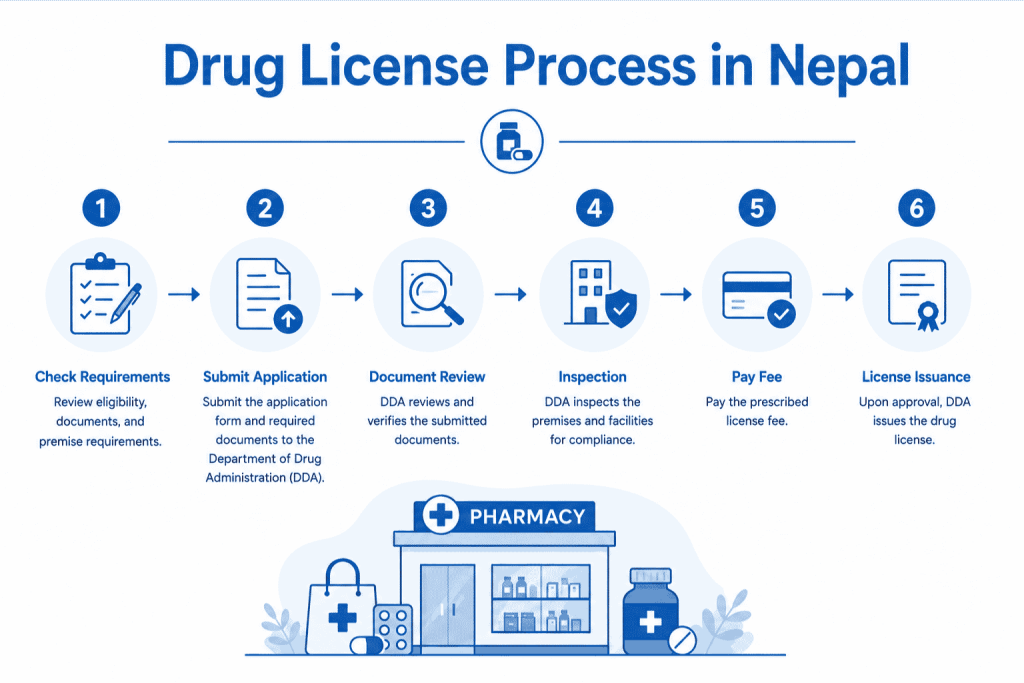
Drug License Process in Nepal regulates the manufacture, sale, distribution, import, and export of drugs through a strict licensing framework under the Drug Act, 2035 (1978) and Drug Regulation, 2038 (1981). Any individual or organization that wishes to deal in pharmaceutical products, medicines, or medical devices in Nepal must obtain a valid drug license from the Department of Drug Administration (DDA), which operates under the Ministry of Health and Population. This article explains the drug license process in Nepal in a clear and factual manner.
What Is a Drug License in Nepal?
A drug license in Nepal is an official authorization issued by the Department of Drug Administration (DDA) that permits a person or organization to manufacture, import, export, sell (wholesale or retail), or distribute drugs and pharmaceutical products within Nepal.
Without a valid drug license, no entity can legally engage in any pharmaceutical-related activity in Nepal. Operating without a drug license is a punishable offense under the Drug Act, 2035.
The Department of Drug Administration Nepal (DDA Official Website) is the primary regulatory authority responsible for drug registration, drug quality control, and licensing in Nepal.
What Laws Govern Drug Licensing in Nepal?
The drug licensing framework in Nepal is built on the following legal instruments:
- Drug Act, 2035 (1978) – The principal legislation governing drugs in Nepal. It defines what constitutes a drug, sets penalties for violations, and establishes the role of the DDA.
- Drug Regulation, 2038 (1981) – Provides detailed procedural rules for licensing, registration, manufacturing standards, and inspection.
- Drug Standard Regulation, 2043 (1986) – Sets quality and safety standards for drugs.
- Drug (First Amendment) Act, 2063 (2007) – Amended provisions related to drug registration and penalties.
Under Section 3 of the Drug Act, 2035, no person shall manufacture, sell, distribute, export, or import any drug without obtaining a valid license from the prescribed authority.
What Are the Types of Drug Licenses in Nepal?
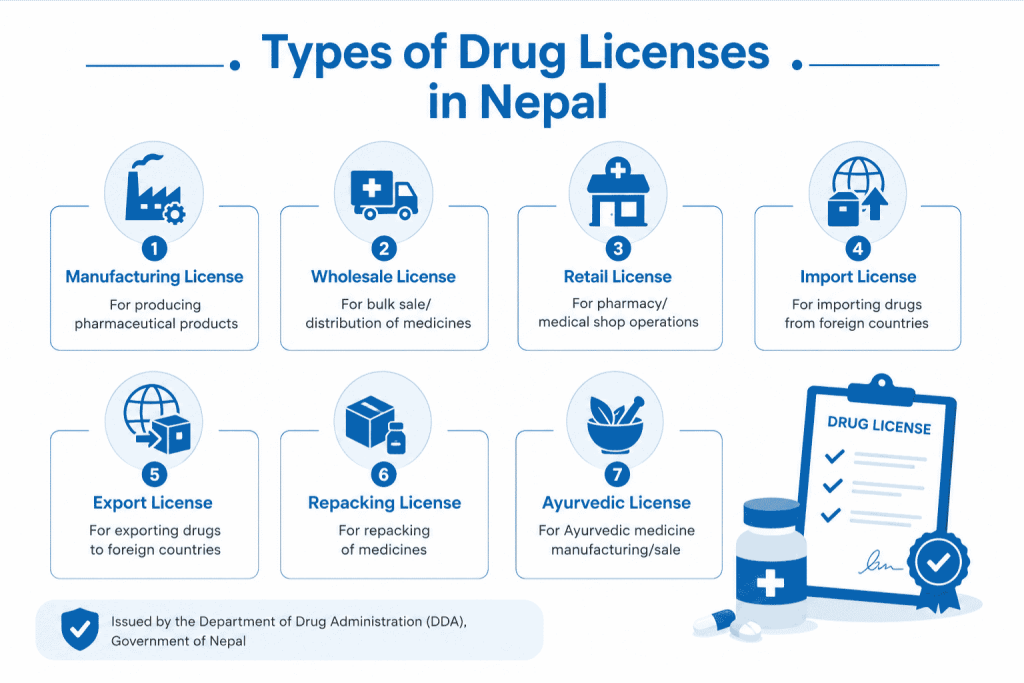
The Department of Drug Administration issues different types of drug licenses depending on the nature of the pharmaceutical activity. The following are the main categories:
| Type of Drug License | Purpose | Issuing Authority |
|---|---|---|
| Drug Manufacturing License | For producing pharmaceutical products | DDA, Central Office |
| Drug Wholesale License | For bulk sale/distribution of medicines | DDA, District/Provincial |
| Drug Retail License | For pharmacy/medical shop operations | DDA, District/Provincial |
| Drug Import License | For importing drugs from foreign countries | DDA, Central Office |
| Drug Export License | For exporting drugs to foreign countries | DDA, Central Office |
| Drug Repacking License | For repacking of medicines | DDA, Central Office |
| Ayurvedic Drug License | For Ayurvedic medicine manufacturing/sale | DDA, with DoA coordination |
Each license type has specific eligibility criteria, documentation requirements, and fee structures.
Who Is Eligible to Apply for a Drug License in Nepal?
The applicant must meet the following basic eligibility requirements under the Drug Regulation, 2038:
- The applicant must be a Nepali citizen or a registered company under the Companies Act, 2063.
- For a retail drug license (pharmacy), at least one licensed pharmacist or pharmacy assistant must be present on the premises.
- For a drug manufacturing license, the applicant must have a qualified pharmaceutical professional (B.Pharm or higher) as the technical supervisor.
- For a drug wholesale license, the applicant must employ a qualified pharmacist or pharmacy assistant.
- The premises must meet the physical standards prescribed by DDA.
- For import/export licenses, the applicant must also be registered with the Department of Commerce, Supplies and Consumer Protection.
What Are the Documents Required for a Drug License in Nepal?
The required documents vary by license type. Below are the general documents needed for the most common categories:
For Drug Retail License (Pharmacy/Medical Shop):
- Completed application form (prescribed by DDA)
- Copy of citizenship certificate of the applicant
- Company registration certificate (if applicable)
- PAN/VAT registration certificate
- Tax clearance certificate
- Rental agreement or ownership document for the premises
- Floor plan/layout of the pharmacy premises
- Academic certificates of the pharmacist/pharmacy assistant
- Nepal Pharmacy Council registration certificate of the pharmacist
- Passport-size photographs of the applicant and pharmacist
- Recommendation letter from the local municipality
For Drug Wholesale License:
- All documents listed for retail license
- Business registration certificate
- Tax clearance certificate
- Storage facility details and layout plan
- Cold chain facility details (if applicable)
- Qualified pharmacist’s employment contract and Nepal Pharmacy Council registration
For Drug Manufacturing License:
- Company registration certificate
- Environmental Impact Assessment (EIA) clearance
- Land ownership or lease agreement for the manufacturing site
- GMP (Good Manufacturing Practice) compliance plan
- Technical supervisor’s academic and professional certificates
- List of machinery and equipment
- Water quality test report
- Fire safety clearance
- DDA inspection clearance
For Drug Import License:
- Company registration certificate
- PAN/VAT registration
- Tax clearance certificate
- Authorization letter from the foreign manufacturer
- Free Sale Certificate from the country of origin
- Drug registration certificate in Nepal (if already registered)
- List of products to be imported
What Is the Step-by-Step Process to Obtain a Drug License in Nepal?
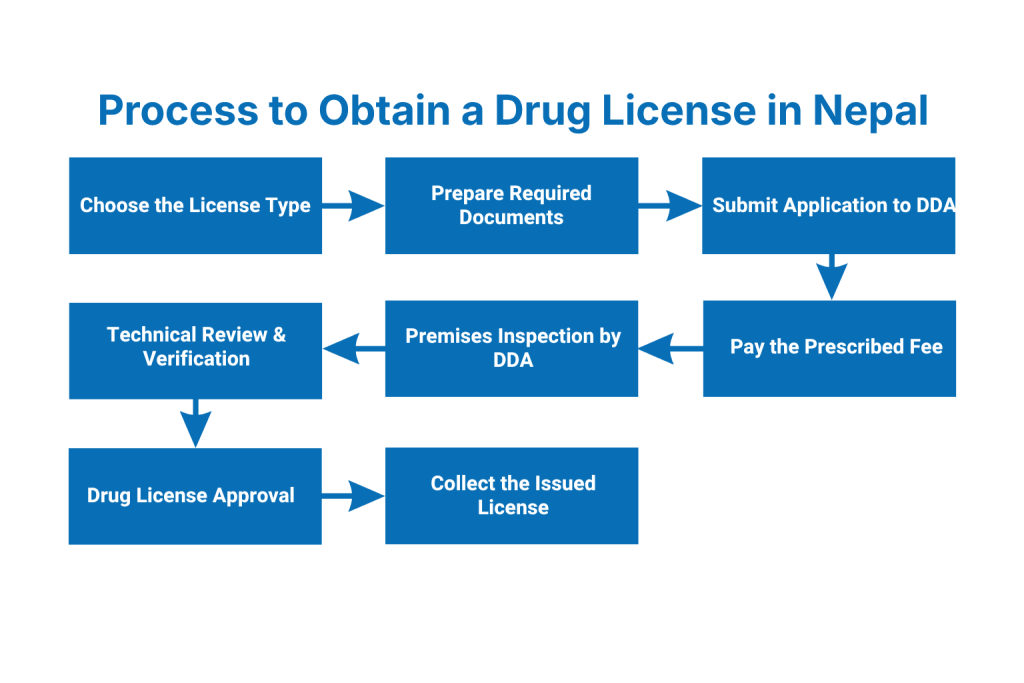
The drug license application process in Nepal follows these steps:
- Determine the license type – Identify which category of drug license you need (retail, wholesale, manufacturing, import, or export).
- Prepare the required documents – Gather all necessary documents as per the DDA checklist.
- Submit the application – Submit the completed application form along with all documents to the DDA Central Office (for manufacturing/import/export) or the relevant Provincial DDA Office (for retail/wholesale).
- Pay the prescribed fee – Pay the drug license application fee at the DDA cash counter or through the designated bank.
- Premises inspection – DDA officials conduct a physical inspection of the proposed premises to verify compliance with minimum standards.
- Technical review – The DDA technical committee reviews the application, inspection report, and submitted documents.
- Issue of drug license – If all conditions are met, DDA issues the drug license within the prescribed timeframe.
- Collect the license – The applicant collects the license from the issuing office.
What Are the Drug License Fees in Nepal?
Drug license fees are prescribed under the Drug Regulation, 2038 and are periodically revised by the Government of Nepal. The fee structure depends on the type and category of license.
| License Type | Approximate Fee (NPR) | Validity |
|---|---|---|
| Drug Retail License (New) | NPR 3,000 – 5,000 | 1–2 Years |
| Drug Wholesale License (New) | NPR 10,000 – 20,000 | 1–2 Years |
| Drug Manufacturing License (New) | NPR 50,000 – 1,00,000+ | 1–2 Years |
| Drug Import License | NPR 20,000 – 50,000 | 1–2 Years |
| Drug Retail Renewal | NPR 1,500 – 3,000 | Per renewal |
| Drug Wholesale Renewal | NPR 5,000 – 10,000 | Per renewal |
Note: Fees are subject to change. Always verify the current fee schedule with the DDA Nepal official website.
How Is Drug Registration Different from Drug Licensing in Nepal?
Drug registration and drug licensing are two separate processes in Nepal.
Drug registration refers to the process of getting a specific drug product registered with the DDA so that it can legally be sold in Nepal. It involves submission of product dossiers, quality data, clinical data, and labeling requirements.
Drug licensing refers to the authorization given to a business entity (manufacturer, importer, retailer, or wholesaler) to carry out pharmaceutical activities.
A business must first obtain a drug license and then apply for registration of individual drug products. Both are mandatory before a drug can be commercially marketed in Nepal.
How Does Drug License Renewal Work in Nepal?
Drug licenses in Nepal are not permanent. They must be renewed periodically. The renewal process under the Drug Regulation, 2038 requires:
- Submission of the renewal application before the license expiry date
- Updated tax clearance certificate
- Updated Nepal Pharmacy Council registration of the pharmacist (if applicable)
- Proof of unchanged premises or updated documents if any changes occurred
- Payment of the prescribed renewal fee
Failure to renew the drug license on time results in a penalty fee and potential cancellation of the license. DDA may also conduct re-inspection before issuing a renewal.
What Are the Penalties for Operating Without a Drug License in Nepal?
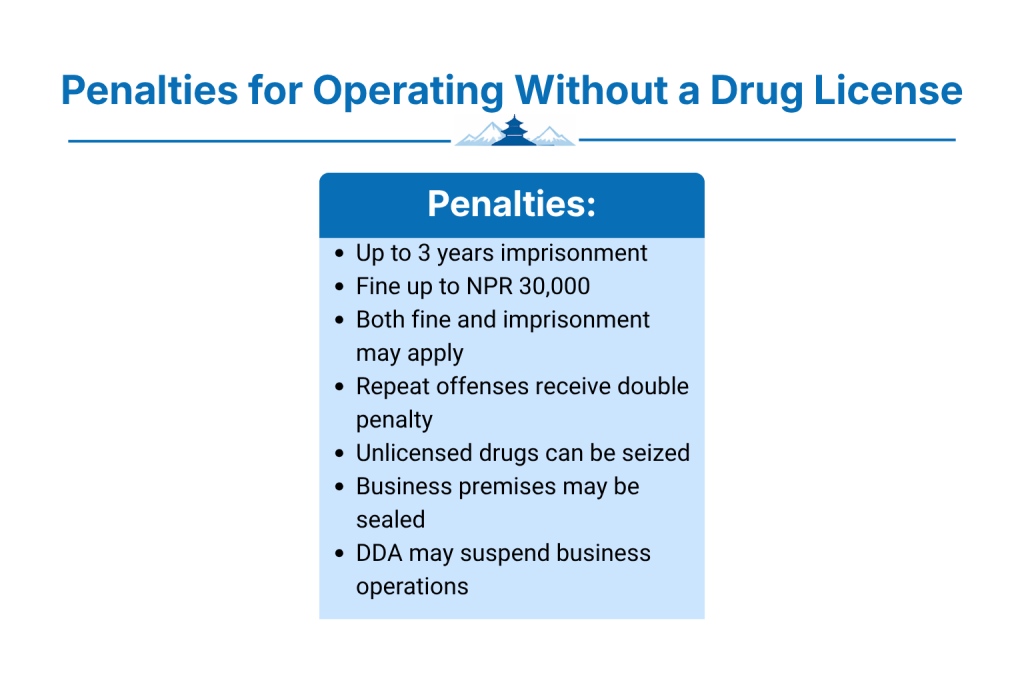
Under Section 19 of the Drug Act, 2035, operating without a valid drug license is a criminal offense. Penalties include:
- Imprisonment of up to 3 years or a fine of up to NPR 30,000, or both, for first-time offenders.
- For repeat offenses, the penalty is doubled.
- All unlicensed drugs may be seized and confiscated by the DDA.
- The business premises may be sealed.
The DDA conducts regular drug inspections and market surveillance operations to enforce compliance across Nepal.
Where to Contact for Drug License in Nepal?
- Department of Drug Administration (DDA) – Bijulibazar, Kathmandu
- Website: https://www.dda.gov.np
- Phone: +977-1-4780509
- Provincial DDA offices are also available in all seven provinces of Nepal for retail and wholesale license applications.
Conclusion
The drug license process in Nepal is governed by the Drug Act, 2035 and Drug Regulation, 2038. The Department of Drug Administration is the central authority that regulates all pharmaceutical activities, including manufacturing, wholesale, retail, import, and export of drugs. Applicants must ensure full compliance with documentation, premises standards, and professional requirements before applying. Timely renewal of the drug license and adherence to DDA regulations are mandatory to avoid legal penalties. For accurate and updated information, always refer to the official DDA Nepal website.
FAQs
1. Who issues the drug license in Nepal?
The Department of Drug Administration (DDA) under the Ministry of Health and Population issues drug licenses in Nepal. The DDA operates under the Drug Act, 2035 and Drug Regulation, 2038.
2. Is a pharmacist required to obtain a drug retail license in Nepal?
Yes. A licensed pharmacist or pharmacy assistant registered with the Nepal Pharmacy Council must be present at the pharmacy premises for a retail drug license to be issued.
3. How long does it take to get a drug license in Nepal?
The process typically takes 30 to 90 days depending on the license type, completeness of documents, and the DDA inspection schedule. Manufacturing licenses may take longer.
4. Can a foreign company obtain a drug import license in Nepal?
A foreign company must register a local entity or appoint a local authorized agent in Nepal. The local representative applies for the drug import license on behalf of the foreign manufacturer.
5. What happens if a drug license expires in Nepal?
If the drug license expires without renewal, the holder must pay a penalty fee and apply for renewal. Continued operation after expiry is treated as operating without a license under the Drug Act, 2035.
6. Can a drug license be transferred to another person in Nepal?
Drug licenses in Nepal are generally not transferable. In case of ownership change, a fresh application must be submitted to the DDA with the required documents and fees.