

Nepal’s food and beverage company registration in Nepal has grown significantly over the past decade. From small food processing units to large-scale beverage manufacturing plants, the sector attracts both domestic and foreign investors. If you plan to start a food and beverage business in Nepal, you must complete several legal formalities before beginning commercial operations. This guide covers every step of food and beverage company registration in Nepal, including the legal framework, required documents, licenses, and regulatory compliance.
What Is the Legal Framework for Food and Beverage Business in Nepal?
The food and beverage sector in Nepal is governed by multiple laws and regulations. Understanding these laws is the foundation of a compliant business.
The key legislation includes:
- Company Act, 2063 (2006) – Governs the registration and operation of companies in Nepal.
- Food Act, 2023 BS (1966 AD) and its Amendment – The primary law regulating food safety, quality, and standards in Nepal.
- Food Regulation, 2027 BS (1970 AD) – Lays out detailed rules for food production, processing, labeling, and distribution.
- Industrial Enterprises Act, 2076 (2020) – Regulates industrial units including food processing industries.
- Foreign Investment and Technology Transfer Act (FITTA), 2075 (2019) – Relevant if foreign investment is involved in the food and beverage company.
- Value Added Tax Act, 2052 (1995) – Covers tax obligations for food businesses.
- Labor Act, 2074 (2017) – Governs employment in the food and beverage sector.
The Department of Food Technology and Quality Control (DFTQC) under the Ministry of Agriculture and Livestock Development is the primary authority for food business licensing in Nepal. Visit DFTQC’s official website for regulatory updates.
What Types of Business Entities Can Register a Food and Beverage Company in Nepal?
Before proceeding with registration, you must decide the business structure. Nepal’s Company Act, 2063 allows several forms of business entities.
1. Private Limited Company (Pvt. Ltd.)
This is the most common structure for food and beverage businesses. It requires a minimum of one shareholder and one director. The liability of shareholders is limited to their shareholding.
2. Public Limited Company
Suitable for large-scale food and beverage manufacturers. It requires a minimum of seven shareholders and can raise capital through public share offerings.
3. Sole Proprietorship (Ekla Byapar)
A single-person business registered under the Department of Commerce, Supplies and Consumer Protection. Suitable for small food stalls, home kitchens, and micro food businesses.
4. Partnership Firm
Two or more individuals operate the business together. Governed by the Partnership Act, 2020 BS (1964 AD).
5. Foreign Company Branch or Subsidiary
If a foreign company wants to operate a food and beverage business in Nepal, it must comply with FITTA, 2075 and obtain approval from the Department of Industry or Investment Board Nepal (IBN), depending on the investment size.
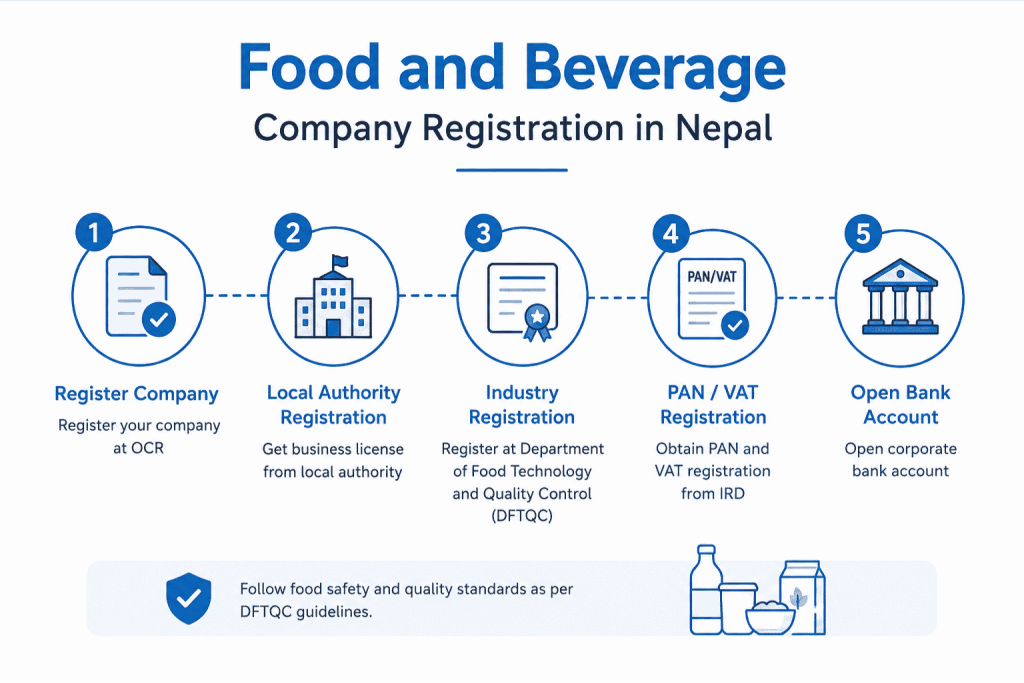
How to Register a Food and Beverage Company in Nepal?
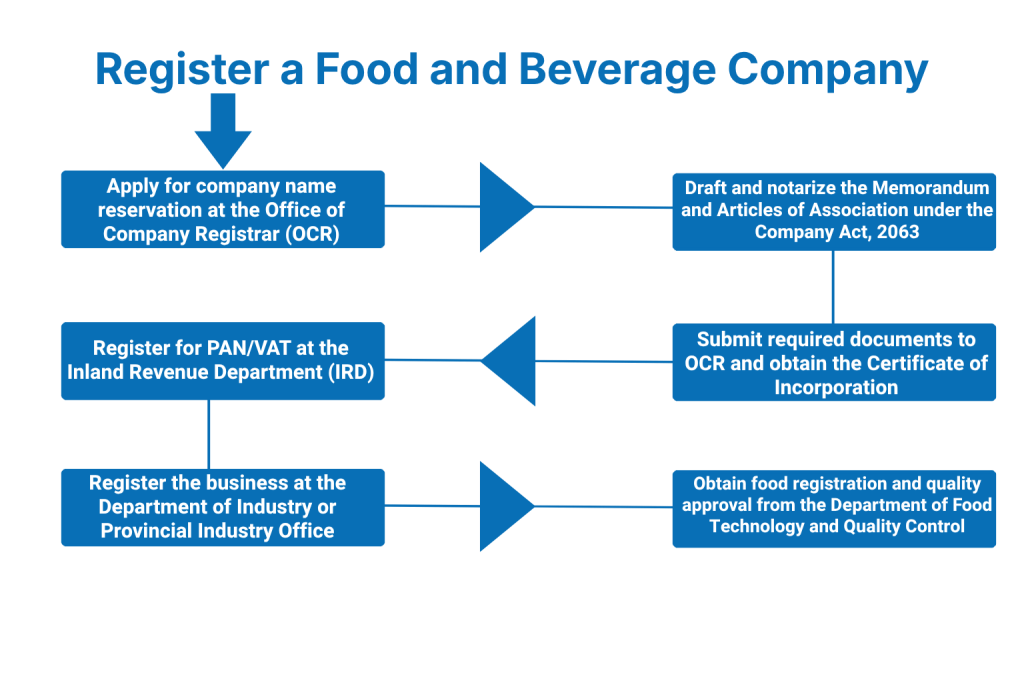
The registration process involves multiple steps across different government bodies.
Step 1: Name Reservation at the Office of Company Registrar (OCR)
- Visit the Office of Company Registrar (OCR) at Tripureshwor, Kathmandu, or use the online portal at ocr.gov.np.
- Submit a name reservation application with at least three proposed company names.
- The OCR verifies that the proposed name is not identical or similar to an existing registered company.
- Name reservation is valid for 15 days.
Step 2: Prepare Memorandum of Association (MoA) and Articles of Association (AoA)
- Draft the MoA and AoA in accordance with Company Act, 2063.
- The MoA must state the company’s business objectives clearly, including food production, processing, distribution, or beverages manufacturing.
- Notarize these documents.
Step 3: Company Registration at OCR
Submit the following documents to the OCR:
- Completed company registration application form
- Memorandum of Association (MoA)
- Articles of Association (AoA)
- Citizenship certificates of all directors and shareholders
- Passport-size photographs of directors and shareholders
- Tax clearance certificate (if applicable)
- Foreign investment approval letter (for foreign investors)
- Proof of registered office address (land ownership certificate or rent agreement)
The OCR issues the Certificate of Incorporation upon successful verification.
Step 4: PAN/VAT Registration at the Inland Revenue Department (IRD)
- Register for a Permanent Account Number (PAN) at the Inland Revenue Department (IRD) or the nearest tax office.
- If the annual turnover exceeds NPR 5 million, VAT registration is mandatory under VAT Act, 2052.
- Food and beverage businesses must obtain PAN for all financial transactions.
Visit IRD Nepal for online PAN/VAT registration.
Step 5: Industry Registration at the Department of Industry (DOI)
- Food and beverage manufacturing units must register as an industry under the Industrial Enterprises Act, 2076.
- Submit the application to the Department of Industry (DOI) or the respective Province Industry Office depending on the scale of operation.
- The DOI classifies industries as Micro, Cottage, Small, Medium, or Large based on fixed capital investment.
Visit DOI Nepal for industry registration details.
Step 6: Food Registration and License from DFTQC
This is one of the most critical steps. The Department of Food Technology and Quality Control (DFTQC) issues the Food Registration Certificate and the Food Production License.
What Documents Are Required for Food Business License from DFTQC?
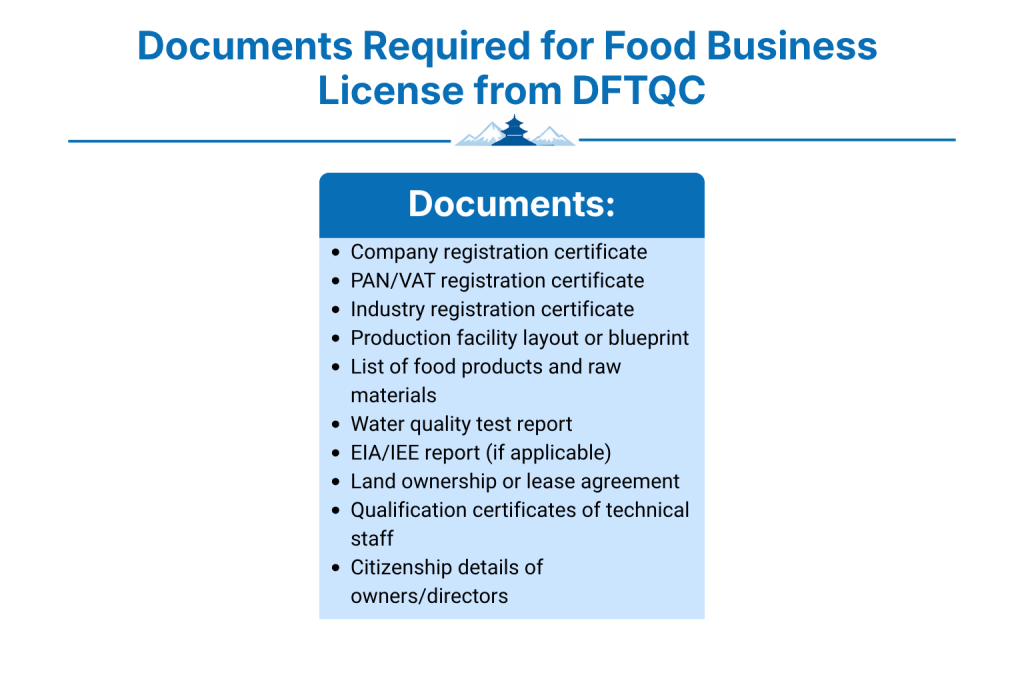
- Company registration certificate from OCR
- PAN/VAT registration certificate
- Industry registration certificate from DOI
- Blueprint or layout plan of the production facility
- List of products to be manufactured
- List of raw materials and ingredients
- Water quality test report from an approved laboratory
- Environmental Impact Assessment (EIA) or Initial Environmental Examination (IEE) if required
- Lease agreement or land ownership document of the production premises
- Technical personnel qualification certificates (food technologist or qualified person)
- Personal details and citizenship of the proprietor or directors
The DFTQC inspects the production facility before issuing the food production license. The license is renewed annually.
What Are the Licenses and Permits Required for a Food and Beverage Company in Nepal?
| License/Permit | Issuing Authority | Purpose |
|---|---|---|
| Certificate of Incorporation | Office of Company Registrar (OCR) | Legal entity establishment |
| PAN Certificate | Inland Revenue Department (IRD) | Tax identification |
| VAT Registration | Inland Revenue Department (IRD) | Tax compliance |
| Industry Registration Certificate | Department of Industry (DOI) | Manufacturing operations |
| Food Production License | DFTQC | Food safety compliance |
| Food Registration Certificate | DFTQC | Product approval |
| Trade License | Local Municipality/Ward Office | Business operation permission |
| Labor Registration | Department of Labor | Employee management |
| Social Security Fund (SSF) Registration | Social Security Fund | Mandatory for employees |
| Environmental Clearance | Ministry of Forests and Environment | If required by scale |
What Are the Requirements for Beverages and Alcohol-Specific Licenses?
For companies specifically dealing in alcoholic beverages, additional permits are required.
- Excise License from the Inland Revenue Department under the Excise Duty Act, 2058 (2002 AD).
- Alcohol Production License from DFTQC.
- Compliance with Nepal Excise Duty Regulation, 2059 BS.
- Payment of excise duties as per the Finance Act applicable for the fiscal year.
- Separate license for wholesale distribution and retail sale of alcohol.
Non-alcoholic beverage companies manufacturing soft drinks, juices, and mineral water must comply with Nepal Bureau of Standards and Metrology (NBSM) standards and obtain Nepal Standard (NS) certification where applicable.
What Is the Capital Requirement for Food and Beverage Industry in Nepal?
Under the Industrial Enterprises Act, 2076, the industry classification based on fixed capital is:
| Industry Category | Fixed Capital (NPR) |
|---|---|
| Micro Industry | Up to NPR 1 million |
| Cottage Industry | Up to NPR 1.5 million (traditional/manual) |
| Small Industry | NPR 1 million to NPR 150 million |
| Medium Industry | NPR 150 million to NPR 500 million |
| Large Industry | Above NPR 500 million |
Food and beverage businesses generally fall under small to large industry categories depending on production capacity and infrastructure.
What Are the Food Safety and Quality Standards in Nepal?
The DFTQC enforces Nepal Food Standards as prescribed under the Food Regulation, 2027. These standards cover:
- Permissible additives and preservatives
- Microbiological safety standards
- Labeling requirements – Product name, ingredients, manufacturing date, expiry date, batch number, net weight, and manufacturer details must appear on food labels.
- Packaging standards – Food-grade packaging material is mandatory.
- Storage and transportation conditions
Nepal also follows Codex Alimentarius standards in alignment with international food safety norms. The DFTQC conducts regular inspections and product testing. Non-compliance leads to cancellation of the food production license and legal action under the Food Act, 2023 BS.
What Is the Role of Nepal Bureau of Standards and Metrology (NBSM)?
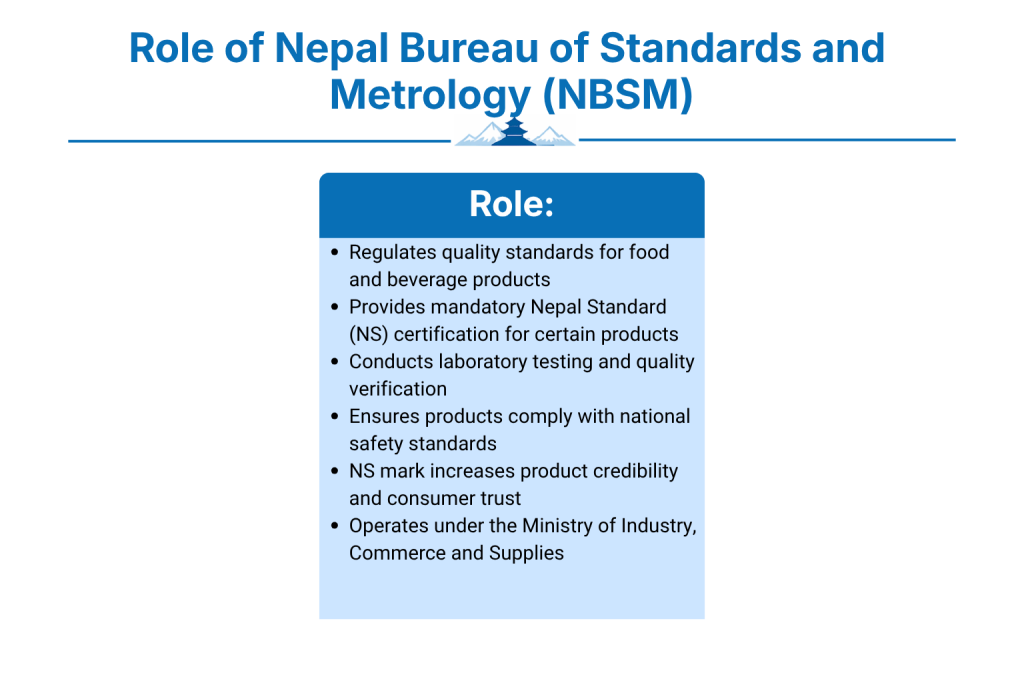
The Nepal Bureau of Standards and Metrology (NBSM) operates under the Ministry of Industry, Commerce and Supplies. For specific food and beverage products, NBSM certification is mandatory.
- Nepal Standard (NS) marks are required for products like packaged drinking water, edible oils, salt, and certain processed foods.
- NBSM conducts product testing at its laboratories.
- NS certification demonstrates conformity to national quality standards.
Visit NBSM Nepal for product standards and certification procedures.
How Much Does It Cost to Register a Food and Beverage Company in Nepal?
The cost varies depending on the type of business entity and scale of operation.
- Company Registration at OCR – NPR 1,000 to NPR 10,000 depending on authorized capital.
- PAN Registration – Free of cost.
- Industry Registration at DOI – NPR 500 to NPR 5,000 depending on industry category.
- Food Production License at DFTQC – NPR 5,000 to NPR 50,000 depending on product category and production scale.
- Trade License at Municipality – Varies by local government.
- Environmental Clearance – Varies based on scale and nature.
Professional fees for company incorporation services, legal drafting, and liaison work add to the total cost.
What Is the Timeline for Food and Beverage Company Registration in Nepal?
- Company registration at OCR: 3 to 7 working days
- PAN/VAT registration: 1 to 3 working days
- Industry registration at DOI: 7 to 15 working days
- Food production license from DFTQC: 30 to 60 working days (includes facility inspection)
- Trade license from municipality: 3 to 7 working days
The total timeline from initial filing to receiving all required licenses is approximately 2 to 3 months for a new food and beverage company in Nepal.
Conclusion
Registering a food and beverage company in Nepal involves a structured process across multiple government bodies, including the Office of Company Registrar, Department of Industry, Department of Food Technology and Quality Control, and the Inland Revenue Department. Compliance with the Food Act, 2023 BS, Industrial Enterprises Act, 2076, and Company Act, 2063 is mandatory for legal operation. Obtaining proper licenses before commencing production ensures your business operates without legal interruptions and builds credibility with distributors, retailers, and consumers.
FAQs
1. Can a foreigner register a food and beverage company in Nepal?
Yes, foreign investors can register a food and beverage company in Nepal under FITTA, 2075. Approval from the Department of Industry or Investment Board Nepal is required depending on the investment amount.
2. Is a food production license mandatory for all food businesses in Nepal?
Yes. Any entity engaged in commercial food production must obtain a food production license from the DFTQC under the Food Act, 2023 BS before beginning operations.
3. What is the validity of the food production license from DFTQC?
The food production license issued by DFTQC is valid for one year and must be renewed annually. Non-renewal leads to cancellation and possible legal penalties.
4. Does a home-based food business in Nepal need registration?
Yes. Even home-based food businesses operating commercially require a trade license from the local municipality and food registration from DFTQC, depending on the scale of operation.
5. What is the minimum capital required to register a food company in Nepal?
There is no mandatory minimum paid-up capital for private limited companies under the Company Act, 2063. However, industry registration requirements and bank financing may influence the capital structure.
6. Is VAT applicable on food products in Nepal?
Basic food items like fresh vegetables, fruits, cereals, and agricultural produce are exempt from VAT. Processed food and beverages are generally subject to 13% VAT under the VAT Act, 2052.